

By: Precious Miracle Kargbo Snr
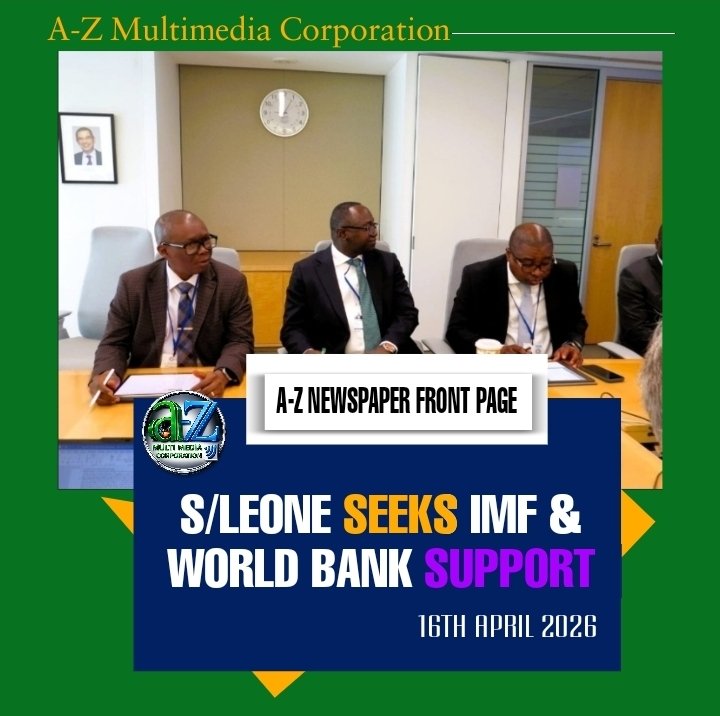
The Minister of Finance, Sheku Ahmed Fantamadi Bangura, is urging international financial institutions to provide targeted support to protect Sierra Leone’s recent macroeconomic gains from potential spillovers linked to escalating tensions in the Middle East. This comes as a high-level government delegation participates in the IMF and World Bank Spring Meetings in Washington, D.C.
Minister Bangura, who is leading the delegation from April 13 to 18, 2026, held initial discussions with the International Monetary Fund’s Fiscal Affairs Department (FAD) and the Sierra Leone country team. He warned that external shocks could undermine two years of notable progress in inflation control, exchange rate stability, primary balance improvement, and reduced government securities rates.
The delegation includes the Ministers of Energy and of Basic and Senior Secondary Education, the Financial Secretary, the Governor and Deputy Governor of the Bank of Sierra Leone, as well as chief economists from the Ministry of Finance and the Central Bank. The team is using the Spring Meetings to align fiscal and monetary policy positions with development partners and international investors.
During his meeting with the IMF Fiscal Affairs Department Director, the Minister acknowledged the Fund’s technical assistance in supporting reforms to the Public Financial Management Act 2016, the Public Procurement Act 2016, cash management systems, and the adoption of Government Finance Statistics 2014 standards. He also called for continued support in strengthening mining sector revenue management, including transfer pricing rules, advance pricing agreements, safe harbour regimes, and a review of the Income Tax Act 2000 and Excise Act 1998. A mid-term review of the Medium-Term Revenue Strategy (2023–2027) is also under consideration. IMF officials reportedly welcomed the requests and said they remain under review.
A more urgent concern emerged during discussions with IMF Mission Chief Christian Saborowski. Minister Bangura noted that the Middle East crisis has created significant challenges under Sierra Leone’s Extended Credit Facility (ECF) arrangement, requiring adjustments to the programme framework. While government has introduced mitigation measures, he called for dedicated support to help developing countries manage rising food insecurity and poverty risks.
In response, Saborowski acknowledged the external pressures but emphasized the importance of maintaining progress on Quantitative Performance Criteria and Structural Benchmarks ahead of the end-April deadline to keep the third ECF review on track for June 2026.
At the World Bank, Minister Bangura met Dr Zarau W. Kibwe, Executive Director for the Africa West I Constituency, to explore crisis-response financing options. He noted that Sierra Leone’s existing portfolio is performing well and highlighted ongoing discussions to access the Bank’s Rapid Response Option (RRO), designed to provide fast-disbursing funds to countries affected by external shocks.
The delegation’s composition spanning finance, energy, education, and monetary authorities reflects Freetown’s effort to present a coordinated approach to reforms while negotiating greater flexibility from development partners. The Minister’s central message emphasized that while Sierra Leone has maintained strong policy discipline, rising global volatility requires swift and responsive financing to protect recent economic gains.
As the Spring Meetings continue, Sierra Leone is positioning itself as a country committed to reform and fiscal discipline, while advocating for timely concessional support to sustain its recovery path through 2026.