

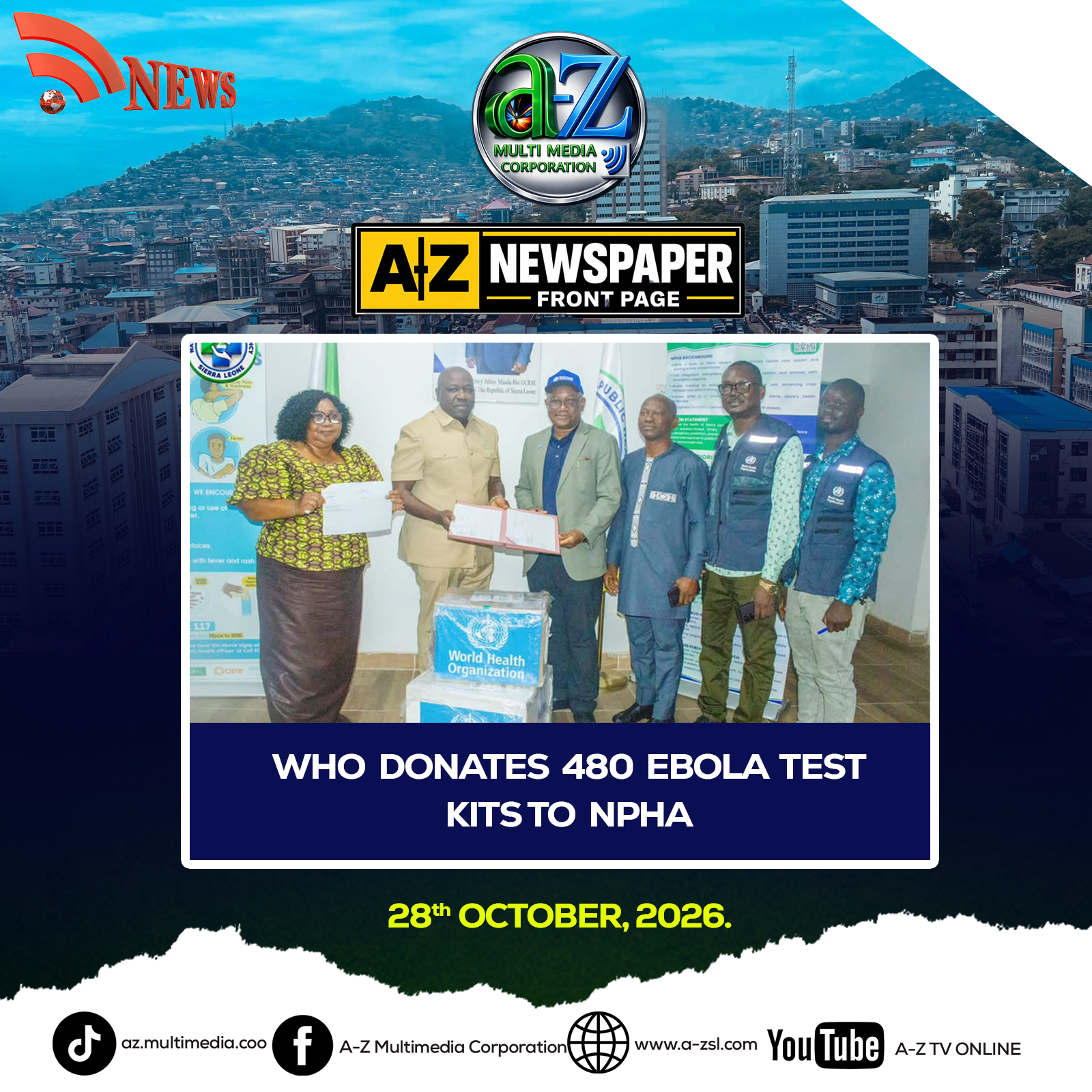
By: Saidu Jalloh
The World Health Organization (WHO), through its representative, Dr. George Ameh, has donated 480 Ebola polymerase chain reaction (PCR) tests and approximately 500 laboratory extraction materials to the National Public Health Agency (NPHA) to strengthen Sierra Leone’s preparedness for a potential Ebola outbreak.
Speaking during the handover ceremony, Dr. Ameh said the donation would strengthen Sierra Leone’s laboratory testing capacity and improve the country’s ability to detect and respond to potential Ebola threats.
He disclosed that Sierra Leone’s preparedness level had improved significantly, rising from approximately 55 per cent before the emergency was declared earlier this year to more than 80 per cent. However, he stressed that further efforts were needed to achieve the Ministry of Health’s target of 100 per cent preparedness.
Dr. Ameh reaffirmed WHO’s commitment to working closely with the Ministry of Health, NPHA and other partners to address remaining gaps and sustain the progress made in strengthening the country’s emergency response capacity.
According to Dr. Ameh, the 480 PCR tests are capable of detecting all five strains of the Ebola virus, including the Bundibugyo strain associated with the outbreak in the Democratic Republic of Congo (DRC). The tests can also detect the Marburg virus, which causes a severe haemorrhagic fever.
In addition to the tests, the donation includes approximately 500 extraction materials used to isolate viral genetic material from biological samples before laboratory testing.
Receiving the supplies, NPHA Executive Director Professor Foday Sahr said the donation would strengthen the country’s readiness to prevent, detect and respond rapidly to potential Ebola cases, despite there being no confirmed cases in Sierra Leone at the time of the handover.
“Currently, there is no Ebola case in the country,” Professor Sahr emphasised, adding that the priority was to prevent the virus from entering Sierra Leone and ensure its early detection and rapid containment should an infection occur.
He explained that Sierra Leone began strengthening its preparedness following the announcement of an Ebola outbreak in the DRC in March. An initial assessment placed the country’s preparedness level at approximately 51 per cent.
According to Professor Sahr, the government subsequently worked with technical partners, including WHO, the United States Centers for Disease Control and Prevention (US CDC), the World Bank and other stakeholders, to address identified gaps in the country’s emergency response system.
A subsequent assessment conducted on 10 October showed that Sierra Leone’s preparedness level had increased to 83 per cent. However, he said the Minister of Health had directed relevant institutions and partners to work towards achieving 100 per cent preparedness.
“The Honourable Minister, however, said that is not enough. He wants us to be 100 per cent ready,” Professor Sahr stated, describing preparedness as a continuous process requiring sustained commitment and collaboration.
He further disclosed that the newly received supplies would be distributed to public health laboratories across the country to strengthen diagnostic services and enable samples to be tested closer to where they are collected.
He said decentralizing laboratory testing would reduce transportation delays, improve turnaround times for results and allow health authorities to respond more quickly to suspected cases, thereby helping to limit the potential spread of the virus.
Addressing public concerns, Professor Sahr urged Sierra Leoneans to avoid spreading misinformation and rumours about Ebola, reiterating that there were no confirmed cases in the country at the time of the interview.
He encouraged the public to seek accurate information from official sources, including the NPHA, the Ministry of Health and the Ministry of Information and Civic Education.
The NPHA Executive Director also assured journalists that the agency remained available to respond to public enquiries, adding that when answers were not immediately available; the agency would endeavour to provide feedback within 24 hours.
The donation forms part of Sierra Leone’s ongoing efforts to improve laboratory testing capacity, strengthen public health preparedness and ensure a timely and effective response to potential Ebola threats.