

By: Mamajah alloh
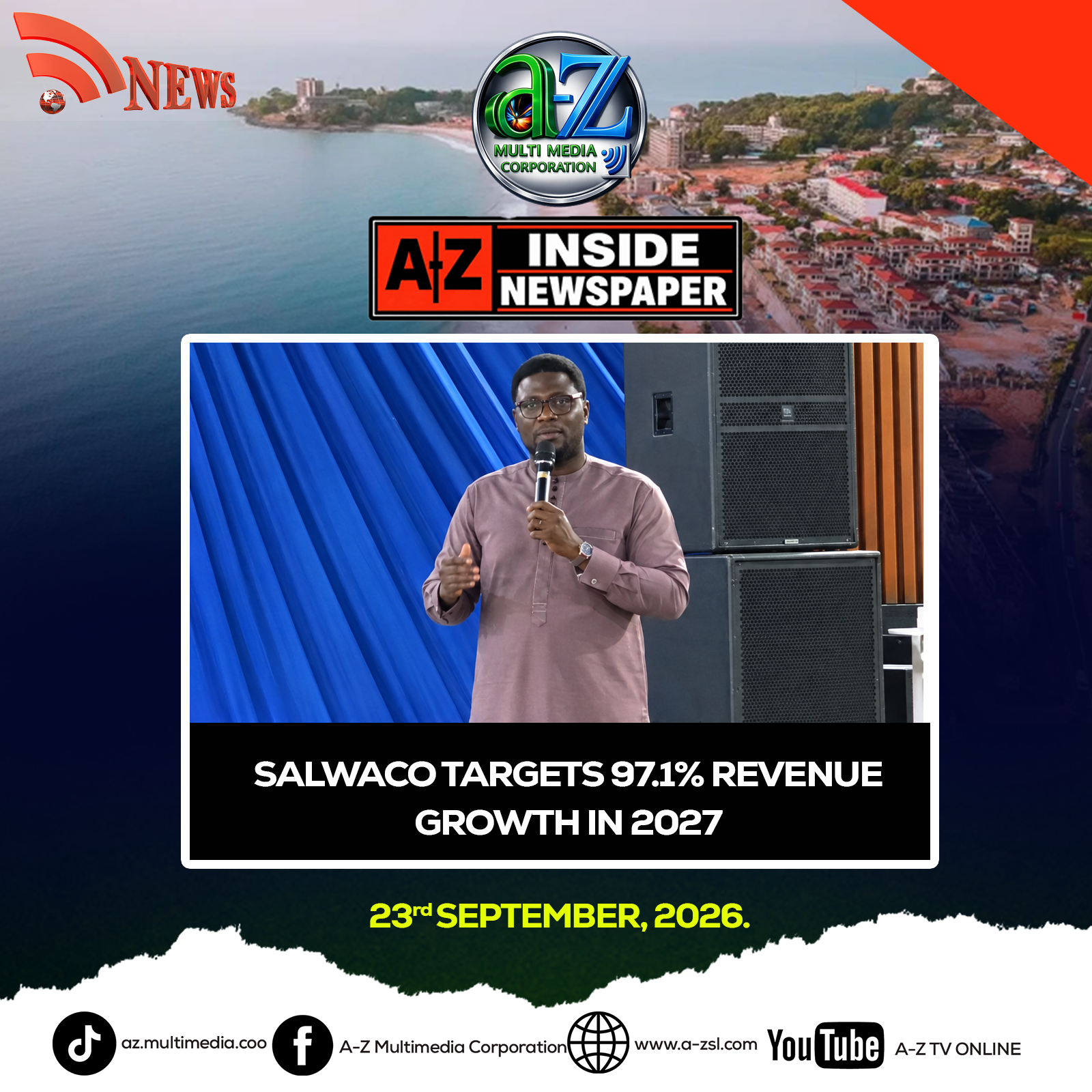
The Sierra Leone Water Company (SALWACO) has projected a 97.1% increase in revenue collection under its FY2027 budget plan, estimated at NLe 17.698 million, under the theme: “Transforming SALWACO into a Functional and Financially Viable Institution.”
Presenting the budget, SALWACO Deputy Managing Director, Dr. Albert Harrison Harvey, said the company has connected 10,580 customers through metering, providing a platform for verified billing and improved revenue collection.
He noted that the company has achieved about 90% metering coverage, while revenue collection currently stands at about 45%, which he attributed to weaknesses in billing and collection.
Harvey said SALWACO has conducted a nationwide assessment of its operational stations, identifying quick-win interventions and structural challenges. He added that the company developed and launched its 2026–2030 Strategic Development Plan (SDP) in March 2026.
He further disclosed that the review of the SALWACO Act, 2017, has commenced through a technical working group, while the centralized billing and revenue management system went live across stations in December 2025.
According to him, SALWACO has also introduced a revised organizational structure aimed at strengthening coordination, accountability and service delivery. He said the company recorded a 15% increase in revenue under its new leadership, alongside a new revenue collection record since November 2025.
“We allocated NLe 11.882 million in 2025 and received NLe 9.072 million, representing 76.3%. In 2026, we allocated NLe 7.573 million and received NLe 5.132 million, representing 67.8%,” Harvey stated.
He said SALWACO’s 2027 station revenue target is 86.8%, with Makeni projected to generate NLe 5.947 million, Kenema NLe 4.729 million and Bo NLe 4.677 million.
Other projected contributions include Mile 91 with NLe 0.093 million, Pujehun NLe 0.144 million, Port Loko NLe 0.309 million, Magburaka NLe 0.511 million, Kambia NLe 0.356 million, Lungi NLe 0.435 million and Bonthe NLe 0.497 million.
Harvey also outlined SALWACO’s approved water tariff structure. The domestic/residential tariff is SLL 9,000, with a fixed charge of SLL 5,000. The commercial tariff is SLL 32,000, with a fixed charge of SLL 10,000.
For institutions such as schools and hospitals, the tariff is SLL 15,000, with a fixed charge of SLL 10,000, while other institutions are charged SLL 20,000, with the same fixed charge. The water packaging tariff is SLL 37,000, with a fixed charge of SLL 10,000.
Under its FY2027 funded deliverables, SALWACO has allocated NLe 808 million for a Water Supply Master Plan, expected to prioritize provincial investment and service planning.
An additional NLe 150 million has been allocated for branding and communications to strengthen public information and customer engagement, while NLe 450 million is earmarked for a revenue mobilization framework to improve revenue generation and financing partnerships.
The billing and revenue system has been allocated NLe 583 million to modernize billing, collections and revenue assurance.
Harvey said SALWACO currently has six water supply stations in Kambia, Kailahun, Moyamba, Kabala, Pujehun and Magburaka, while water supply projects in Njala, Mattru, Daru and Mogo/Mongor are among the ongoing infrastructure programmes.
He further disclosed that the company has several pending and pipeline initiatives, including the RWSSP Successor Project, which has been submitted to the Ministry of Finance and is expected to expand rural and small-town water services.
The rollout of 30,000 prepaid meters is also expected to improve billing accuracy and payment discipline, while an off-grid solar initiative for Bo, Kenema and Makeni is being considered as a short-term measure to reduce operating costs, lower energy expenditure and improve production reliability.
Harvey identified several risks to SALWACO’s funding and implementation plans, including delays in disbursements, weak collections and arrears, rising energy costs, inflation, foreign exchange pressures, safeguards and implementation delays, as well as gaps in execution capacity.
He said the company plans to address these risks through time-bound fund releases and certification schedules, debt ageing and monitoring, digital collection systems, customer account segmentation, stronger station accountability, plant-level energy assessments, solar assessments, preventive maintenance, early funding, active grievance mechanisms, targeted expertise, performance contracts and structured management reviews.