

By: Audrey Raymonda John
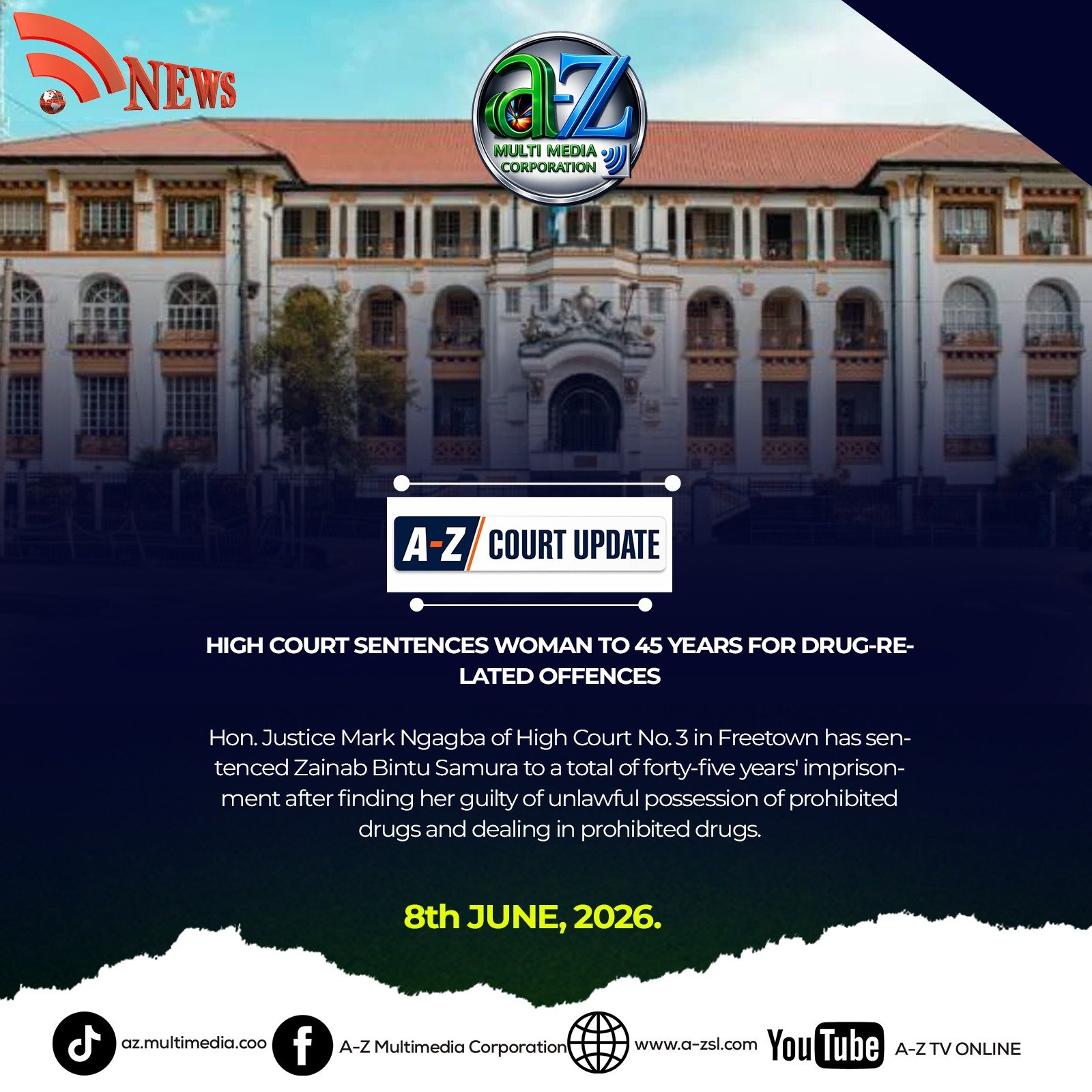
Hon. Justice Mark Ngagba of High Court No. 3 in Freetown has sentenced Zainab Bintu Samura to a total of forty-five years’ imprisonment after finding her guilty of unlawful possession of prohibited drugs and dealing in prohibited drugs.
The conviction followed the court’s determination that the prosecution had proved its case beyond reasonable doubt.
The accused was arraigned on six counts, comprising three counts of Unlawful Possession of Prohibited Drugs, contrary to Section 8(a) of the National Drugs Control Act, 2008, and three counts of Dealing in Prohibited Drugs, contrary to Section 7(c) of the same Act.
According to the prosecution, on 6 November 2025, at the Pademba Road Magistrate Court in Freetown, the defendant was found in possession of 210 pink-coloured, circular, film-coated tablets of Tramadol weighing 100.4 grams, loose cannabis sativa weighing 40 grams, and kush weighing 60 grams. She was also alleged to have been dealing in prohibited substances without lawful authority.
Following preliminary proceedings, the matter was committed to the High Court, where, on 2 February 2026, the defendant pleaded not guilty to all six counts.
In delivering judgment, Justice Ngagba stated that the burden rested on the prosecution to prove the charges beyond reasonable doubt. He emphasized that any reasonable doubt arising from the evidence must be resolved in favour of the accused.
To establish its case, the prosecution called three witnesses. Among them was Detective Police Constable 17834 Abdul Koroma of the Transnational Organized Crime Unit (TOCU), who testified that on 6 November 2025, a TOCU team led by Abass Y. Bangura arrested the defendant and recovered substances suspected to be kush, cannabis sativa, and 210 tablets suspected to be Tramadol.
Several exhibits were tendered before the court, including the Police Abstract Report, Forensic Analyst Laboratory Request Form, Voluntary Caution Statement, Search Warrant, and Charge Statement.
The witness further testified that the recovered substances were registered in the Book of Court Exhibits and that samples were forwarded for forensic examination. Laboratory analysis subsequently confirmed that the substances were kush, cannabis sativa, and Tramadol.
At the close of the prosecution’s case, the defendant elected to make an unsworn statement. She told the court that she had gone to visit her husband at the Pademba Road Court when an unidentified man approached her and handed her a black plastic bag to deliver to him. She claimed that she was unaware of the contents of the bag and that it was intercepted by a corrections officer before reaching her husband.
She further stated that she was later arrested and taken to TOCU headquarters before being escorted to her residence, where a search allegedly yielded nothing of evidential value to the police.
Justice Ngagba held that the prosecution had established all the essential elements of the offences charged. He relied heavily on the testimony of the forensic analyst and the laboratory reports, which conclusively confirmed that the substances recovered from the defendant were prohibited drugs.
The judge referred to Section 57 of the National Drugs Control Act, 2008, which provides that where a sample of a substance is tested and found to possess properties, it is presumed that the entire substance possesses the same properties unless proven otherwise.
In his verdict, Justice Ngagba found that the defendant had failed to establish any lawful authority for possessing the drugs. He ruled that the prosecution had successfully proved that she was in possession of and dealing in Tramadol, cannabis sativa, and kush.
Consequently, the court found Zainab Bintu Samura guilty on all six counts.
Justice Ngagba sentenced her to fifteen years’ imprisonment on each of Counts One, Two, and Three, and five years’ imprisonment on each of Counts Four, Five, and Six.
The court ordered that the sentences run concurrently, resulting in an effective prison term of fifteen years.