

By: Mohamed Sahr
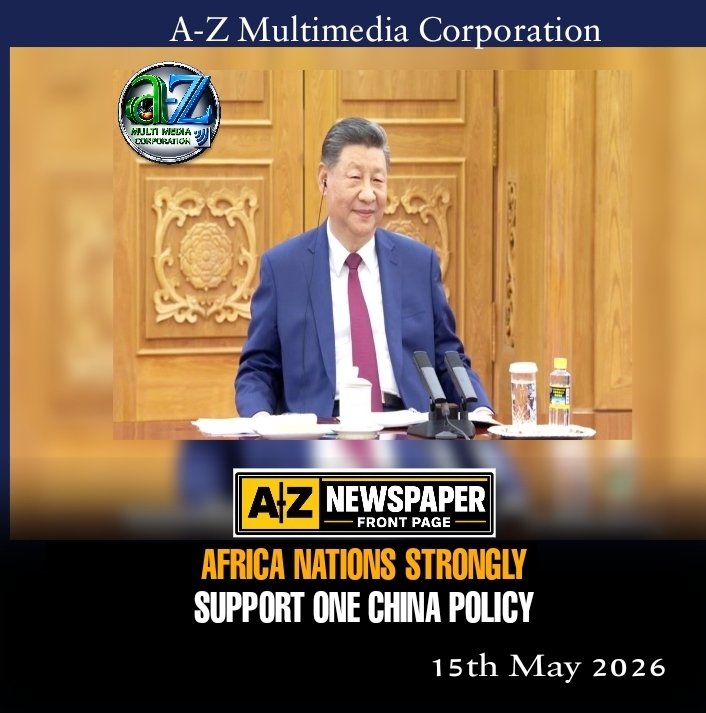
The One China Policy also known as ‘the One China Principle’ is a diplomatic position stating that there is only one China in the world, that Taiwan is an inseparable part of China, and that the People’s Republic of China (PRC) is the sole legitimate government representing all of China.
Under this policy, countries that establish official diplomatic relations with China cannot maintain formal diplomatic relations with Taiwan. The policy became internationally significant after the PRC regained China’s seat at the United Nations through United Nations General Assembly Resolution 2758 in 1971.
In today’s rapidly changing global order, few diplomatic principles carry as much political weight and strategic significance as the One China Policy. Though often discussed in formal diplomatic language, the policy reaches far beyond government communiqués and international summits. It influences trade routes, development projects, foreign aid, global alliances, military tensions, and the everyday lives of millions of people across Asia, Africa, and the wider world.
At the centre of the policy lies one of the most sensitive geopolitical questions of the modern era: the status of Taiwan and China’s insistence that there is only one sovereign Chinese state represented by the People’s Republic of China (PRC). For Beijing, the issue is not simply about territory or diplomacy; it is tied deeply to national identity, historical memory, sovereignty, and the legacy of a painful century marked by foreign occupation, civil war, and political fragmentation. Chinese leaders frequently describe reunification with Taiwan as part of the country’s ‘national rejuvenation’ a symbolic restoration of unity after decades of division.
WHY AFRICAN COUTRIES SUPPORT THE ONE CHINA POLICY?
The continued support for the One China Policy across Africa is not accidental, emotional, or purely symbolic. It is rooted in history, diplomacy, economic necessity, and strategic calculation. For many African countries, including Sierra Leone, the policy represents far more than a position on Taiwan; it reflects a broader partnership with People’s Republic of China that has evolved over decades and continues to shape development and international relations today.
From an African perspective, the One China Policy is often viewed through the lens of sovereignty and mutual respect. Many African nations emerged from colonial rule after long struggles for independence and remain highly sensitive to issues involving territorial integrity and foreign interference. China’s emphasis on non-interference in domestic affairs resonates strongly with governments that prefer partnerships free from political conditionalities. In this sense, supporting China’s territorial claims is also seen as defending the principle of sovereignty that African states themselves value deeply.
Across Africa, under the patronage of trust and mutual relations, Chinese-funded roads, bridges, railways, hospitals, stadiums, ports, and government buildings have become visible symbols of Beijing’s growing influence. In Sierra Leone, Chinese support has contributed to infrastructure projects, agricultural cooperation, healthcare assistance, and post-crisis recovery efforts, particularly during challenging periods such as the Ebola epidemic. To many African governments, China represents not only an economic partner but also a diplomatic friend, one that emphasizes sovereignty, non-interference, and long-term cooperation.
This relationship did not emerge overnight. It is rooted in decades of historical solidarity dating back to the anti-colonial struggles of the twentieth century. During the Cold War and the era of African independence movements, China positioned itself as a supporter of liberation struggles and developing nations seeking alternatives to Western dominance. In return, African countries played a decisive role in helping the PRC reclaim China’s seat at the United Nations in 1971 through United Nations General Assembly Resolution 2758. That diplomatic support laid the groundwork for what would later become one of the most influential geopolitical partnerships of the twenty-first century.
Economics also plays a significant role. China has become Africa’s largest trading partner and one of its biggest investors in infrastructure and development projects. Across the continent, Chinese-funded roads, railways, airports, hospitals, schools, ports, and energy projects have transformed both urban and rural communities. In countries such as Sierra Leone, Nigeria, Ghana, South Africa, Egypt, Ethiopia, Kenya, Tanzania, Rwanda among others, Chinese cooperation has contributed to infrastructure development, agriculture, healthcare support, and post-crisis recovery efforts. For many governments, maintaining strong relations with Beijing under the One China framework is considered essential for continued economic growth and development financing.
At the same time, African leaders understand the geopolitical realities of the modern world. China is now one of the most influential global powers economically, politically, and technologically. Supporting the One China Policy helps African nations strengthen diplomatic relations with Beijing while securing access to trade opportunities, investment, and international cooperation platforms such as the Forum on China-Africa Cooperation (FOCAC).
Nevertheless, most African countries continue to believe that the practical benefits of engagement with China currently outweigh the disadvantages. For many governments, the One China Policy has become a diplomatic foundation for broader cooperation in trade, technology, education, healthcare, infrastructure, and international diplomacy.
CONCLUSION
The One China Policy remains one of the defining pillars of modern international diplomacy and a central foundation of China-Africa relations. For China, it represents sovereignty, national unity, and historical legitimacy. For African countries such as Sierra Leone, it represents strategic partnership, economic opportunity, and diplomatic cooperation built over decades of mutual engagement.
The policy has contributed significantly to stronger China-Africa relations through trade, infrastructure development, healthcare support, education partnerships, and political cooperation in global institutions. At the same time, it continues to generate debate over issues such as Taiwan’s international status, democratic representation, debt sustainability, and geopolitical competition between major powers.
Seamlessly, Africa’s overwhelming support for the One China Policy reflects a broader global reality: nations often shape foreign policy according to practical interests, historical relationships, and long-term development priorities. As China’s influence continues to grow globally, the One China Policy will likely remain a powerful and enduring feature of international relations.
This is one of the best pieces I have read on this One China Policy. keep it up, Mohamed Sahr.
Thank you my brother!