

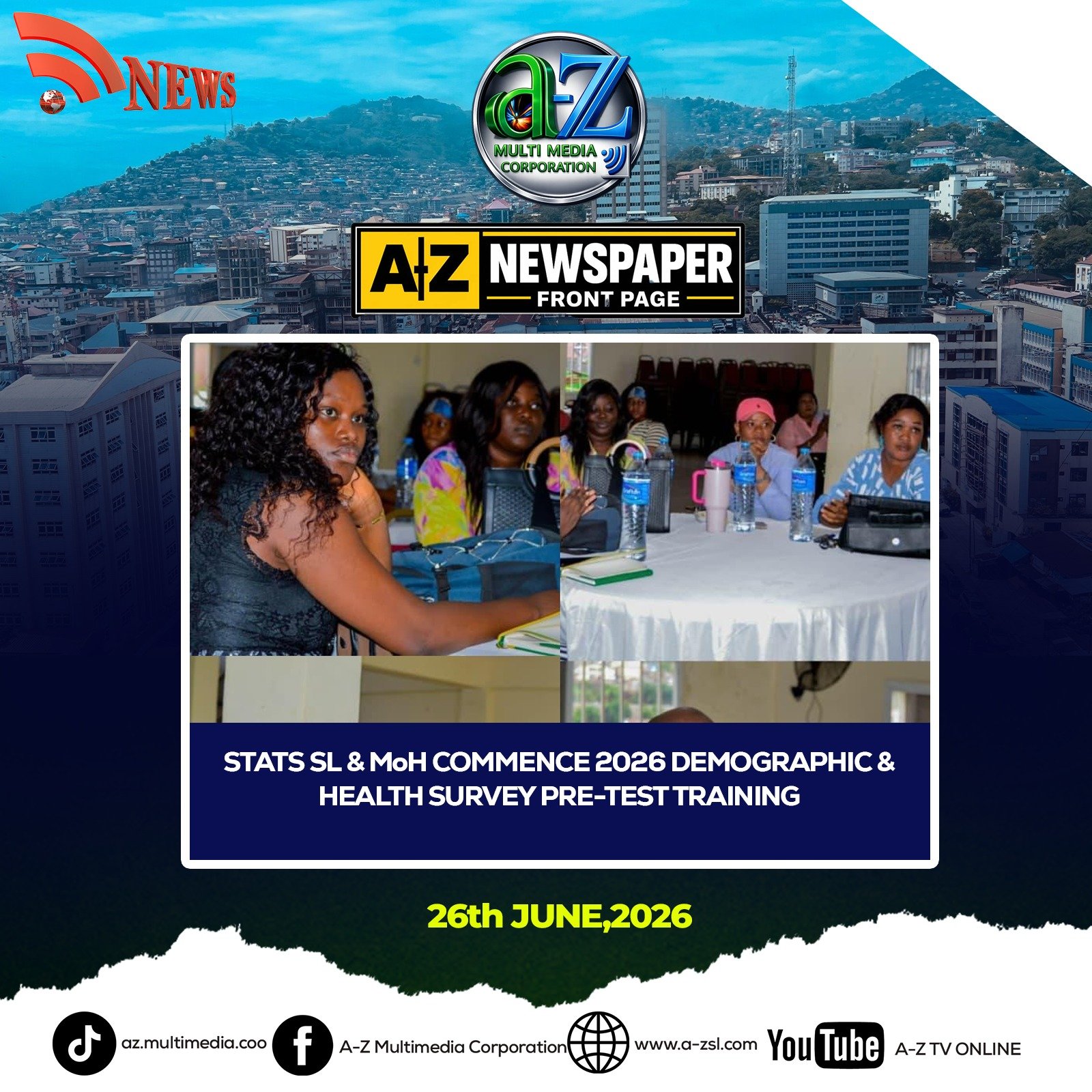
Statistics Sierra Leone (Stats SL), in collaboration with the Ministry of Health (MoH) and with technical support from ICF, has commenced a three-week Demographic and Health Survey (DHS) Pre-Test Training of Trainers workshop aimed at equipping field personnel with the knowledge and skills required for effective data collection ahead of the nationwide survey.
The training brings together key stakeholders, technical experts, survey personnel, and sector representatives to build capacity on survey instruments and prepare participants for the pre-testing of questionnaires that will guide the successful implementation of the 2026 Demographic and Health Survey.
Speaking at the opening session, the Director of Demographic, Health and Social Statistics at Statistics Sierra Leone, Mohamed Koblo Kamara, outlined the objectives of the training and highlighted the significance of the survey. He described the DHS as one of Sierra Leone’s most important national surveys, providing critical data on maternal and child health, nutrition, fertility, mortality, and other key development indicators.
Kamara noted that the survey serves as a vital source of information for the Ministry of Health and other stakeholders, supporting evidence-based decision-making, policy formulation, and programme planning. He encouraged participants to actively engage in the training and maintain high professional standards throughout the exercise, emphasizing that quality data is essential for effective national development planning.
Representing ICF, Hanna Useem expressed her enthusiasm about working with Statistics Sierra Leone to achieve the objectives of the survey. She described the DHS as a crucial exercise that will contribute significantly to strengthening Sierra Leone’s health and demographic data systems.
Useem reaffirmed ICF’s commitment to supporting Statistics Sierra Leone throughout the survey process and commended the institution for its continued dedication to producing reliable and high-quality statistics that support national development.
Speaking on behalf of the Ministry of Health, Monitoring and Evaluation Specialist Nelson Fofanah highlighted the importance of the DHS in assessing the effectiveness of health interventions across the country. He noted that the survey enables the Ministry to monitor progress in service delivery, identify gaps, and evaluate the impact of health programmes and services.
According to Fofanah, the DHS remains a critical component of Sierra Leone’s healthcare system, providing evidence needed to guide policy development, programme implementation, and resource allocation. He added that many of the Ministry’s interventions are informed by data generated through surveys such as the DHS.
Delivering the keynote address and officially declaring the training open, the Statistician General and Chief Executive Officer of Statistics Sierra Leone, Andrew Bob Johnny, underscored the importance of the Demographic and Health Survey in informing national health policies and development programmes.
He noted that Sierra Leone has successfully conducted several rounds of the DHS over the years, each generating valuable data that has supported national planning and development efforts. He urged participants to take the training seriously, stressing that the survey will play a critical role in monitoring progress on key health indicators and improving the well-being of citizens.
Mr. Johnny further stated that future health interventions by the Government and development partners will be guided by the findings of the survey. He encouraged participants to remain focused, disciplined, and committed throughout the training, emphasizing that quality remains paramount and that the success of the survey depends on the professionalism, competence, and dedication of those involved.
The Demographic and Health Survey (DHS) is a nationally representative household survey that collects standardized data on population, health, and nutrition. It provides critical information on fertility, maternal and child health, nutrition, mortality, and other key health indicators, help policymakers, development partners, researchers, and public health officials make informed decisions, develop effective policies, and monitor development progress.
This version improves readability, eliminates grammatical inconsistencies, strengthens transitions between paragraphs, and aligns the article with professional news reporting standards while preserving all key facts and quotations.