

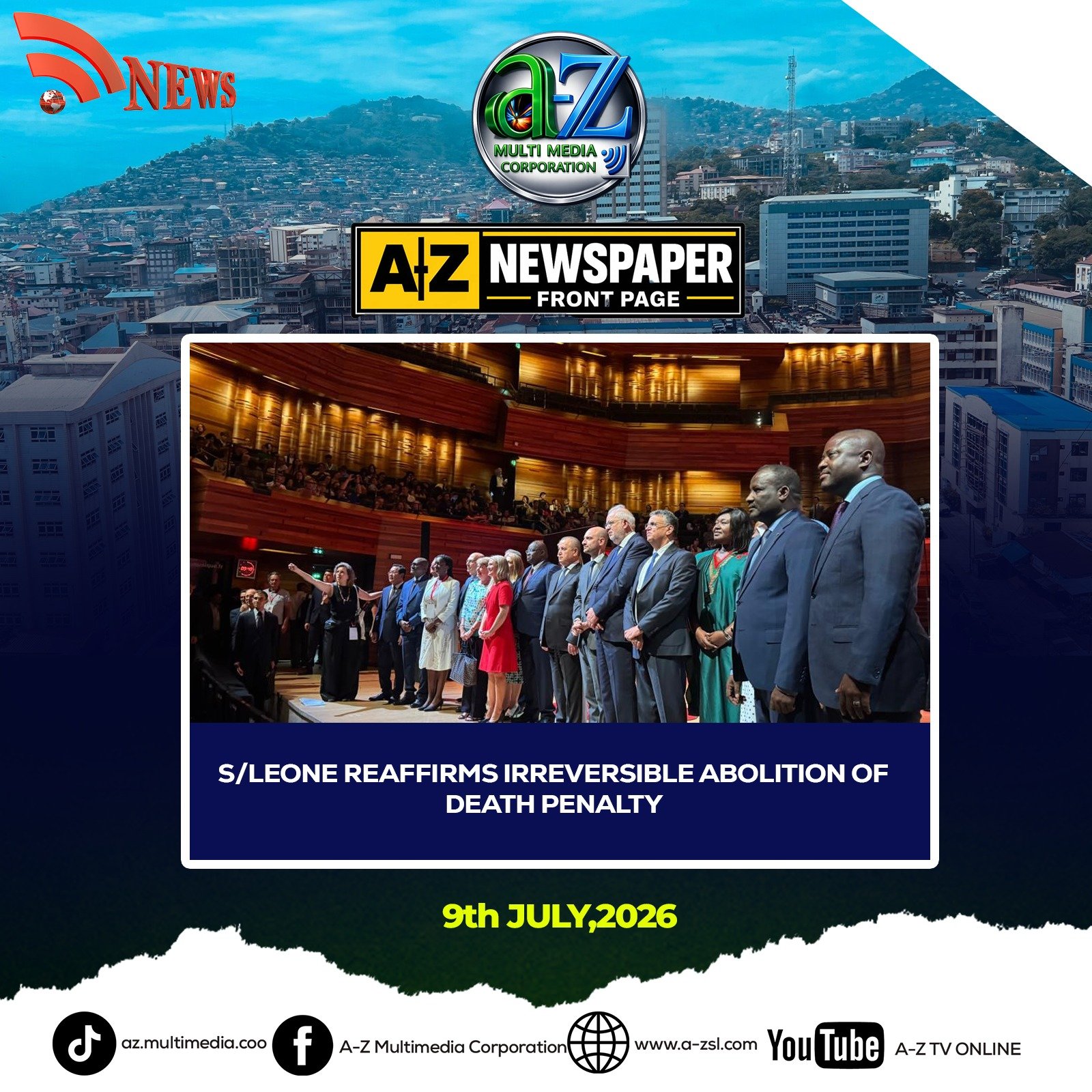
Sierra Leone has reaffirmed its irreversible commitment to the abolition of the death penalty, declaring that its recent ratification of the Second Optional Protocol to the International Covenant on Civil and Political Rights (ICCPR) marks the permanent end of capital punishment under both domestic and international law.
Speaking during a high-level panel at the opening session of the 9th World Congress Against the Death Penalty in Paris on 29 June 2026, the Attorney General and Minister of Justice underscored the country’s legal and moral transformation, describing the abolition of the death penalty as “absolute, irreversible and grounded in principle rather than convenience.”
The Attorney General conveyed the greetings of President Julius Maada Bio, the Government and the people of Sierra Leone, noting that the country’s participation in the Congress reflected its continued commitment to advancing global human rights.
Recalling Sierra Leone’s participation at the 2022 World Congress Against the Death Penalty in Berlin, the Attorney General referenced the enactment and entry into force of the Abolition of the Death Penalty Act, 2021, which removed capital punishment from the country’s domestic legal framework. He stated that Sierra Leone had unequivocally “chosen life.”
The Minister noted that the country’s commitment to abolition was tested during the violent attempted overthrow of the Government in November 2023, when there were calls from some quarters for the reinstatement of the death penalty. However, President Bio rejected those calls, maintaining Sierra Leone’s abolitionist position based on constitutional values and principle rather than political expediency.
Highlighting recent legal developments, the Attorney General announced that on 9 June 2026, the Parliament of Sierra Leone ratified the Second Optional Protocol to the ICCPR. He further disclosed that on 24 June 2026; the Instrument of Accession was executed by the Minister of Foreign Affairs and International Cooperation and subsequently transmitted to the United Nations in New York for deposit with the Secretary-General.
He explained that Sierra Leone has now abolished the death penalty under both domestic legislation and international law, making its abolition permanent and irreversible.
The Attorney General outlined three major implications of the ratification.
First, he explained that all provisions relating to the death penalty in Sierra Leone’s 1991 Constitution are now rendered unenforceable by virtue of the country’s international treaty obligations, regardless of any future legislative or governmental changes. He added that the forthcoming revised Constitution will further entrench the abolition of the death penalty as a protected constitutional principle.
Second, he affirmed that no Sierra Leonean will ever again face capital punishment.
Third, he noted that Sierra Leone has joined the growing community of African and international states that have permanently removed the death penalty from their legal systems.
Reflecting on the country’s historical position, the Attorney General observed that Sierra Leone voted against the adoption of the Second Optional Protocol in 1989. He described the country’s journey from retention to abolition as evidence that, although the transition may be challenging, it is both possible and worthwhile.
Addressing countries that still retain the death penalty, the Attorney General urged them to ratify the Second Optional Protocol, stressing that doing so should not be viewed as a loss of sovereignty but rather as “a gain for humanity.”
He concluded by encouraging sustained global efforts towards the universal abolition of capital punishment and reaffirmed Sierra Leone’s commitment to serving as a strong advocate for the worldwide abolition of the death penalty.
The 9th World Congress Against the Death Penalty was held in Paris from 30 June to 2 July 2026 and was hosted by the Governments of France and Switzerland, with the European Union serving as a co-sponsor. The Congress was organized by ECPM (Ensemble contre la peine de mort/Together Against the Death Penalty), a France-based organization dedicated to the global abolition of capital punishment.
Sierra Leone’s delegation comprised the Deputy Minister of Foreign Affairs and International Cooperation, Mrs. Frances Piagie Alghali; Sierra Leone’s Ambassador to France, H.E. Dr. Mohamed Kanja Sesay; Deputy Ambassador Ms. Mamadi Gobeh Kamara; Mr. Samuel Kargbo, Minister Plenipotentiary and Head of Chancery at the Sierra Leone Embassy in Paris; and Mr. Patrick Hassan Morlai Koroma, Esq., Director of Legal, Economic and Technical Cooperation at the Ministry of Foreign Affairs and International Cooperation.