

By: Saidu Jalloh
The Sierra Leone Maritime Administration (SLMA) has signed a landmark Memorandum of Understanding (MoU) with Njala University to strengthen maritime education and build national capacity in Sierra Leone’s growing marine sector.
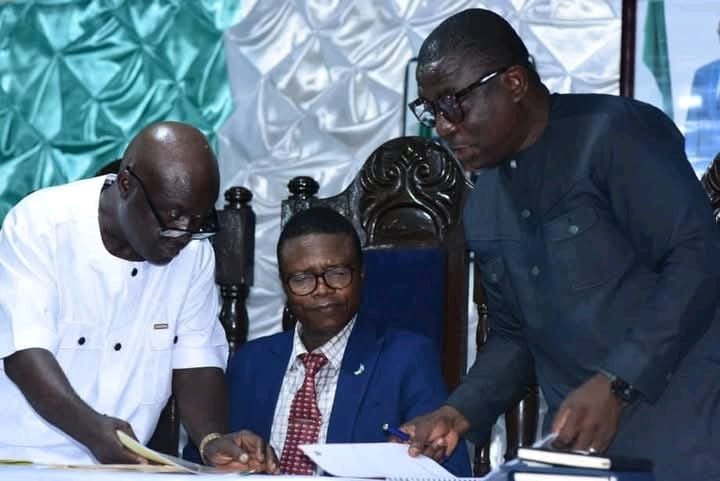
The agreement was formalized on Tuesday at the University’s Secretariat Hall on the Njala Campus in the presence of senior university officials, SLMA representatives, members of the Students’ Union Government, media representatives, and other stakeholders.
The MoU seeks to promote and integrate maritime education and training programmes into Njala University’s academic curriculum. It also ensures that maritime courses and qualifications offered by the university align with SLMA guidelines and the Standards of Training, Certification and Watchkeeping for Seafarers (STCW) Convention. The partnership further aims to strengthen institutional and human capacity for effective maritime governance, research, and workforce development.
Speaking at the ceremony, SLMA Executive Director Dr. Daniel B. Kaitibi described the maritime sector as a critical yet underdeveloped area in Sierra Leone.
“There are over 600 vessels flying the Sierra Leone flag, and on board each vessel, we need trained personnel. Regrettably, we do not have enough institutions to train these workers,” he said. “The marine sector is an area that needs serious attention, and Njala University is well positioned to help fill that gap.”
Vice Chancellor and Principal of Njala University, Professor Alhaji Bashiru M. Koroma, said the agreement goes beyond a formal signing ceremony.
“Today is not just about signing a document; it is about building a relationship between two institutions that share common values and purpose,” he stated. “Sierra Leone has enormous potential in the marine sector, but potential alone is not enough. We need trained professionals, strong research, and practical collaboration to develop our maritime space responsibly and sustainably.”
Under the terms of the MoU, both institutions will collaborate on capacity development and training programmes for seafarers, instructors, and maritime professionals in line with international standards. The partnership also provides for staff exchanges, mentorship programmes, workshops, industry attachments, onboard training, and sea-time placements.
In addition, the agreement includes plans for joint research and feasibility studies toward establishing a School of Maritime Studies at Njala University. The proposed school would serve as a national hub for maritime education, training, and research.
Director of Higher Education at the Ministry of Technical and Higher Education, Mr. Emmanuel J. Momoh, described the partnership as timely and aligned with national education priorities.
“This collaboration will create opportunities for students to gain hands-on experience, internships, and exposure to the realities of the marine industry,” he said, adding that SLMA would also benefit from academic research and innovation.
The Students’ Union President of Njala University, Ahmed Bantoa Koroma, welcomed the initiative, describing it as a forward-looking milestone in the institution’s growth and development.
Representing SLMA at the signing were Dr. Kaitibi; Mr. Emmanuel Pius Richards, Director of Research and Maritime Education; Mr. Michael Katta, Legal Supervisor; Mr. Raju Gidwani, Head of Standards of Training, Certification and Watchkeeping for Seafarers; and Mr. Sahr Ngaujah, Public Relations Manager.
Mr. Richards described the MoU as a significant step toward developing a sustainable and globally competitive maritime workforce for Sierra Leone, expressing confidence that the collaboration would yield tangible results.
In his closing remarks, Dr. Kaitibi noted that SLMA is working with the International Maritime Organization to ensure that graduates of the programme are properly certified to serve onboard vessels.
“There is a lot to be done in the maritime sector, but we must start somewhere,” he said. “We need to reignite the culture of placing our seafarers back on vessels to reap the benefits of their hard work, as was the case in previous years.”