

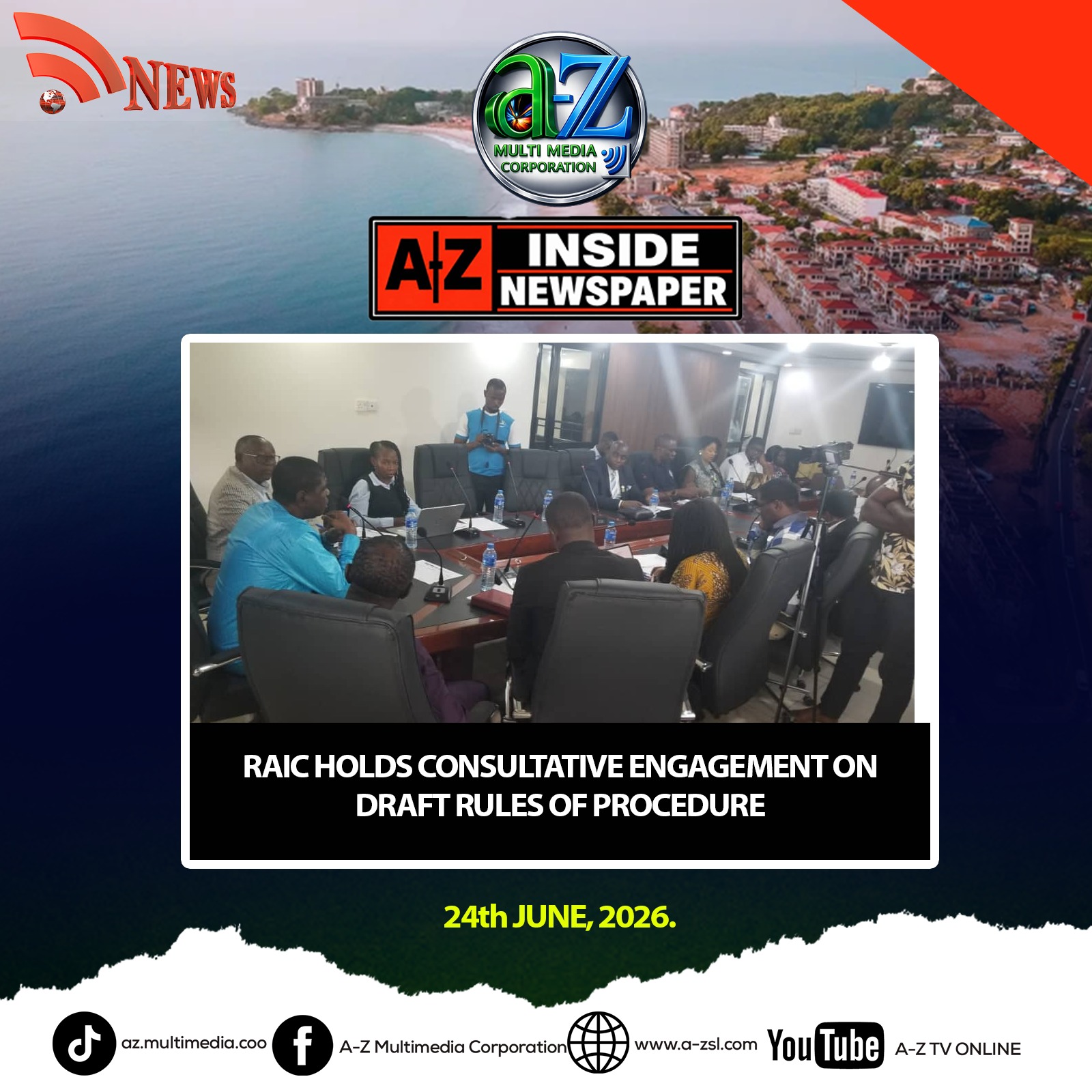
The Right to Access Information Commission (RAIC) has held a day-long consultative engagement with public authorities and civil society organizations aimed at developing the RAIC Rules of Procedure and Complaints Handling Manual. The document is intended to provide a comprehensive and user-friendly guide on accessing information held by public authorities, as well as handling complaints arising from alleged breaches of the Right to Access Information Act 2013.
The engagement took place on Thursday, 18th June 2026, at the RAIC National Secretariat in Freetown, bringing together key state and non-state stakeholders in the access to information space to review and critically examine the draft manual.
Welcoming participants, the Chairman and Information Commissioner of RAIC, Dr. Ibrahim Seaga Shaw, said the development of the procedures and complaints manual is part of the Commission’s continued efforts to enhance public understanding and expedite complaint resolution processes.
Dr. Seaga Shaw noted that RAIC is mandated under the Right to Access Information Act 2013 to facilitate access to information held by public authorities, a goal that can only be sustainably achieved through awareness-raising, capacity-building, and strong enforcement mechanisms.
He explained that the draft manual was developed by a consultant but emphasized that RAIC deliberately involved civil society organizations and government institutions to ensure broad participation.
“We invited you to carefully review the document and recommend necessary adjustments or modifications where appropriate, as we value your expertise and contributions,” he said.
He encouraged participants to critically examine the document with the aim of shaping it into a national instrument that meets best practice standards and stands the test of time.
Speaking on behalf of civil society, Eleanor Thompson, Managing Lead of Citizens’ Barray, commended RAIC for involving key stakeholders in the development process. She noted that the manual would help standardize complaint handling procedures and improve public understanding of the access-to-information process.
Similarly, Charles Keif-Kobai, Executive Director of FORWARD Sierra Leone, praised RAIC for consistently engaging civil society organizations in its work to strengthen public awareness and implementation of the right to information law.
He said such collaboration enhances understanding of the RAIC mandate, improves access to information, and promotes accountability among public institutions.
Elkass Sannoh, Director of Communications at the Judiciary of Sierra Leone, reaffirmed the Judiciary’s commitment on behalf of the Chief Justice to upholding human rights, including the right to information. He commended RAIC for involving key stakeholders in reviewing the draft manual.
Alice A. Kamara, Legal and Policy Adviser at the Ministry of Information and Civic Education, also pledged the Ministry’s continued support for RAIC. She noted that access to information remains a priority area for the Ministry and for Minister Chernor Bah, who views it as central to the protection of other human rights.
She added that promoting access to information among all public authorities is essential for strengthening transparency and civic participation.
During the engagement, Alan Benjamin Esq., Legal and Compliance Manager at RAIC, delivered a detailed PowerPoint presentation on the draft manual, guiding participants through its contents for review and input.
Over thirty participants drawn from civil society and public institutions contributed valuable recommendations and observations during the session.
In his closing remarks, Dr. Ibrahim Seaga Shaw assured participants that all inputs and recommendations would be carefully considered and incorporated into the final document, which will serve as a practical guide for handling access-to-information complaints and related matters.
The engagement was chaired by Hon. Mustapha M. Braima, Executive Secretary of RAIC, who encouraged participants to further review the draft manual and submit additional comments via the designated email address provided during the session.