

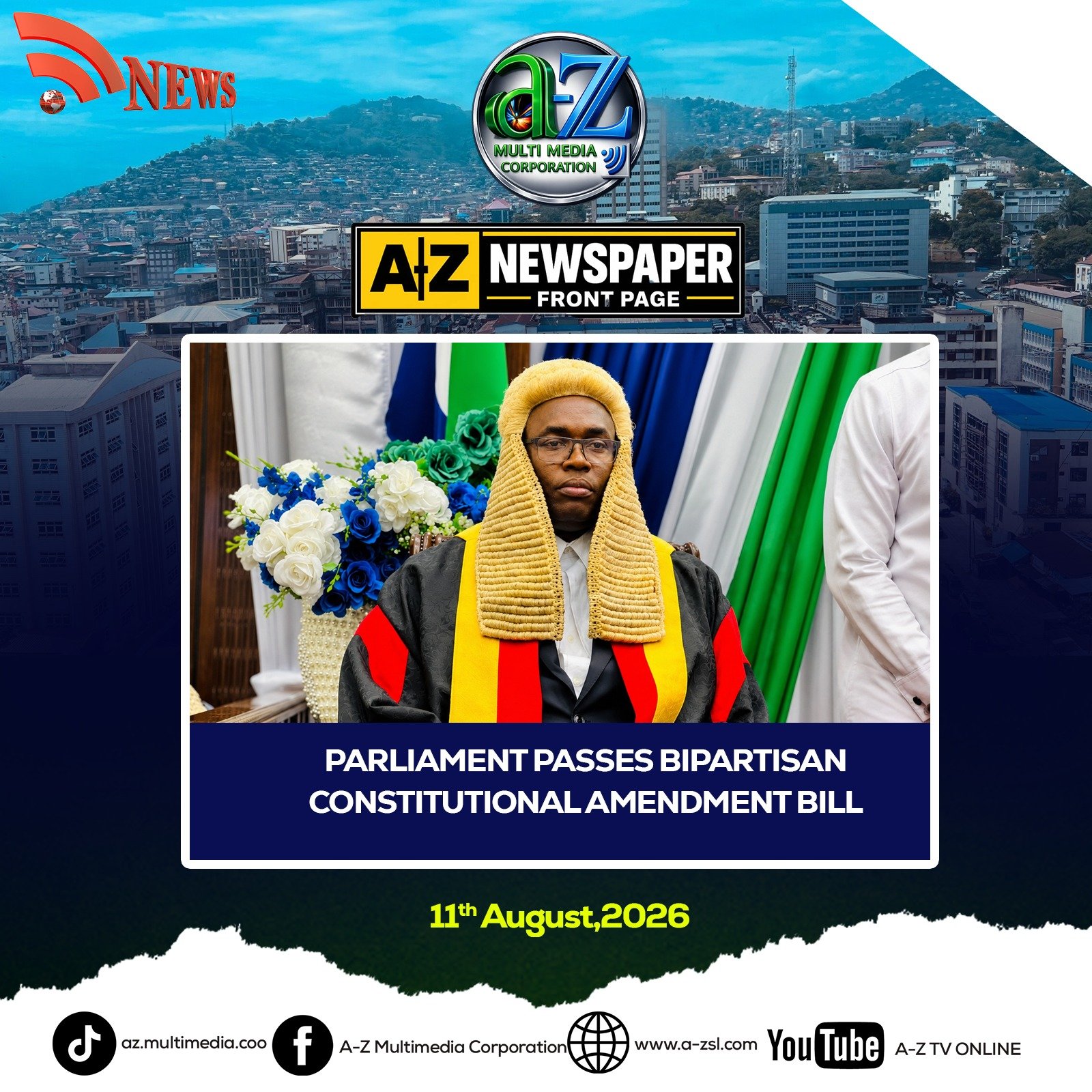
The Parliament of Sierra Leone has passed the long-debated Constitutional Amendment Bill, paving the way for significant changes to the country’s electoral and governance framework.
The Bill, which has undergone extensive consultations and consideration through the parliamentary committee and Third Reading stages, was put to a vote on Monday, August 10, 2026.
The legislation was passed following a series of votes in Parliament, with the opposition All People’s Congress (APC) staging a walkout after an earlier vote that resulted in a 97-46 defeat.
According to parliamentary sources, different provisions of the constitutional amendments required different voting thresholds, with a simple majority applying to certain provisions and a two-thirds majority required for the final approval of the constitutional amendment.
Members of Parliament of the Sierra Leone People’s Party (SLPP), Paramount Chiefs and two APC MPs remained in the Chamber and participated in the subsequent proceedings, which resulted in the passage of the remaining provisions, including the final amendment.
The passage of the Bill represents the culmination of a lengthy process of constitutional review and political debate. The exercise has generated considerable public discussion, particularly around electoral representation, presidential elections, citizenship and the administration of elections.
Among the key provisions retained in the amendments is the Proportional Representation (PR) electoral system which intends to provide a more inclusive mechanism for translating votes into parliamentary representation.
The 50+1 requirement for presidential elections has also been retained. Under this arrangement, a presidential candidate must secure half of the valid votes cast to win in the first round.
Another significant provision concerns dual citizenship. Under the amended framework, eligible dual citizens will be permitted to contest parliamentary elections. However, restrictions remain on their eligibility to serve as Speaker or Deputy Speaker of Parliament or to assume the presidency under circumstances requiring the President and Vice President to be absent from the country.
The amendments also make a change concerning the proposed Search Committee for the appointment of the Chief Electoral Commissioner. The proposal to introduce the Search Committee was reversed, with the previous arrangement for the appointment of the electoral commissioner retained.
The reforms come at a time when Sierra Leone continues to strengthen its democratic institutions and electoral processes. The introduction and retention of proportional representation is particularly significant because it has the potential to broaden parliamentary representation and ensure that political parties and groups receive representation more closely aligned with the level of electoral support they command.
The 50+1 presidential threshold is similarly important for strengthening the democratic mandate of the presidency. By requiring a successful presidential candidate to obtain a majority of valid votes, the system can encourage candidates to appeal to a broader cross-section of the electorate and build wider national support.
The dual citizenship provision could also create additional opportunities for Sierra Leoneans with international experience and expertise to participate in parliamentary governance, potentially bringing new skills, perspectives and networks into national policymaking.
More broadly, the constitutional reforms are expected to provide clearer rules for political participation and representation, while helping to strengthen confidence in the country’s democratic institutions.
The passage of the Constitutional Amendment Bill is therefore more than a parliamentary milestone; it represents an important development in Sierra Leone’s continuing democratic evolution.
Ultimately, the success of the reforms will be measured not simply by their passage into law, but by their ability to deepen democratic participation, strengthen representative governance and ensure that the voices and votes of Sierra Leoneans are meaningfully reflected in the institutions that govern the country.
The Constitutional Amendment Bill consequently marks a significant step in Sierra Leone’s efforts to modernize its democratic framework and build electoral institutions capable of supporting a more inclusive, representative governance system.
In his ruling, Rt. Hon. Speaker of Parliament, Segepoh Solomon Thomas stated that the Constitution must be interpreted as a whole and that the general rule under Section 91(1) applies unless the Constitution expressly provides for different voting requirement.
He explained that Section 108 specifically deals with amendments to provisions that are subject to the entrenched amendment procedure and argued that the provisions contained in the Bill did not fall within those requiring approval by a two-thirds majority.
The Speaker also referred to previous parliamentary practice, including the amendment of Section 79 of the Constitution in 2012, which he cited as an example of a constitutional provision being amended without the application of the two-thirds majority requirement.
Although Speaker Thomas ruled on the procedure followed by Parliament, he acknowledged the broader constitutional implications surrounding the interpretation of the relevant provisions.
He subsequently referred the matter to the Supreme Court for an authoritative opinion on whether a non-entrenched provision of the Constitution can be amended solely through the application of Section 91(1).
The referral was made pursuant to Section 94(2) of the 1991 Constitution, with the Speaker requesting that the Supreme Court provide its opinion to Parliament within three months.
The Supreme Court’s interpretation is expected to have significant implications for future constitutional amendment processes and the way Parliament exercises its constitutional powers.
The passage of the Bill, despite the opposition walkout and the unresolved constitutional question, is expected to continue generating political and legal debate as the country awaits the Supreme Court’s opinion.
Questions remain over the legal effect and implementation of the amendment pending the Court’s determination of the constitutional issue referred to it.
The constitutional debate now moves beyond the parliamentary chamber, with attention focused on the Supreme Court’s forthcoming interpretation of the constitutional provisions governing amendments to Sierra Leone’s supreme law.