

By: Vickie Remoe
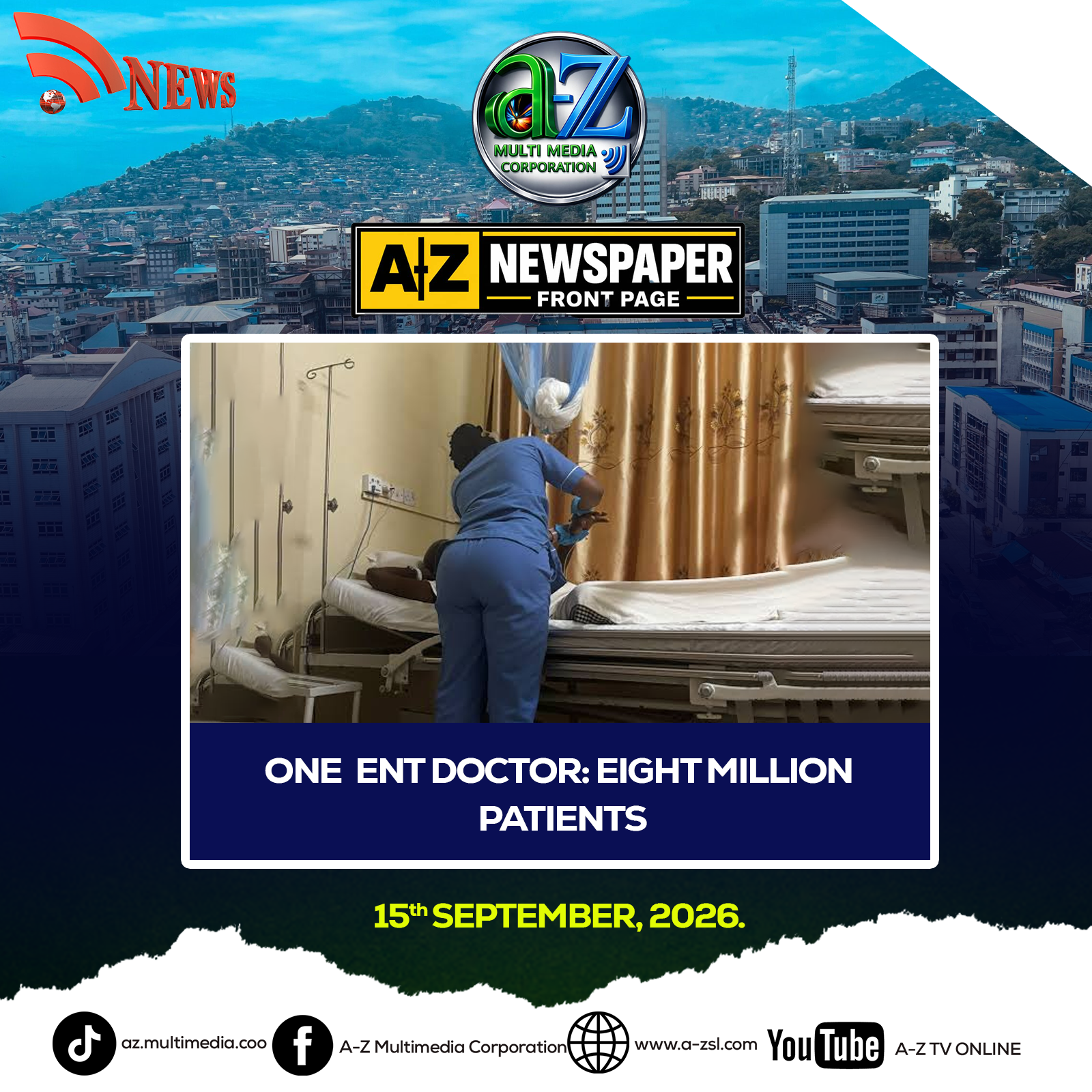
It is a known fact that Sierra Leone has only one Ear, Nose and Throat (ENT) specialist serving a population of more than eight million people.
My father, who turned 80 on Monday, has been trying to see the ENT specialist since last week. He has been experiencing a ringing sensation in his ear and, as a result, has had difficulty maintaining his balance. He also suffered an episode of vomiting in the middle of the night.
He was admitted to Choithrams Hospital, but even before his admission, the family had been trying to get him to see the ENT specialist.
“Posin say di doctor day make lek im na God,” people say. In other words, the doctor is reportedly so difficult to reach that some people joke that he behaves as if he were God.
I was told that, at times, he even switches off his phone.
In my naïveté, I asked: Why don’t they simply call another ENT specialist?
“Na e wan day.”
What do you mean?
“There is only one ENT specialist. It used to be Dr. Songo Williams, but he has retired.”
The new one-man ENT service is now reportedly provided by Dr. Kabineh, whom I am told is a young doctor.
There are more than eight million people in Sierra Leone, and this one specialist is expected to serve them all.
I began to imagine what life must be like for Dr. Kabineh. “E wan grain”—he must be exhausted—receiving calls from patients and hospitals from all over the country. When does he even have time for himself?
The situation becomes even more worrying when considered against the wider shortage of doctors in Sierra Leone.
In the last two weeks, two doctors have reportedly died in Freetown. One, Dr. Adrian Hanciles, was initially reported missing before his body was later found at the morgue.
On August 27, Dr. Aruna Maada Jabbi died at just 36 years old.
I do not know the circumstances surrounding either doctor’s death, and I would not want to speculate. But when the physician-to-population ratio is roughly one doctor for every 24,000 people—far above the World Health Organization’s commonly cited benchmark of one doctor per 1,000 people—it is difficult not to think about the enormous physical and professional burden placed on our doctors.
My father is due to be discharged this morning. He is stable, but he still has not seen the ENT specialist. I am not sure whether he will.
We have decided that perhaps the best option is for him to return to the United States for treatment.
Too much of Sierra Leonean life is left to chance.
One ENT specialist for an entire country?
Every young professional I speak to who is returning to school tells me they intend to study law.
Each time, I wonder: Do we really need more lawyers right now?
If the law school stopped admitting students for a decade, society would continue to function. But a shortage of doctors can cost lives every single day.
This is not a criticism of the legal profession or the “dangerously educated.” Rather, it is a reflection on the stark mismatch between what our country urgently needs and what our workforce continues to produce.
I know that the conditions of service for doctors still need to improve. I also know that medical specialization costs money and that doctors often have to leave Sierra Leone to acquire specialist training, sometimes at great personal expense.
But change is needed.
If for no other reason, it is needed for lone specialists like Dr. Kabineh.
I have never met him, but I cannot imagine the pressure and workload he faces as the country’s only ENT specialist.
I wrote this simply to remind everyone to have a little more empathy for healthcare workers.
The next time you cannot see the doctor you need, remember that for some doctors, you may be patient number 1 of 24,000.
For others, like Dr. Kabineh, you may be one of more than eight million.
Give them a little grace.