

By: Audrey Raymonda John
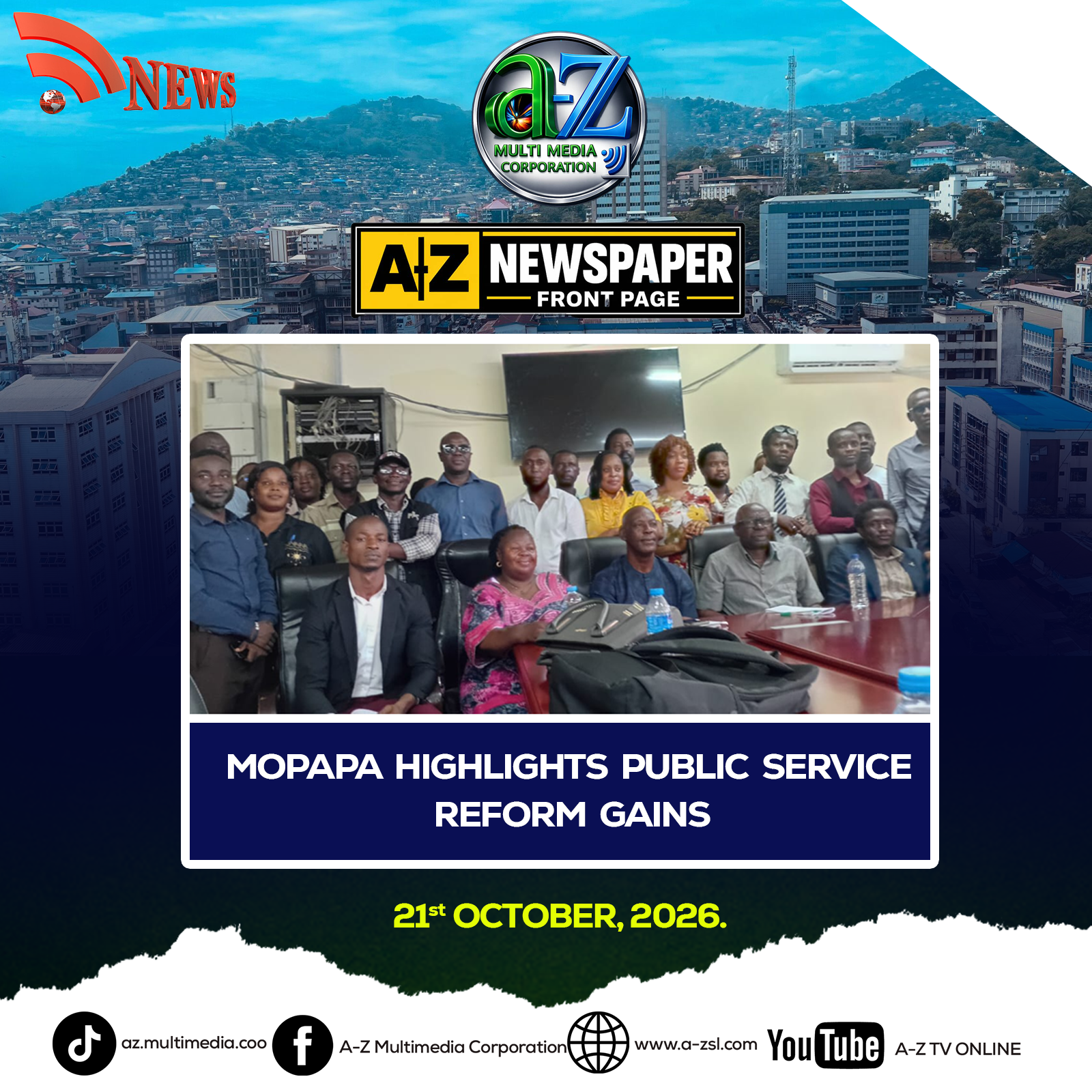
The Ministry of Public Administration and Political Affairs (MOPAPA) has highlighted key achievements, ongoing initiatives and challenges in its efforts to transform Sierra Leone’s public service under the government’s Medium-Term National Development Plan.
Deputy Minister of Public Administration and Political Affairs, Hon. Philip Tondoneh, made this disclosure during a press conference held on Monday, 19 October 2026, at the Ministry’s conference room at Youyi Building in Freetown.
He said the Ministry had made significant progress in strengthening public administration, improving civil service efficiency and building institutional capacity since its establishment in 2023. However, he acknowledged that longstanding institutional and professional challenges continued to affect the effective delivery of public services.
According to Tondoneh, the reform process began with a multi-stakeholder engagement in November 2023, bringing together international partners, including the African Peer Review Mechanism (APRM), and experts from countries such as Egypt and South Africa. The engagement provided an opportunity for Sierra Leone to learn from international best practices and identify administrative models that could inform its reform agenda.
He explained that the Ministry subsequently developed eight strategic pillars to guide public service transformation from 2024 to 2030. It has also continued to engage development partners, including the European Union (EU), the United Nations Development Programme (UNDP), the Japan International Cooperation Agency (JICA) and the Government of India, to mobilize technical and financial support for implementing its reform priorities.
Tondoneh stressed that strengthening the capacity of public officers remained essential to achieving the government’s development objectives.
He identified institutional rigidities, limited career progression, overlapping policies and concerns about tribalism, regionalism and nepotism in recruitment, promotion and career advancement as some of the persistent challenges confronting the civil service.
He warned that these challenges could undermine staff motivation, professional development and the effective functioning of public institutions.
The Deputy Minister also highlighted gaps in digital literacy and professional skills, noting that some graduates entered the public service without the technological competencies required in a modern working environment.
He said the reforms were intended to address these shortcomings through professional training, improved digital skills and clearer career development pathways.
Drawing lessons from countries such as Kenya, Egypt and South Africa, Tondoneh emphasised the need for structured professional development systems that would promote specialization, continuous learning and career advancement among public officers.
Tondoneh highlighted efforts to strengthen the former Civil Service Training College, now known as the Public Service Academy, as part of the broader public service reform agenda.
He explained that the transformation was intended to expand the institution’s mandate beyond the traditional civil service and provide training tailored to the needs of the wider public service.
He expressed optimism that the Academy would develop sustainable training programmes with broader participation from government institutions and the private sector.
The Deputy Minister also highlighted capacity-building opportunities for Sierra Leonean public officers in countries such as Japan and India. He said the Ministry was working to improve coordination to ensure that knowledge gained through international training translated into practical improvements within government institutions.
He noted that an effective public service was essential to the functioning of government institutions, including the military and the police, making administrative efficiency and accountability critical to national development.
On constitutional reform, Tondoneh said the Ministry was working to strengthen the legal and institutional framework governing public service administration.
He observed that the 1991 Constitution contained limited provisions addressing the broader requirements of a modern public service, with particular emphasis on the Public Service Commission’s responsibilities for recruitment, promotion and dismissal.
He said the ongoing constitutional review process presented an opportunity to address these gaps and establish a more comprehensive framework for public service administration.
According to him, relevant committees and institutions, including those responsible for human resource management and the Cabinet Secretariat, had contributed to efforts to give public service administration greater attention in the review process.
He described these efforts as essential to strengthening institutional accountability, professional standards and the overall administrative structure of the civil service.
Meanwhile, Vandi Gamanga of the European Union Programme Coordination Unit commended the Ministry for its commitment to implementing public service reforms supported under the EU-funded MACO Programme.
Gamanga said MOPAPA had demonstrated commitment to advancing the government’s public administration reform agenda through its participation in programme coordination, planning and implementation.
He explained that the Ministry had been assigned specific responsibilities under the national programme alongside the Public Service Commission (PSC) and other relevant institutions.
He particularly acknowledged the Ministry’s collaboration with the Human Resource Management Office (HRMO), the Permanent Secretary and other stakeholders in implementing activities aimed at strengthening institutional capacity and improving public service delivery.
However, Gamanga stressed the need to complete outstanding activities, properly document deliverables and establish mechanisms to sustain the reforms beyond the programme’s implementation period.
He urged the Ministry to address remaining implementation gaps promptly, noting that timely completion was essential as the programme approached its deadline.
He also recognized the contributions of the Ministry’s leadership and technical team, including Director Momoh, Mr. Sillah and Florence, in supporting implementation.
Gamanga reaffirmed the Programme Coordination Unit’s satisfaction with the Ministry’s participation and progress, describing the engagement as the Ministry’s final activity under the public service reform process supported by the programme.
He expressed confidence that the outstanding activities would be completed and thanked stakeholders for their continued support.
Earlier, the Ministry’s Director of Public Administration, Momoh Conteh, outlined the institutional changes that led to the establishment of MOPAPA and explained the strategic framework guiding its reform activities.
Conteh said President Julius Maada Bio considered it necessary in 2023 to establish a ministry specifically responsible for overseeing and coordinating the public service. This led to the transformation of the Ministry of Political and Public Affairs into the Ministry of Public Administration and Political Affairs.
He explained that the decision was intended to create a central institution responsible for coordinating public service institutions and leading the transformation of the country’s administrative system.
Citing South Africa, Kenya and Uganda as examples, Conteh said several countries had established dedicated ministries to oversee public service administration.
He noted that MOPAPA’s mandate aligned with the fifth of the President’s five Big Game Changers under the Medium-Term National Development Plan, which focuses on transforming the public service architecture.
Following consultations with key public sector institutions, the Ministry developed the Strategic Roadmap for the Transformation of the Public Service, covering 2024 to 2030.
Conteh identified six key institutions working closely with the Ministry to implement the reform agenda: the Public Service Commission, Cabinet Secretariat, Human Resource Management Office, Public Sector Reform Unit, Wages and Compensation Commission, and the Public Service Academy.
He said the roadmap’s eight pillars covered structural alignment and rationalization of mandates; human resource management and manpower planning; public sector coordination and management; monitoring, evaluation and performance management; governance and modernization; pay and incentives; gender inclusion and women’s empowerment; and citizen engagement.
According to him, the pillars were designed to address critical areas of public administration, align institutional responsibilities with national development priorities and improve the overall effectiveness of public service delivery.
Providing details of the Ministry’s activities under the EU-supported project, Conteh said several initiatives had been undertaken to strengthen institutional capacity and advance implementation of the strategic roadmap.
He disclosed that the Ministry had conducted an institutional assessment and developed terms of reference for staff positions to ensure that roles and responsibilities aligned with its mandate.
He also identified curriculum development for the Public Service Academy as a key component of the reform process.
Conteh explained that the expansion of the former Civil Service Training College into the Public Service Academy required a new curriculum capable of meeting the training needs of the wider public service.
He noted that on 23 June 2026, the Chief Minister, on behalf of the President, announced the institution’s change of name.
He said the new curriculum was intended to reflect the Academy’s broader mandate and prepare public officers for the evolving demands of modern governance.
The Director also highlighted stakeholder consultations conducted across the regions to gather views and recommendations on the proposed reforms.
He said the Ministry believed public service transformation should not be designed solely within government offices but should incorporate the experiences and concerns of public officers and other stakeholders across the country.
According to Conteh, the consultations sought contributions on how to achieve the 19 policy targets and actions under the Medium-Term National Development Plan, as well as the 21 targets and actions contained in the strategic roadmap.
He said the consultations also informed curriculum development and helped identify measures needed to achieve the government’s public service transformation objectives by 2030.
Conteh further disclosed that the Ministry had conducted monitoring and evaluation exercises through its Monitoring and Evaluation Directorate to track implementation, assess progress and identify areas requiring additional attention.
He stressed that citizen engagement remained a critical pillar of the reform agenda, as public understanding and participation were necessary to promote transparency, accountability and effective service delivery.
In his closing remarks, Tondoneh expressed appreciation to the European Union and other development partners for their continued support for institutional reform, capacity building and public administration development in Sierra Leone.
He called on the partners to sustain their support to ensure that the reforms produced lasting results.
The Deputy Minister also underscored the importance of citizen engagement within the Ministry’s political affairs mandate, encouraging civil society organizations, the media and members of the public to participate constructively in discussions on governance and public service delivery.
He described the media as an important partner in informing citizens about government initiatives and promoting accountability through accurate and responsible reporting.
Tondoneh concluded by reaffirming the Ministry’s commitment to building a professional, efficient, accountable and resilient public service capable of supporting Sierra Leone’s national development priorities.