

By: Mohamed Sahr
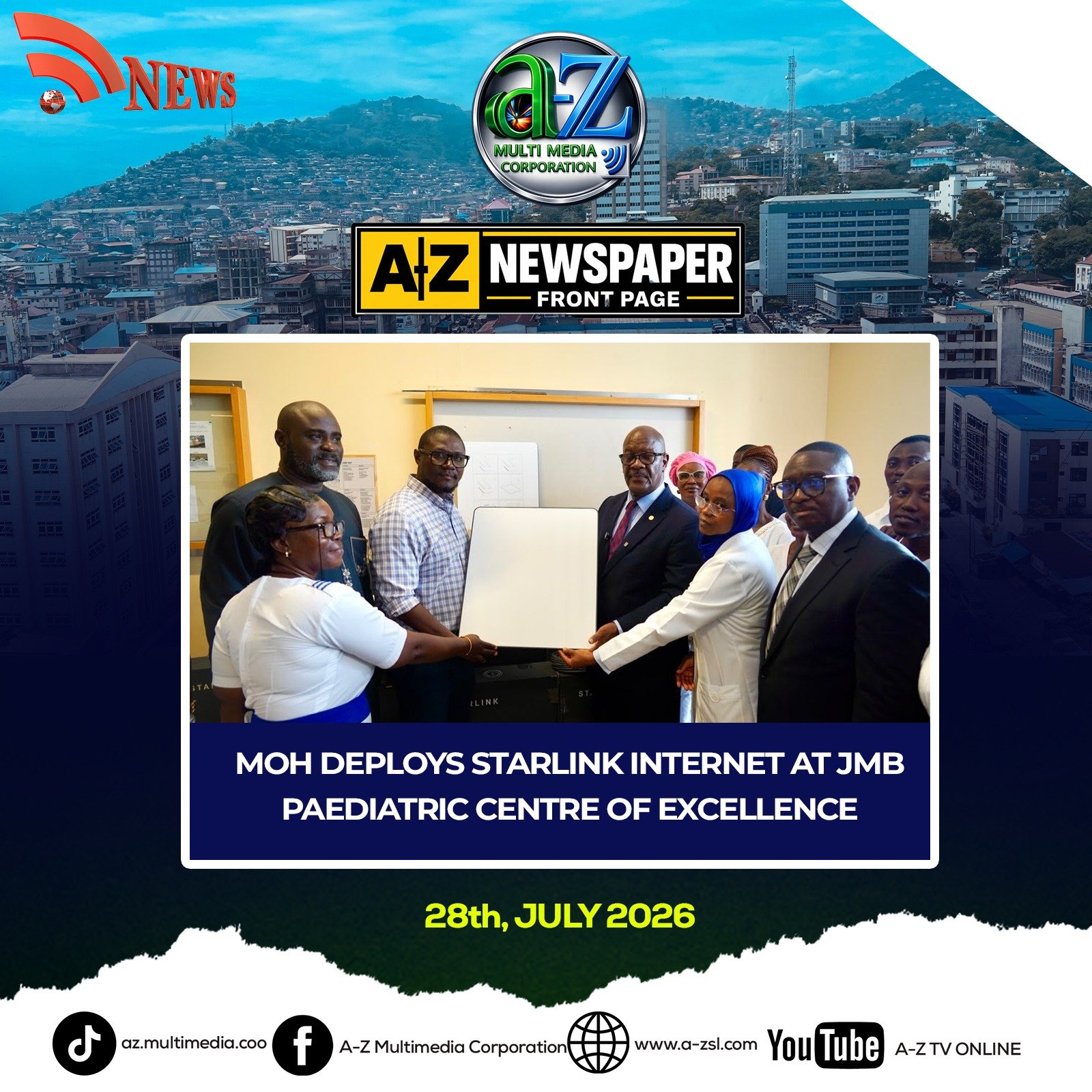
The Ministry of Health has introduced Starlink satellite internet connectivity at the Julius Maada Bio Paediatric Centre of Excellence in Freetown as part of efforts to improve healthcare delivery, strengthen medical collaboration, and enhance the use of technology in the health sector.
The facility received the Starlink equipment on Monday, 27 July 2026, in a move expected to address longstanding challenges associated with poor internet connectivity, electronic medical records, telemedicine, and professional training.
Speaking at the handover ceremony, Minister of Health Dr. Austin Demby said the initiative would help bridge a critical digital gap within Sierra Leone’s healthcare system by enabling health professionals to access, analyze, and act on real-time information.
He explained that the technology represents a major step towards achieving “data for action,” where healthcare decisions are guided by accurate and timely information.
“The exciting part is that technology provides information as close to real time as possible. When information is available quickly, decision-makers can respond quickly,” Dr. Demby said.
According to the Health Minister, improved connectivity will allow doctors to prepare better before patients arrive at the hospital, ensuring that appropriate treatment and resources are available in advance.
He added that the system would also expand opportunities for healthcare workers in Sierra Leone to connect with medical experts across the world, including specialists in countries such as the United States, Australia, and India.
The Julius Maada Bio Paediatric Centre of Excellence, being the country’s first new paediatric centre of excellence, will use the platform to support medical training, case discussions, and knowledge sharing with other hospitals and health institutions.
Dr. Demby noted that modern technology now makes it possible for complex medical procedures to be shared remotely for educational purposes while protecting patient privacy. Young doctors and trainees will be able to observe procedures virtually and gain practical knowledge from specialists around the world.
He highlighted the difference between traditional internet services and Starlink technology, noting that previous providers offered speeds of about 5, 10, or 20 megabytes per second, while Starlink can provide speeds exceeding 300 megabytes per second.
This improved capacity will enable high-quality video conferencing, live streaming, telemedicine services, and faster communication between hospitals.
“For the first time, we can establish reliable video communication between hospitals. Previously, communication was mainly through phone calls, which only provided limited information. Now, doctors can share images, medical data, and real-time information to improve decision-making,” he said.
The Minister explained that satellite technology will reduce dependence on traditional underground cable networks and expand reliable connectivity to health facilities across the country.
The project is a government-led initiative implemented in partnership with Starlink and its local representative, Malado Group. Dr. Demby said the partnership began with pilot testing in selected locations before plans were made to expand the service to district-level facilities.
He revealed that Starlink representatives visited Sierra Leone during the United Nations General Assembly and expressed interest in supporting the country’s development vision, particularly in the health sector.
The initial plan is to extend the programme to about 300 health facilities after assessing the success of the pilot phase. Dr. Demby stressed that the value of the technology would depend on how effectively healthcare workers use it.
“Technology is only a tool. You can have the best hammer in the world, but if it is placed in the wrong hands, it can cause damage instead of solving problems,” he said.
He emphasized that the introduction of Starlink would be accompanied by training, monitoring, technical support, and proper oversight to ensure healthcare workers have the skills needed to maximize its benefits.
The Minister also highlighted the importance of transparency and accountability, noting that the system would allow health authorities to better understand what is happening across healthcare facilities without relying solely on reports from district officials.
“We are not only measuring processes; we are focusing on results. We want to see improvements in the health of our people,” Dr. Demby stated.
He said Sierra Leone’s innovations in healthcare are attracting attention across Africa and beyond, adding that successful initiatives could provide valuable lessons for other countries.
Dr. Ayeshatu Mustapha, Medical Superintendent of the Julius Maada Bio Paediatric Centre of Excellence, said the hospital had previously struggled to sustain electronic medical records due to unreliable internet connectivity.
“We had started implementing electronic medical records, but we were unable to sustain the system because we did not have reliable internet access,” she explained.
She noted that electronic medical records have several benefits, including faster communication, improved coordination among departments, reduced costs, and better management of patient information.
With improved connectivity, Dr. Mustapha said the hospital would be able to fully establish the system, allowing departments such as laboratories, radiology units, and pharmacies to communicate electronically and respond faster to patient needs.
She explained that the technology would also improve referral services.
“When another hospital wants to refer a critically ill child to us, they can contact us before sending the patient. They can explain the child’s condition, and while the ambulance is on the way, we can advise them on what steps to take and prepare ourselves to receive the patient,” she said.
She added that healthcare workers in other districts would also be able to receive guidance on managing difficult cases before patients are transferred.
According to Dr. Mustapha, this could reduce risks associated with transporting critically ill children over long distances, especially where poor road conditions may worsen their condition.
The system will also allow Sierra Leonean healthcare workers to connect with international specialists who can provide support in managing complex cases.
She expressed optimism that the technology would improve service delivery at the hospital and benefit students and medical trainees by enabling access to research materials, virtual conferences, and global learning opportunities.
Kadijatu Jalloh, Nurse-in-Charge of the Emergency Unit, said the introduction of improved connectivity would help address challenges previously experienced with patient record management.
She explained that before the introduction of electronic systems, patients’ information was recorded manually. When patients returned to the hospital, locating their previous medical charts was often difficult, forcing healthcare workers to create new records.
This resulted in duplication of records and difficulties in tracking patients’ medical histories.
She said the improved system would help strengthen patient data management by making medical records easier to access, improving continuity of care and ensuring healthcare workers have accurate information when treating returning patients.
The introduction of Starlink at the Julius Maada Bio Paediatric Centre of Excellence marks a significant step towards building a more connected, data-driven, and efficient healthcare system in Sierra Leone.