

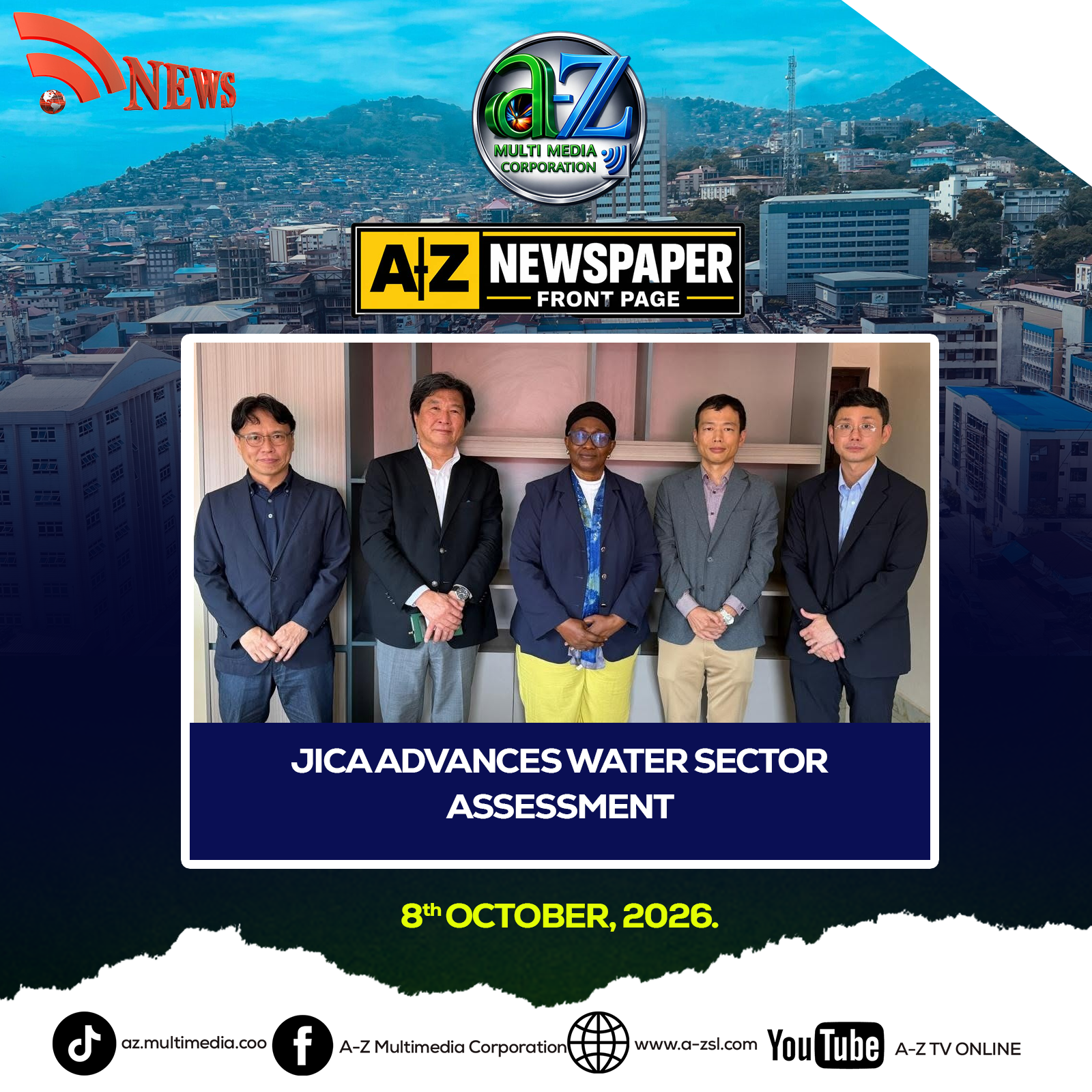
The Japan International Cooperation Agency (JICA) has commenced a follow-up technical assessment of Sierra Leone’s water sector to identify priority areas for renewed cooperation and support.
The follow-up engagement was held on Wednesday with the Minister of Water Resources and Sanitation, Dr. Sao-Kpato Hannah Isatta Macarthy, as JICA continues discussions on strengthening Sierra Leone’s water, sanitation and hygiene (WASH) sector.
The latest mission follows strategic discussions held on 20 August 2026 between the Ministry and senior JICA officials, during which the agency expressed renewed interest in supporting Sierra Leone’s WASH sector after more than a decade of limited engagement.
The August meeting brought together the Minister and senior Ministry officials with JICA Chief Representative for Ghana, Uchiyama Takayuki; JICA Sierra Leone Resident Representative, Satoru Matsuyama; and Project Formation Advisor, Ken Awano.
The discussions focused on potential areas of cooperation, including technical assistance, institutional capacity building, technology transfer, private-sector participation and future investment.
During Wednesday’s follow-up engagement, the JICA delegation said it had procured the services of a Japanese consultant and was deploying WASH experts to work with the Ministry to identify priority areas for intervention.
The delegation said it would undertake a detailed assessment of the sector, including existing challenges and opportunities for technology and knowledge transfer.
Welcoming the team, Minister Macarthy highlighted the scale and complexity of Sierra Leone’s water challenges, including gaps in access, pressure on water sources and the need for stronger management of surface and groundwater resources.
She also raised concerns about the impact of mining activities on water sources and stressed the importance of effectively managing transboundary water resources shared with neighbouring countries.
The Minister said the Government was interested not only in acquiring infrastructure but also in ensuring that interventions were sustainable and that communities had the capacity to manage and maintain appropriate technologies.
“We have to be informed to make decisions,” she said, emphasizing the importance of evidence and technical knowledge in guiding future interventions.
She added that the assessment would help the Ministry and JICA determine practical areas in which both sides could collaborate.
Dr. Macarthy further stressed that a key priority of the Government under President Julius Maada Bio was to ensure that engagements of this nature result in lasting institutional capacity rather than short-term technical support.
She said designated Ministry officials would work alongside the JICA experts to ensure that knowledge and skills gained from the engagement are retained locally.
“By the time this is over, we would have transferred knowledge from your team to my team,” she said, underscoring the importance of knowledge transfer and institutional ownership.
The Ministry assured the delegation that relevant technical directorates and agencies would be involved in the assessment, while the JICA experts would use the findings to identify potential areas for technical cooperation, technology application and future project development.
The follow-up mission marks a continuation of the August discussions, moving the proposed JICA-Sierra Leone partnership from the initial identification of opportunities towards a detailed assessment of the country’s water-sector priorities and the practical support that could be provided.