

By: Saidu Jalloh
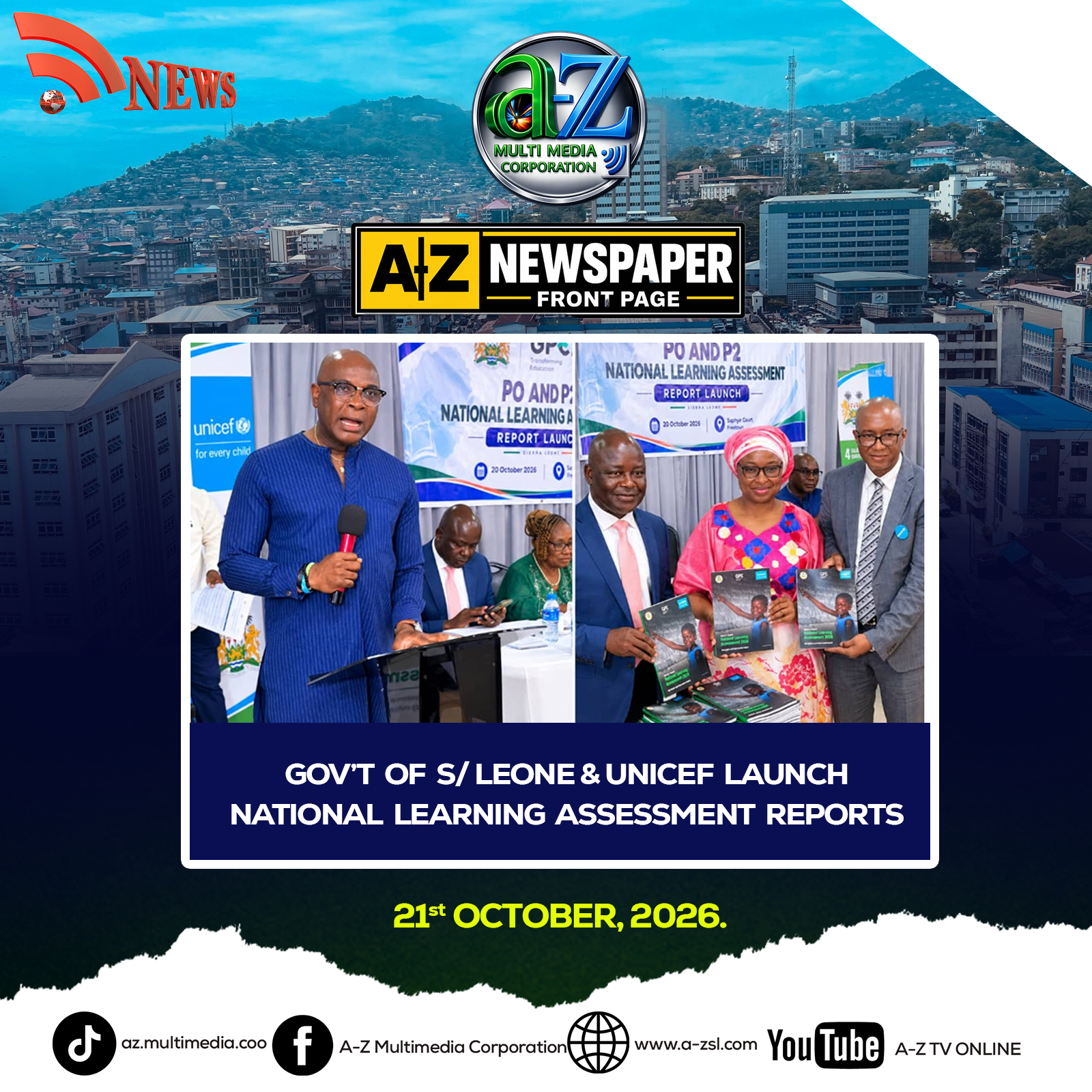
The Government of Sierra Leone, in collaboration with the United Nations Children’s Fund (UNICEF), has launched the country’s Primary 0 (P0) and Primary 2 (P2) National Learning Assessment Reports to strengthen evidence-based decision-making and improve learning outcomes for children across the country.
The reports were launched at Spring Innovation Hall, off Kinghaman Road, Freetown, on Tuesday, 20 October 2026, bringing together government officials, education stakeholders, development partners, civil society representatives and teachers to discuss the state of foundational learning in Sierra Leone.
Delivering the keynote address, Minister of Basic and Senior Secondary Education, Conrad Sackey, emphasised that school attendance alone does not guarantee learning, stressing the need for the education sector to ensure that every child acquires essential skills from an early age.
He highlighted reading and numeracy as critical foundations for children’s future academic success, warning that pupils who struggle to develop these skills in the early grades may encounter difficulties understanding other subjects as they progress through school.
Sackey explained that the national assessment was conducted with support from UNICEF and the Global Partnership for Education, alongside technical assistance from Australia. He clarified that the exercise was not intended to fail or punish children but to identify learning gaps and guide improvements in teaching and learning.
He called for practical interventions, including improved teaching guidance and appropriate learning materials, to ensure that children receive quality education.
Meanwhile, Alpha Cisse, UNICEF Deputy Representative for Operations, said the assessments marked an important step towards ensuring that every child in Sierra Leone not only attends school but also learns and succeeds.
Cisse explained that the P0 assessment provides a nationally representative picture of children’s development and readiness as they begin primary school, while the P2 assessment measures how well pupils acquire foundational literacy and numeracy skills after completing Grade 2.
He said the reports establish a baseline for understanding children’s learning and development, enabling stakeholders to identify areas of progress, persistent challenges and where investments and interventions are most needed.
According to Cisse, the findings will also help the country track learning progress over time and determine whether education policies and interventions are producing better outcomes. He added that the P2 assessment would contribute to monitoring Sierra Leone’s progress towards Sustainable Development Goal 4, which focuses on inclusive and equitable quality education.
Emphasizing the importance of translating evidence into action, Cisse said the true value of the assessments would depend on how the findings are used to strengthen policies, improve teaching practices and allocate resources effectively.
“Evidence alone does not change children’s lives. Action does,” he stressed, urging stakeholders to use the findings to ensure that every child has the opportunity to reach their full potential.
Cisse reaffirmed UNICEF’s commitment to supporting the Government-led initiative, with funding from the Global Partnership for Education. He also expressed appreciation to teachers, head teachers, caregivers, assessment teams and the children who participated in the exercise.
He urged stakeholders to use the findings to accelerate progress so that more children are ready for school, more pupils read with confidence, and more learners master foundational numeracy skills.
The launch of the reports provides an important evidence base for strengthening Sierra Leone’s education system, with stakeholders expected to use the findings to improve learning outcomes and ensure that children acquire the foundational skills needed for future success.