

By: Saidu Jalloh
The Government of Sierra Leone’s flagship Free Quality School Education (FQSE) program has successfully delivered on all five of its core commitments, according to Augustine Moses Koroma, National Program Coordinator.
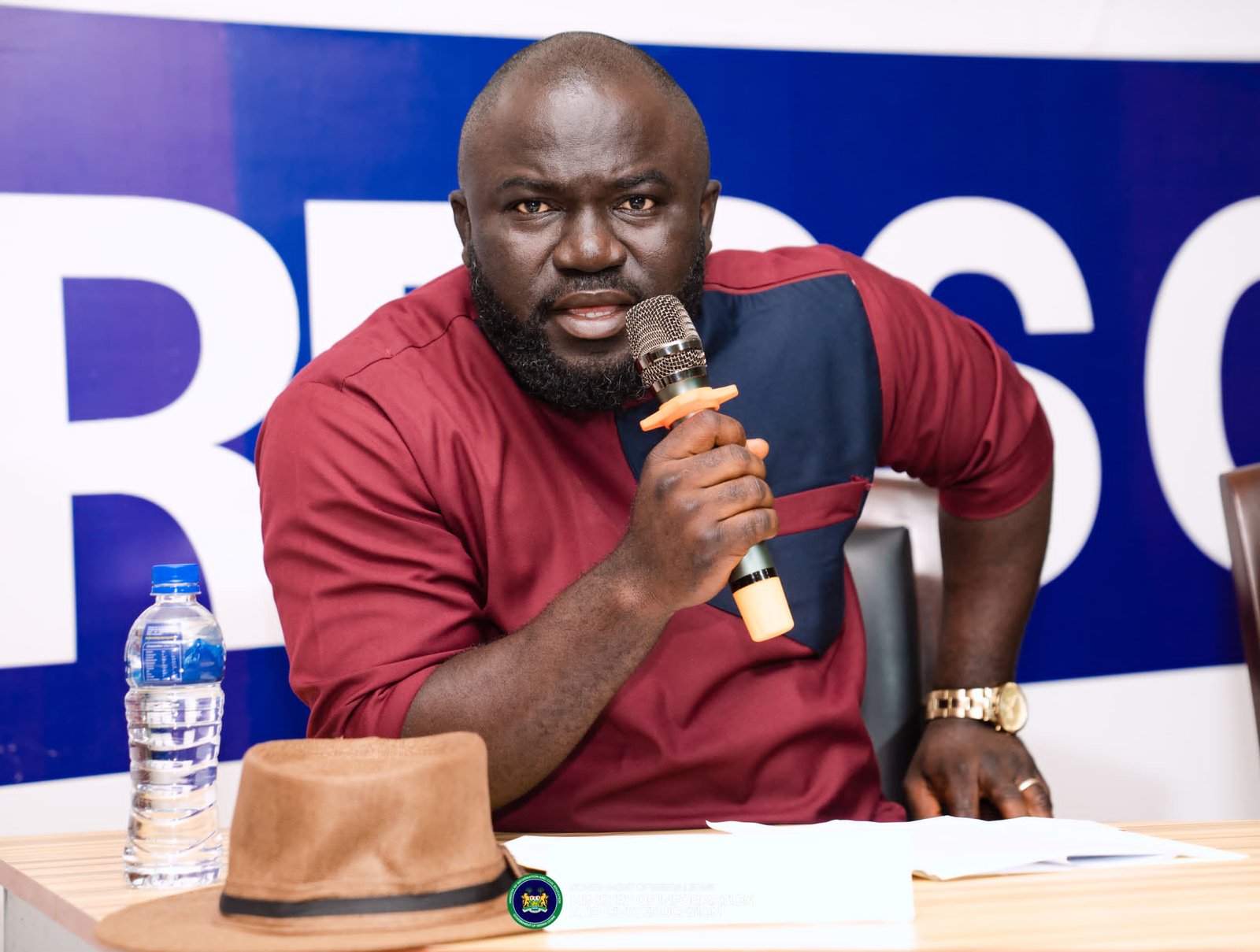
He made the announcement during the Ministry of Information and Civic Education’s weekly press conference held in Freetown on Tuesday, September 2, 2025.
Koroma stated that since the program’s launch in 2018, the government has consistently fulfilled its promises to cover school fees for pupils in public and government-assisted schools, pay for public examination fees, provide core textbooks, supply teaching and learning materials and expand the school feeding program “These commitments have not only been fulfilled but are transforming Sierra Leone’s education sector,” Koroma said.
Among the program’s most notable achievements over the past seven years, 3,000 schools approved. 12,000 teachers recruited, 94 containers of learning materials distributed, 538 primary schools built or renovated, 367 school expansion projects completed to reduce overcrowding.
Enrollment rates have risen dramatically from 37% to 85% while retention rates now stand at 129%. Additionally, teacher salaries have increased by 40%. Koroma also highlighted key education policies contributing to this progress, including the Radical Inclusion Policy, the School Catchment Policy, the Integrated Early Childhood Development Policy. These reforms aim to ensure that no child is left behind, regardless of gender, ability, or socio-economic background.
Mariama Khai Fornah, CEO and Founder of Moving Women for Sustainable Development Sierra Leone, praised the government for its tangible achievements, especially in promoting girls’ education. “More girls are in school today than ever before, and they are excelling in public examinations,” Fornah noted.
She credited the increase in female enrollment to strategic government policies such as the construction of new schools, the Radical Inclusion framework, and the nationwide school feeding program.
“These gains reflect a major step forward in gender equality and national development,” she added. The combined perspectives from government and civil society underscore that the FQSE program is not only expanding access to education but also building a foundation for long-term human capital development in Sierra Leone.