

By: Mamajah Jalloh
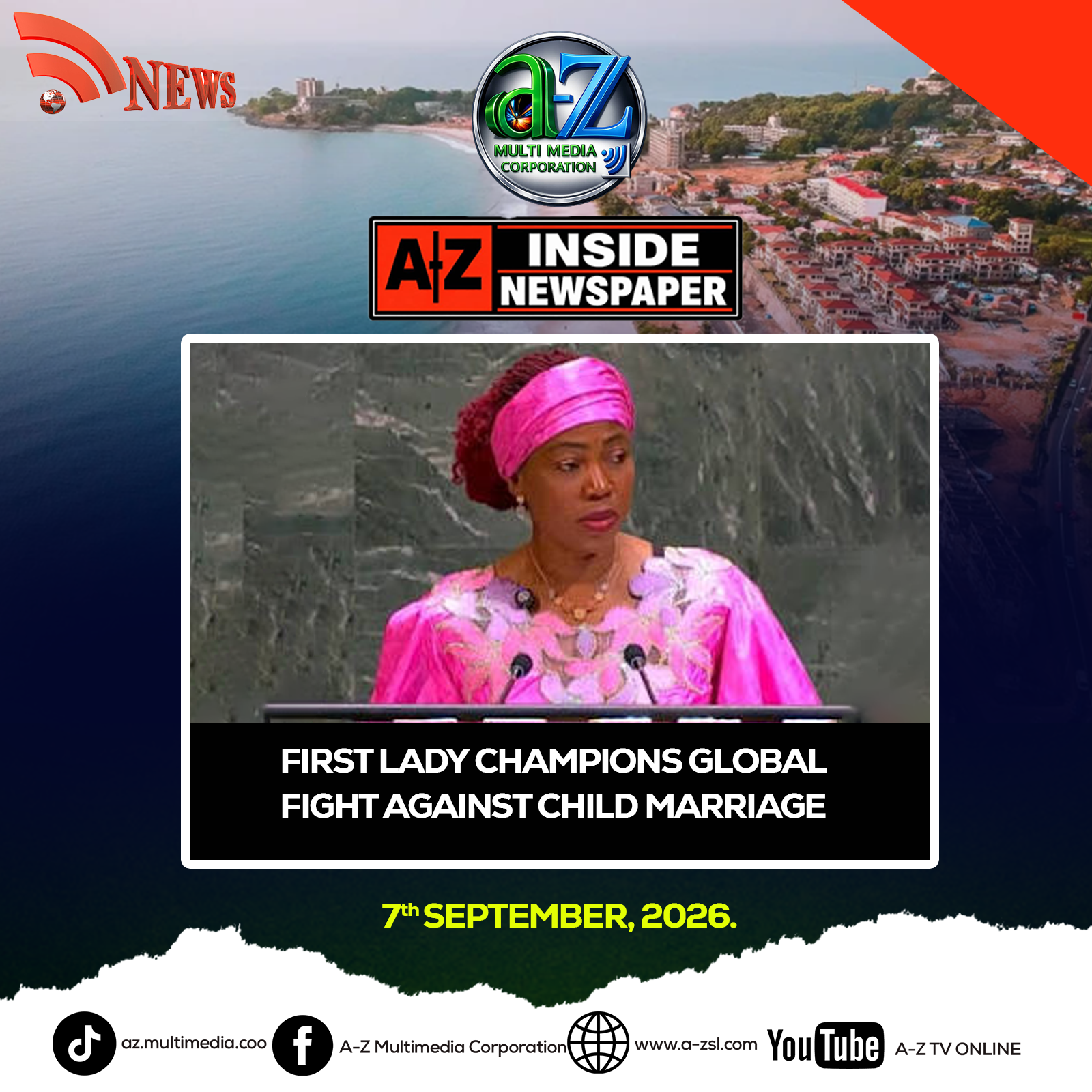
The First Lady of Sierra Leone and President of the Organization of African First Ladies for Development (OAFLAD), H.E. Dr. Fatima Jabbie Bio, has championed a landmark resolution at the United Nations General Assembly calling for an end to child, early and forced marriage.
The resolution was adopted by consensus by all 193 UN Member States on Friday, September 4, 2026, in New York, marking a significant milestone in the global campaign to protect girls from child marriage and safeguard their rights, dignity, education and future.
As part of the resolution, November 27 has been designated as the International Day for the Elimination of Child, Early and Forced Marriage.
The adoption provides an annual international platform for governments, civil society organizations, communities and development partners to strengthen awareness, prevention, protection and action against child, early and forced marriage.
Speaking at the UN General Assembly, First Lady Fatima Bio drew from her personal experience of narrowly escaping early marriage as a child.
She recalled how adults once decided that it was time for her to be married, describing the fear of having her childhood taken away before she had the opportunity to fully live it. She said refusing the marriage forced her to leave her home, family and country in order to pursue a future of her own.
“Early marriage is a journey I know from my own life experience, one which I was fortunate to survive. Today, with my voice, I carry the hopes of millions of children, so that the girl child may be spared what so many have endured,” she stated.
Dr. Bio said the adoption of the resolution was not merely a diplomatic achievement but a deeply personal moment, adding that the world had finally responded to the girl she once was and to millions of girls who continue to live in fear of forced marriage.
She stressed that child marriage should not be defended as culture or tradition, but recognized as a violation of children’s rights.
“Child marriage is not culture. It is a crime. It is not a tradition, but a theft of childhood, the right to education, dignity and the right to decide one’s own life,” she stated.
The First Lady further noted that forcing a girl into marriage takes away more than her childhood, as it also limits her choices, opportunities and ability to contribute to society.
“When a girl is forced into marriage, we do not only take away her childhood, we take away her choices, her opportunities, and too often, the future she could have helped build,” she stated.
Dr. Bio described the resolution as a permanent platform for countries to renew their commitment, strengthen accountability, share best practices and invest in programmes that protect girls from child marriage.
She also emphasized that ending child marriage is not only a human rights obligation but an investment in human potential, families, economies and communities.
“A day alone cannot end child marriage, but political attention can. Strong laws can. Effective institutions can. Education can. Economic opportunities can. And sustained political will can,” she stated.
She described the resolution as more than a symbolic declaration, calling it a global mandate for action and reaffirming the responsibility of governments, leaders and advocates to ensure that every girl is free to dream, learn and thrive without being forced into marriage.
Dr. Bio concluded her address with a direct message to girls around the world.
“You are not alone, you are not forgotten, and your future is yours to write. Let girls grow. Let girls learn. Let girls choose.”
The First Lady also thanked her husband, President Julius Maada Bio, whom she described as “the pillar I graciously stand on,” as well as African First Ladies through OAFLAD and grassroots organizations that have supported the campaign.
The achievement follows years of collaboration among African First Ladies, grassroots organizations and global child-rights advocates, including Just Rights for Children and its founder, Bhuwan Ribhu.
The resolution’s adoption marks a major international step in addressing child, early and forced marriage, a practice that continues to affect millions of girls worldwide, particularly in developing countries.
According to UNICEF, more than 650 million women alive today were married as children, while approximately 12 million girls under the age of 18 are married each year.