

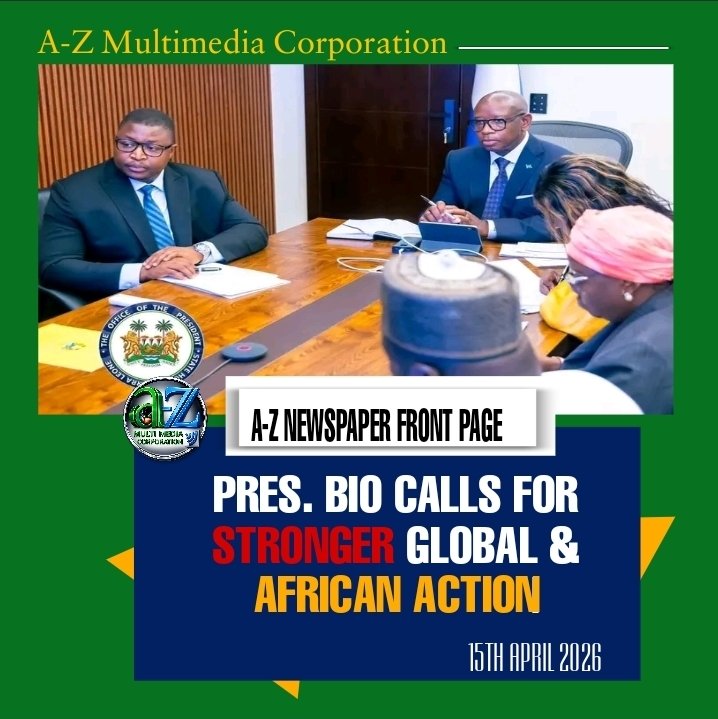
Minister of Finance, Sheku Ahmed Fantamadi Bangura, has presented an update on the country’s economic progress and macroeconomic stability to the International Monetary Fund (IMF), the World Bank Group, and global economists at the 2026 IMF World Bank Spring Meetings in Washington, D.C.
During his engagements, the Minister outlined key reforms in public financial management, including the revision of the Public Financial Management Act (2016) and the Public Procurement Act (2016), as well as improvements in cash management, forecasting systems, and the transition to Government Finance Statistics (2014).
The five-day meetings, held from 13 to 18 April 2026, bring together Finance Ministers, Central Bank Governors, development partners, global investors, civil society representatives, and academics to deliberate on global economic policy issues, including growth prospects, financial stability, and poverty reduction.
Representing His Excellency President Julius Maada Bio and leading Sierra Leone’s delegation, Minister Bangura commended the IMF’s Fiscal Affairs Department (FAD) for its continued technical assistance in strengthening the country’s public financial management systems.
He noted that, under President Bio’s leadership, the Government has implemented sound economic policies over the past two years, yielding strong macroeconomic outcomes. These include low inflation, a stable exchange rate, a positive primary balance, and sustainable interest rates on government securities.
The Minister further appealed for continued IMF support, particularly in building capacity within the mining sector. Priority areas highlighted include transfer pricing, implementation of advance pricing agreements and safe harbour regimes, review of the Income Tax Act (2000) and the Excise Act (1998), and the mid-term review of the Medium-Term Revenue Strategy (2023-2027).
In response, the Director of the IMF’s Fiscal Affairs Department, Rodrigo Valdés, commended Minister Bangura for his leadership in advancing public financial management reforms in Sierra Leone. He reaffirmed the IMF’s commitment to continued collaboration and assured the Government of careful consideration of its requests.
In a separate engagement with the IMF Country Team, discussions focused on recent economic developments and the potential impact of the Middle East crisis on Sierra Leone’s economy. Minister Bangura informed the IMF Mission Chief, Christian Saborowski, that the geopolitical crisis has necessitated adjustments to the existing framework under the Extended Credit Facility (ECF) arrangement.
Mr. Saborowski acknowledged the challenges facing developing countries and noted the potential adverse effects of the crisis on food security and poverty levels. He reiterated the IMF’s awareness of these pressures and its continued engagement with affected countries.
Additionally, Minister Bangura met with Dr. Zarau W. Kibwe, Executive Director for the Africa West I Constituency at the World Bank Group. Discussions centred on potential support mechanisms for developing countries to mitigate the impact of the ongoing global crisis.
The Minister highlighted that Sierra Leone’s World Bank portfolio remains strong and disclosed that discussions are ongoing to utilise the Rapid Response Option (RRO) to help cushion the economic effects of the Middle East crisis.