

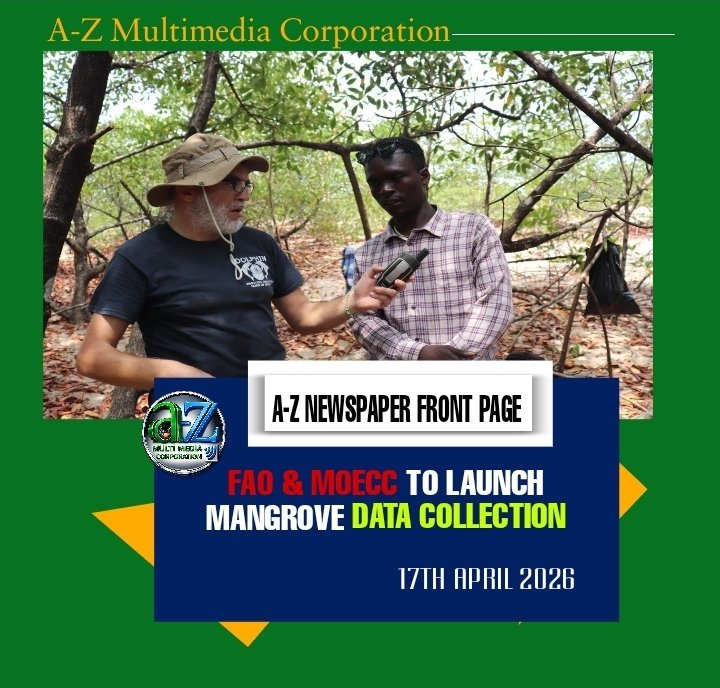
The Ministry of Environment and Climate Change (MOECC), with funding support from the European Union (EU) and technical assistance from the Food and Agriculture Organization (FAO), is set to roll out a mangrove data collection exercise across the Western Area, as well as parts of the North-East and Southern Regions. This initiative forms part of Sierra Leone’s National Forest Inventory (NFI) Programme.
The project, titled “Support to Sustainable Forestry in Sierra Leone,” is a collaborative effort aimed at contributing to the country’s achievement of the Sustainable Development Goals (SDGs) and FAO’s Country Programming Framework. It seeks to enhance the availability and quality of data on forests and land-use changes at both national and sub-national levels.
Data generated through the project will support evidence-based policymaking, strengthen sustainable forest resource management, and improve Sierra Leone’s capacity to monitor forest cover dynamics and environmental changes.
As part of preparations for the mangrove data collection, the Ministry, in collaboration with FAO, conducted a five-day specialized training from 13th to 17th April 2026. The training focused on equipping participants with the knowledge and skills needed to understand mangrove ecosystems, organize fieldwork under challenging site conditions, correctly apply mangrove-specific cluster and plot procedures, and carry out measurements safely and consistently.
According to Madam Kate Karemo-Garnett, Director of Forestry, the training was designed to prepare Sierra Leone’s NFI teams for the upcoming mangrove inventory campaign by addressing its unique technical and operational requirements. She noted that the training would enhance participants’ understanding of mangrove-specific inventory methods, improve field readiness, and ensure accurate, safe, and consistent data collection.
During the sessions, NFI international experts Anibal Cuchietti, Falgoonee Kumar Mondal, and Salis Antonello alongside national expert Dr. Anthony Lamine-Samu, emphasized the importance of accurate data collection, stressing that the results of the NFI exercise would play a critical role in shaping national policy decisions.
The training also covered key technical areas, including mangrove inventory design and field setup. Participants explored differences between mangrove/swamp and upland clusters, line clusters versus L-shaped layouts, plot design, sub-plot structures, diameter at breast height (DBH) thresholds, and relevant procedural guidelines.
In addition, practical sessions focused on field measurement techniques and safety considerations. Topics included plot establishment in waterlogged environments, handling difficult tree stems, ensuring consistent DBH measurements, addressing species identification challenges, observing safety precautions, understanding tidal influences, and adhering to key operational dos and don’ts.
Following the training, the Ministry of Environment and Climate Change is expected to deploy trained data collectors to mangrove areas to carry out field data collection as part of the National Forest Inventory.