

By: Mamajah Jalloh
The Electoral Commission for Sierra Leone (ECSL) has launched a Training of Trainers (ToT) workshop for the country’s new Bachelor of Science (BSc) in Political and Electoral Studies, marking what Chief Electoral Commissioner and ECSL Chairman, Commissioner Edmond Sylvester Alpha, described as “a decisive shift from recommendation to reality.”
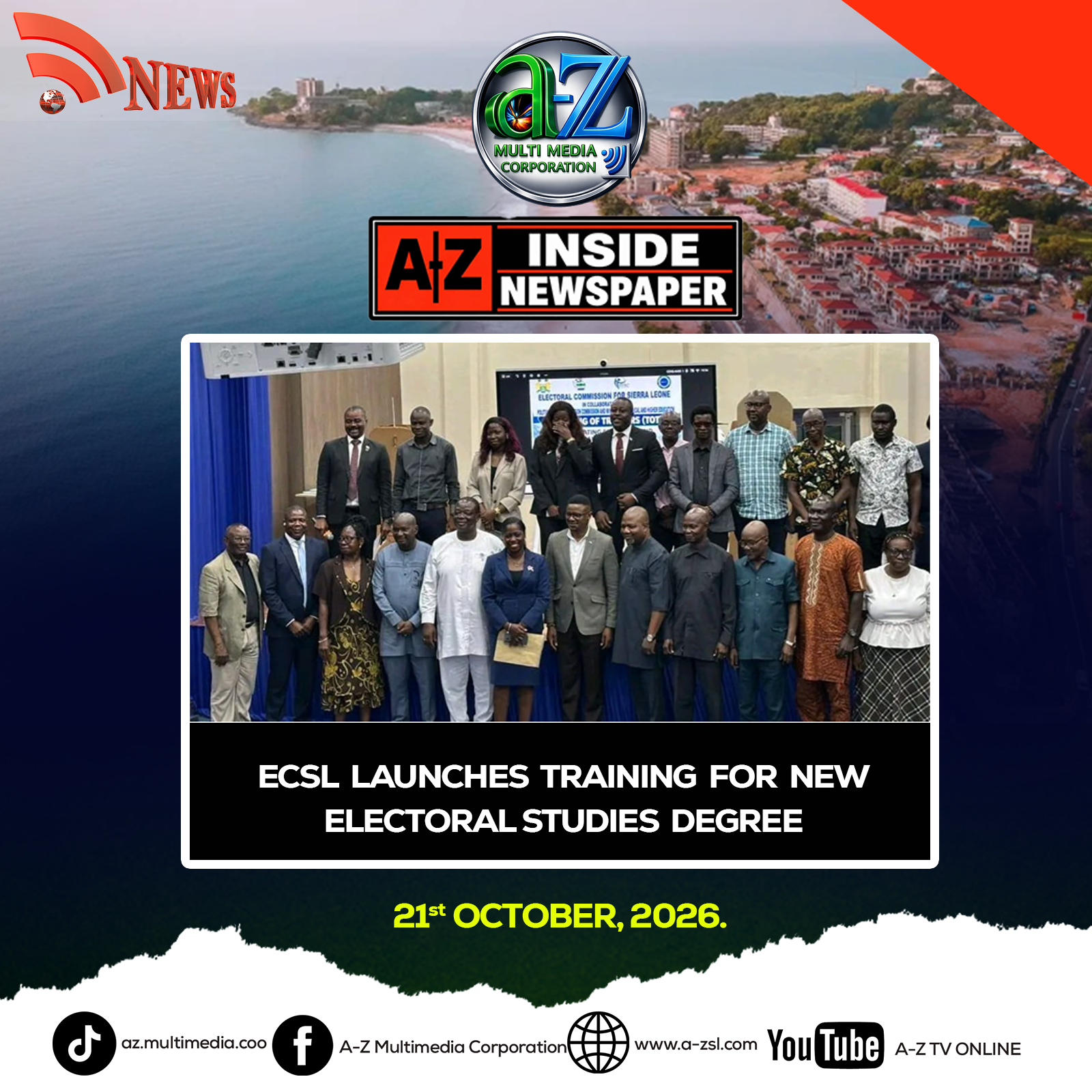
The launch took place in Freetown on Tuesday, 20 October 2026, bringing together vice chancellors, university lecturers, representatives of the Ministry of Technical and Higher Education (MTHE), the Tertiary Education Commission (TEC), fellow ECSL commissioners, management staff of the ECSL, the Political Parties Regulation Commission (PPRC), development partners and members of the media.
In his address, Commissioner Alpha explained that the programme was designed to implement Recommendation 13 of the 2024 Cross-Party Committee Report, which called on the ECSL to collaborate with the Ministry of Education and universities to ensure that citizens are adequately informed and equipped to participate meaningfully in electoral processes.
“For too long, knowledge of election management, legal frameworks, and civic responsibility was confined to a small circle of practitioners. Today, we break that monopoly. We are placing the tools of democratic understanding directly into the hands of the academy,” he said.
Commissioner Alpha described the initiative as a historic milestone, stressing that it was not merely an addition to university curricula but a structured four-year degree programme developed and validated through stakeholder engagement. He said the programme aims to build a professional pool of electoral administrators, researchers and civic educators.
Addressing the trainers, he emphasised their responsibility in preparing future generations to safeguard peace and strengthen democracy. He noted that the curriculum covers critical areas, including artificial intelligence and cybersecurity in elections, the psychology of misinformation, conflict resolution, voter registration and electoral justice.
He urged the trainers to instil in students the values of tolerance, non-violence and respect for the rule of law, adding that these principles were essential to promoting peaceful electoral competition and democratic stability.
The ECSL also pledged institutional support for the programme through the provision of technical expertise, resource materials and personnel. The Commission further committed to facilitating internships, election observation opportunities and joint research initiatives to strengthen the link between classroom learning and practical electoral administration.
According to Commissioner Alpha, an educated electorate remains one of the strongest defences against electoral manipulation and voter apathy. He stressed that democracy should not be viewed merely as an event that takes place every five years but as a continuous culture of participation and accountability.
He expressed appreciation to the MTHE, TEC, PPRC and academics who contributed to developing the curriculum, while urging the trainers to go beyond teaching electoral procedures.
“Teach not just the mechanics of elections, but the soul of democratic citizenship,” he charged.