

By: Saidu Jalloh
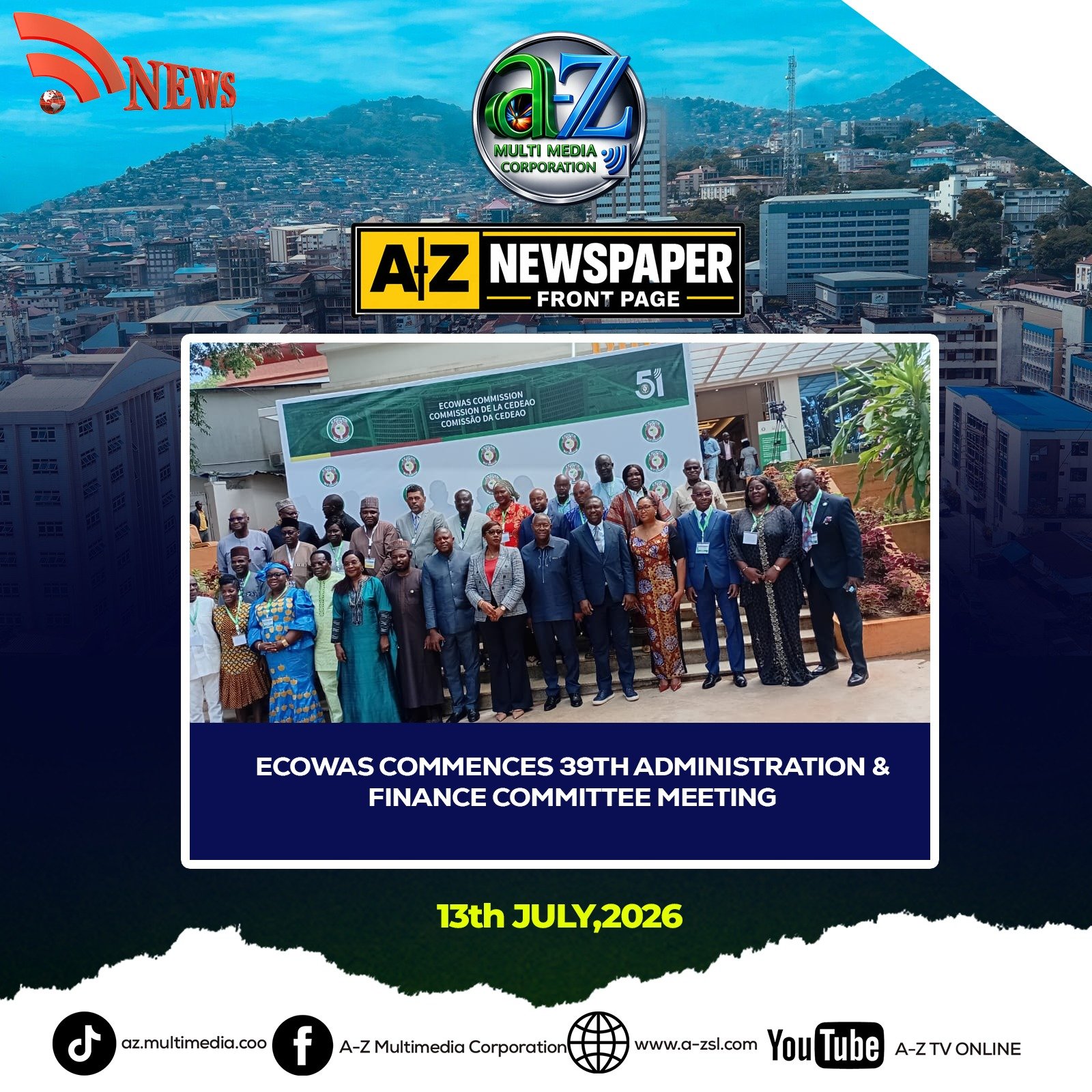
The Economic Community of West African States (ECOWAS) has commenced its 39th Administration and Finance Committee (AFC) Meeting in Freetown, with regional leaders reaffirming their commitment to strengthening institutional governance, promoting financial accountability, and advancing regional integration as the Community prepares for a leadership transition and continues the implementation of its Vision 2050 agenda.
The high-level meeting, which brings together senior officials from ECOWAS institutions and Member States, was officially opened by the Vice President of the ECOWAS Commission, Mrs. Damtien Larbli Tchintchibidja, who described the gathering as timely, given the ongoing institutional reforms and efforts to improve financial management systems within the regional bloc.
The meeting attracted ECOWAS Commissioners, members of the Administration and Finance Committee, representatives of the Permanent Representatives Committee, Resident Representatives, senior officials of Community institutions, and delegates from Member States. Participants are expected to deliberate on critical administrative, financial, and strategic issues affecting the operations and future direction of ECOWAS.
Welcoming delegates to Sierra Leone, Mrs. Tchintchibidja described Freetown as the “Pearl of West Africa” and expressed appreciation to the Government and people of Sierra Leone for hosting the statutory meeting.
She emphasized that the Administration and Finance Committee plays a vital role in ensuring good governance, prudent financial management, and effective implementation of ECOWAS programmes. She urged participants to engage in constructive discussions that would lead to practical recommendations aimed at improving transparency, efficiency, and institutional performance.
The Vice President disclosed that following the opening ceremony, the committee would proceed with closed-door sessions to review financial and administrative reports, assess ongoing reforms, and consider measures to strengthen accountability and operational effectiveness across ECOWAS institutions.
Speaking on behalf of the Government of Sierra Leone, Mr. Komba Momoh, Chairman of the Administration and Finance Committee, reaffirmed the country’s commitment to regional integration, financial discipline, and strengthening the effectiveness of ECOWAS institutions.
Mr. Momoh encouraged delegates to conduct their discussions in a spirit of cooperation, mutual respect, and shared responsibility, emphasizing that decisions taken by the Community must reflect the interests and aspirations of the people of West Africa.
He noted that the region continues to face complex challenges, including insecurity, economic vulnerabilities, climate change, and youth unemployment. According to him, addressing these challenges requires stronger regional institutions, transparent governance systems, and responsible management of Community resources.
Mr. Momoh said Sierra Leone was honoured to host the statutory meetings under the leadership of President Dr. Julius Maada Bio, who currently serves as Chairman of the ECOWAS Authority of Heads of State and Government.
He explained that ECOWAS protocols require the country holding the chairmanship of the Authority to host and preside over the Community’s statutory meetings. He reaffirmed Sierra Leone’s commitment to working with Member States and ECOWAS institutions to promote peace, security, economic development, and regional cooperation.
The AFC Chairman further noted that the meeting coincides with the 51st anniversary of ECOWAS, providing an opportunity for Member States to reflect on the achievements of the regional organization, examine emerging challenges, and renew their commitment to building a more peaceful, prosperous, and people-centred West Africa.
He highlighted the important oversight role of the Administration and Finance Committee in reviewing budgetary, administrative, financial, and human resource matters while ensuring the responsible use of ECOWAS resources.
Meanwhile, ECOWAS Commissioner for Internal Services, Dr. Habibu Yayah Bappah, commended the committee for its continued contribution to budget preparation, financial oversight, and institutional governance. He said the committee’s recommendations have played an important role in strengthening ECOWAS as one of Africa’s leading regional economic communities.
While acknowledging the progress achieved, Dr. Bappah stressed the need for further improvements as the Commission prepares for a transition from the current management team to new leadership later this year.
He announced that additional extraordinary sessions of the committee would be held before December to support a smooth transition process and provide strategic guidance to the incoming administration.
Reflecting on the outgoing Commission’s tenure, Dr. Bappah noted that the current leadership assumed office during one of the most significant reform periods in ECOWAS history. He highlighted major achievements, including institutional restructuring that reduced the number of Commissioners from 15 to seven, as well as reforms in governance, finance, and human resource management.
He also cited the implementation of ECOWAS Vision 2050, the Community Strategic Framework, revised financial and procurement regulations, audit reforms, the European Union Pillar Assessment, and the deployment of the ECOLINK Enterprise Resource Planning system as key milestones achieved during the administration’s four-year mandate.
Dr. Bappah further praised the leadership of ECOWAS Commission President Dr. Omar Alieu Touray for introducing the Commission’s “4-by-4 Strategic Objectives,” which he said strengthened institutional planning, performance monitoring, and alignment of development priorities across ECOWAS institutions.
He informed delegates that the committee would receive a comprehensive assessment of the outgoing administration’s performance, highlighting achievements under the strategic objectives and identifying areas requiring continued attention by the incoming leadership.
The Commissioner expressed confidence that the committee’s deliberations would produce recommendations capable of strengthening ECOWAS institutions and accelerating programmes focused on peace, democratic governance, regional integration, and sustainable development.
The 39th ECOWAS Administration and Finance Committee Meeting is expected to review key financial, administrative, and policy matters that will influence the future direction of the Community, enhance financial oversight, and support the implementation of the ECOWAS Vision 2050 agenda.