

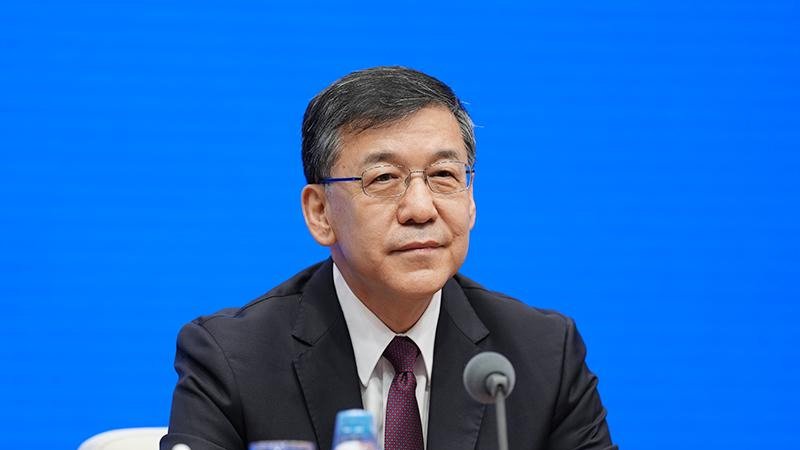
China has accelerated its science and technology innovation over the past five years, with the country now ranking ninth globally in national innovation capability, according to Minister of Science and Technology Yin Hejun.
Speaking at a State Council Information Office press conference on Tuesday, Yin said China’s research and development (R&D) spending exceeded 3.92 trillion yuan in 2025, equivalent to 2.8 percent of its gross domestic product (GDP). He said the figure surpassed the average R&D investment of OECD countries for the first time.
China has also ranked first globally for several years in PCT international patent applications and high-level international journal publications. The country has built the world’s largest education system and the largest R&D workforce, Yin said.
He said China had recorded major breakthroughs in several areas, including quantum computing, space exploration, semiconductors, artificial intelligence, new energy vehicles, robotics, innovative medicines and new crop varieties.
The “Jiuzhang” series of quantum computers has repeatedly set world records. According to Yin, the latest generation, Jiuzhang 4.0, demonstrated a quantum computational advantage on a specific mathematical task, completing it more than 10 to the power of 54 times faster than the world’s fastest supercomputer.
In space exploration, the Tianwen-1 Mars orbiter, which remains operational, captured rare images of an interstellar object in 2025. The newly launched Tianwen-2 is travelling to collect samples from a near-Earth asteroid, while Tianwen-3 is planned to conduct a Mars sample-return mission around 2031.
Yin said China is now among the world’s fastest-rising innovators and is entering a crucial period in its efforts to become a global science and technology powerhouse.
He said the 15th Five-Year Plan period, covering 2026 to 2030, will focus on strengthening strategic and original basic research, supporting young scientists, diversifying research funding and improving scientific research platforms.
The ministry will also focus on developing core technologies in artificial intelligence, quantum technology and semiconductors. It plans to promote demand-driven industrial innovation by encouraging enterprises to lead collaboration among industry, universities and research institutions, while accelerating the commercialisation of scientific research.
Yin said science and technology development would also be directed towards improving people’s livelihoods, particularly in health, agriculture and environmental protection. The ministry will strengthen links between education, science and talent development to create opportunities for young researchers to lead scientific work.
China will also continue to support international research cooperation on global challenges, including climate change and energy, while participating in international science programmes and encouraging international scientific organisations to establish branches in the country.
Yin said China was rapidly moving from being a participant in global science and technology to becoming a pioneer and leader.