

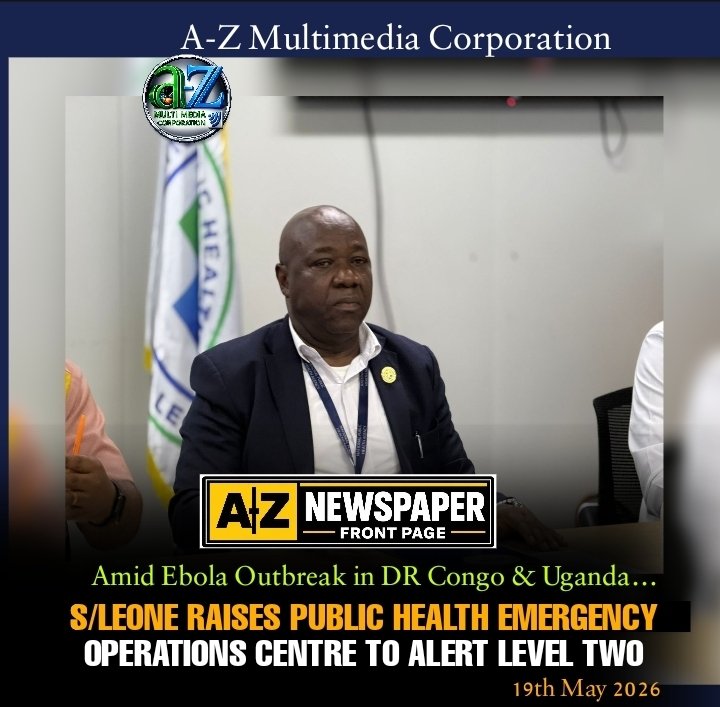
By: Mohamed Sahr
The National Public Health Agency (NPHA) has elevated the Public Health Emergency Operations Centre to Alert Level Two as part of efforts to strengthen preparedness and response mechanisms following an Ebola outbreak in the Democratic Republic of Congo (DRC) and Uganda.
This announcement was made on Monday, 18 May 2026, in Freetown by Professor Foday Sahr, Executive Director of the NPHA, during a media engagement.
Professor Sahr stated that the National Emergency Health Committee has been convened to oversee and coordinate the government’s response. He explained that screening measures have been intensified at all points of entry, including the Lungi International Airport, the Freetown Harbour, and major land border crossings, with trained personnel deployed.
He further noted that emergency supplies have been pre-positioned across the country, particularly personal protective equipment (PPE), isolation materials, and rapid diagnostic tools. These supplies have been prioritized for the Western Area and high-risk border districts, including Kambia, Koinadugu, and Kailahun.
According to him, rapid response teams are on standby in all sixteen districts, while isolation protocols are being reviewed and reinforced at key referral health facilities. He added that Sierra Leone is maintaining close communication with the Africa Centres for Disease Control and Prevention (Africa CDC), the ECOWAS Health Authority, the World Health Organization (WHO), and neighboring countries such as Guinea and Liberia to ensure real-time information sharing.
Prof. Sahr also stated that risk communication and community engagement activities have been launched across all districts. He emphasized that official updates will be disseminated through verified government channels, including the NPHA, the Ministry of Health, and the Sierra Leone Broadcasting Corporation (SLBC).
He confirmed that Sierra Leone currently has no suspected or confirmed cases of Ebola, stating: “We are Ebola-free.”
Speaking on the regional situation, Prof. Sahr noted that the World Health Organization (WHO) has declared a Public Health Emergency of International Concern (PHEIC) in response to the Ebola outbreak in the DRC and Uganda.
He explained that the current outbreak is caused by the Bundibugyo strain of the Ebola virus, a rare strain for which there are no licensed vaccines and no approved treatments. He added that while the situation is serious, it is not a pandemic, but rather a regional emergency requiring coordinated action.
Prof. Sahr also recalled that as of 16 May 2026, the DRC had recorded 246 suspected cases and 80 suspected deaths in Ituri Province. In Uganda, he said, two laboratory-confirmed cases have been reported, including one death in Kampala, both linked to travel from the DRC, with no evidence of local transmission.
He urged Sierra Leoneans and residents to immediately call 117 if they experience symptoms such as sudden fever, severe headache, vomiting, diarrhea, unexplained bleeding, or rash, particularly if they have recently traveled to the DRC or Uganda. He also advised against unnecessary travel to affected areas.
Prof. Sahr further encouraged the public to avoid contact with blood or bodily fluids of individuals showing signs of unexplained hemorrhagic illness and to maintain regular handwashing and other hygiene practices.
He cautioned citizens against spreading unverified information during health emergencies and emphasized the importance of relying on official sources.
Finally, he called on all health workers in both public and private facilities to maintain a high level of vigilance for patients presenting with hemorrhagic symptoms, especially those with a history of travel to affected regions, and to promptly report any suspected cases.