

By: Audrey Raymonda John
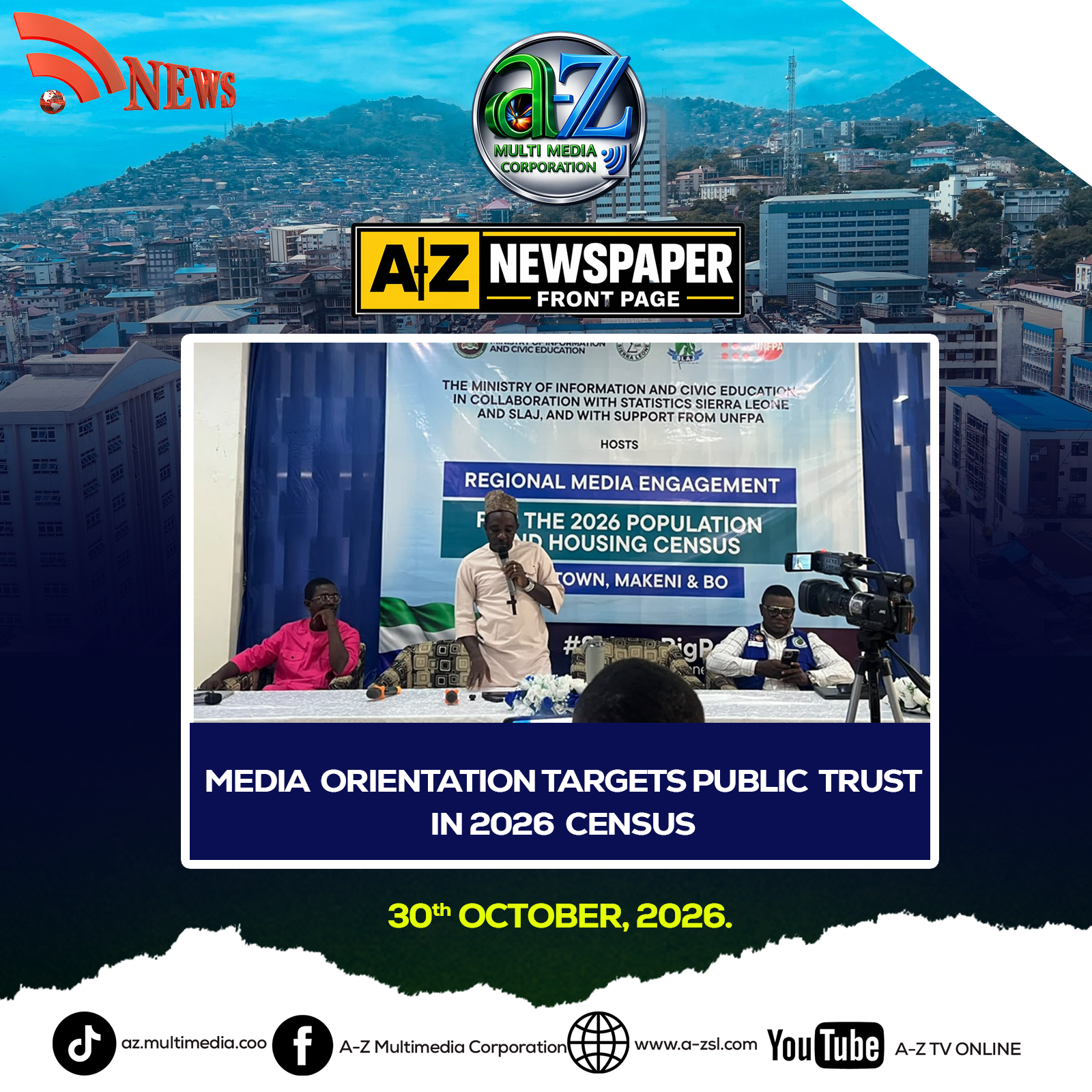
The Ministry of Information and Civic Education, in collaboration with Statistics Sierra Leone and the Sierra Leone Association of Journalists (SLAJ), with support from the United Nations Population Fund (UNFPA), on Thursday, October 29, 2026, engaged journalists in Freetown to strengthen public confidence in the 2026 Population and Housing Census.
The engagement aimed to equip media practitioners with accurate information about the census, promote responsible reporting and improve public understanding of the national exercise ahead of its implementation.
Speaking at the engagement, Samuel Ansumana, Director of Communications at Statistics Sierra Leone, said the orientation was intended to familiarize journalists with the census process and their responsibility to keep the public accurately informed.
He acknowledged the technical challenges and competing priorities involved in preparing for the census but stressed that the exercise was crucial and required cooperation among all stakeholders.
Ansumana explained that the Ministry of Information and Civic Education had been working with technical partners, civil society organisations and other stakeholders over the past two years to support preparations for the census.
He emphasised that the media was essential to the success of the exercise, noting that journalists had a critical role in explaining its purpose, methodology, timing and implementation to the public. He encouraged participants to ask questions and seek clarification to deepen their understanding of the process.
Meanwhile, the Secretary-General of SLAJ, Edward Marrah, urged journalists to strengthen their knowledge of statistics and contribute meaningfully to public awareness of the census.
He described the census as more than a numerical exercise, noting that its findings would inform national development planning, resource allocation and the delivery of essential public services.
Marrah said citizens needed clear information about why the census was being conducted, the importance of their participation and how the data collected would benefit the country.
He stressed that the success of the exercise would depend not only on the technical capacity of Statistics Sierra Leone but also on public cooperation and confidence.
According to him, journalists should communicate census information in local languages and accessible formats while addressing misinformation before it spreads.
He observed that public trust was particularly important in a politically competitive environment, where information from government institutions could sometimes be interpreted through a political lens.
Marrah said independent journalism could strengthen public confidence through fact-checking, verification, relevant questioning and clear communication of official information.
However, he clarified that journalistic independence did not mean opposing the government or treating every official statement with suspicion. Rather, he said, census authorities and journalists should complement one another, with the authorities providing technical information and journalists independently verifying and explaining it in language the public could understand.
He urged census authorities to make information readily available, respond promptly to journalists’ questions and provide evidence-based explanations. Journalists, he added, should avoid sensationalism, distinguish established facts from speculation and ensure that political considerations did not undermine accurate reporting.
He also encouraged the use of community meetings, local radio programmes, newspapers, television and online platforms to reach people across different communities and literacy levels.
As Sierra Leone prepares for its seventh census, Marrah reminded journalists that the figures collected represented real people and communities whose participation should be based on understanding rather than fear, rumours or political suspicion. He reaffirmed SLAJ’s commitment to supporting credible and responsible census coverage.
Also speaking, Director of Civic Education Timothy Sam highlighted the responsibility of journalists to provide accurate information to the public ahead of the census.
He said the engagement was designed to equip media practitioners with reliable facts and practical tools to educate citizens through print, radio, television and social media.
Sam observed that misinformation did not always result from deliberate attempts to mislead the public but could also arise from inadequate knowledge and limited access to accurate information.
Using football statistics to illustrate his point, he explained that data became meaningful when properly interpreted and communicated. He stressed that census figures would have limited value if their significance was not clearly explained to the public.
He further discussed the importance of census data using the PESTLE analytical framework, which examines political, economic, social, technological, legal and environmental factors.
According to Sam, population statistics would help the country understand population distribution, geographical composition, languages and other social characteristics. The data would also support economic planning, assessments of living standards and decisions on the provision of public amenities, including hospitals.
He added that technology would support data collection, processing and interpretation, while the legal framework would guide the exercise. He also highlighted the importance of understanding the relationship between population distribution, communities and their environment.
Sam noted that the census would provide information on the country’s population and its distribution across districts and other geographical areas, enabling authorities to make informed decisions on national development.
The programme also featured technical presentations by Statistics Sierra Leone on census methodology, data collection personnel and the use of census statistics in national planning.
A separate session on responsible census reporting was designed to strengthen journalists’ capacity to deliver accurate, balanced and accessible information to the public.
The organizers underscored the need for sustained collaboration among the media, Statistics Sierra Leone, the Ministry of Information and Civic Education, SLAJ, UNFPA and other partners to promote public awareness, participation and confidence in the 2026 Population and Housing Census.