

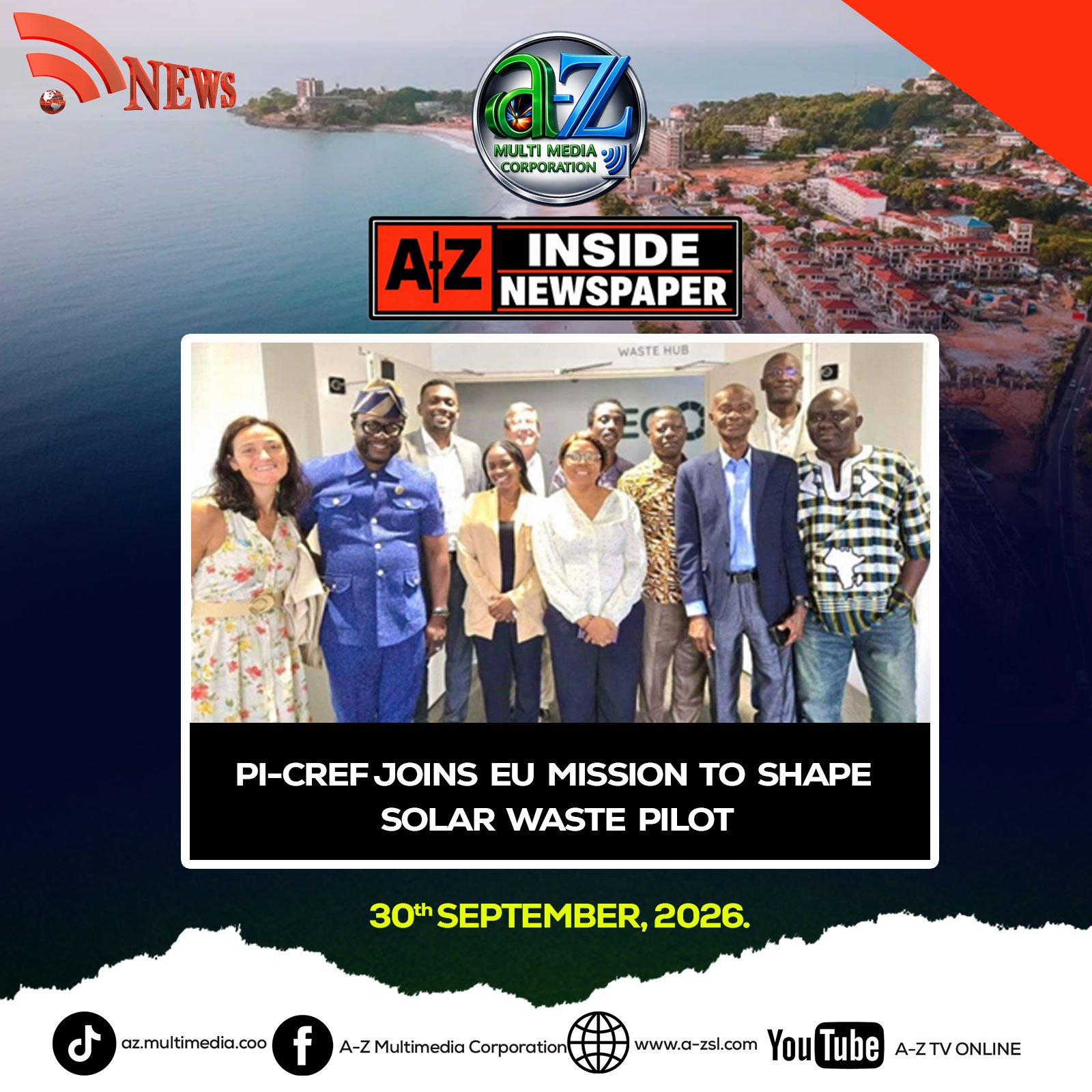
The Presidential Initiative on Climate Change, Renewable Energy and Food Security (PI-CREF) has joined a five-day benchmarking mission to Spain to help develop Sierra Leone’s first solar waste management pilot.
The study visit, held from September 21 to 25, 2026, was facilitated by the United Nations Office for Project Services (UNOPS) under the Salone Off-Grid Renewable Energy Acceleration (SOGREA) initiative, an European Union-funded project implemented in collaboration with the Government of Sierra Leone through the Ministry of Energy.
PI-CREF was represented by its Director of Renewable Energy, Abraham Grass-Sessay, who joined a multi-sectorial delegation comprising representatives from the Ministry of Energy, Environmental Protection Agency (EPA), Electricity and Water Regulatory Commission (EWRC), Public-Private Partnership Unit, Sierra Leone Standards Bureau, University of Sierra Leone’s Fourah Bay College, and the UNOPS SOGREA Technical Team.
The mission focused on strengthening Sierra Leone’s approach to managing end-of-life solar panels and batteries as the country expands access to off-grid renewable energy.
Spain was selected for the study visit because of its established waste management systems, including frameworks aligned with the European Union’s Waste Electrical and Electronic Equipment (WEEE) Directive, Extended Producer Responsibility (EPR) schemes, public-private partnerships and research infrastructure.
During the visit, the delegation examined the full lifecycle of solar equipment, including policy development, regulatory compliance, collection systems, private-sector logistics and technologies for recovering and recycling materials.
The lessons from the mission are expected to inform the pilot phase under SOGREA Work Package 7 and support the EPA’s proposed Integrated Waste Management Facility at Masiaka.
The mission will also contribute to a Benchmarking Mission Report, National Action Matrix, and specialized policy and technical guidance. These outputs are expected to clarify institutional responsibilities and timelines while supporting the development of Sierra Leone’s national Solar Waste Management Framework, business models and technical training curricula.
The initiative is intended to help Sierra Leone establish a structured system for managing solar equipment at the end of its useful life as the country expands renewable energy access.