

By: Aminata Sesay
The Parliamentary Committee on Social Welfare has raised concerns over financial accountability, Hajj scholarship allocations and information-sharing gaps in the administration of Hajj operations in Sierra Leone.
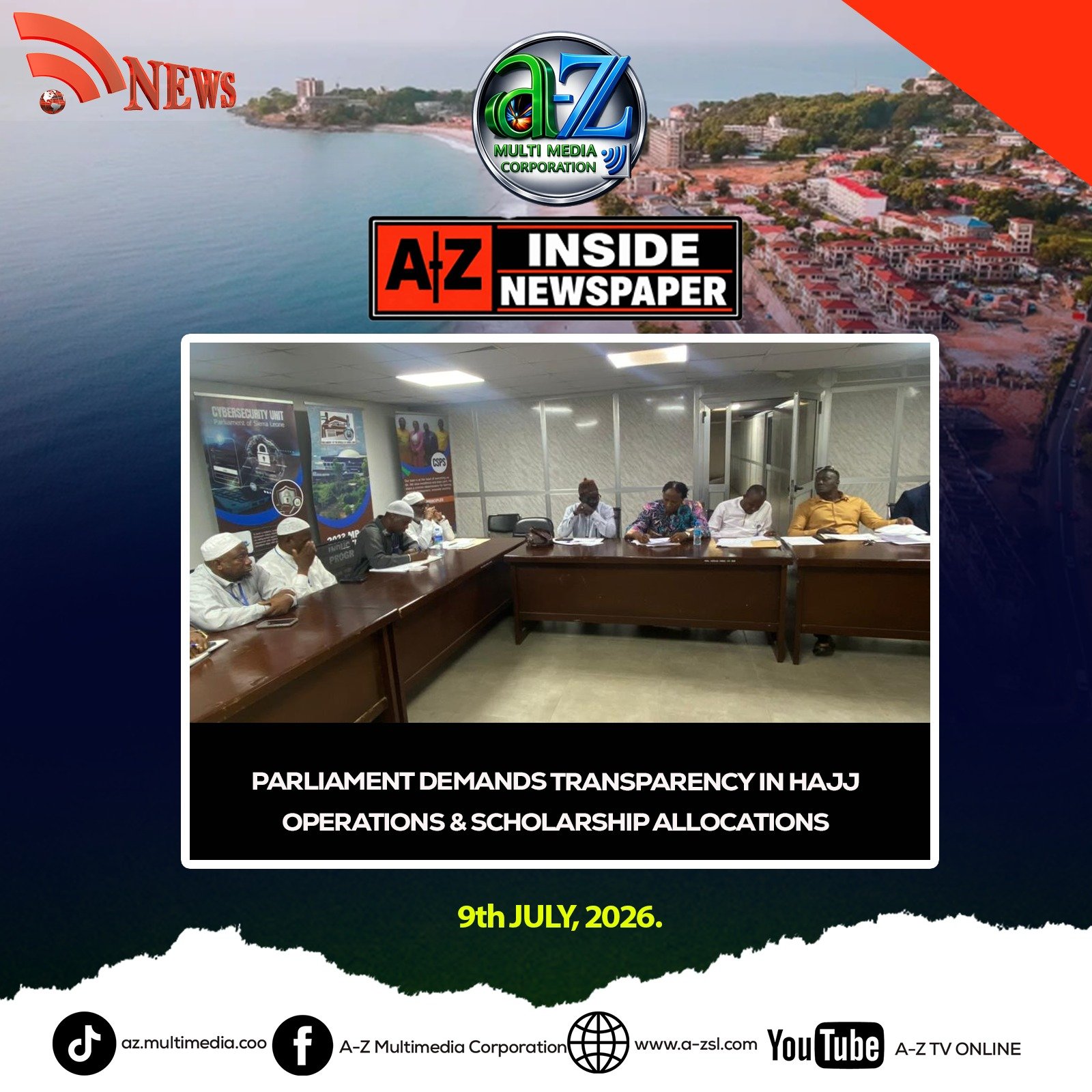
The concerns were raised during an oversight hearing with officials of the Presidential Hajj Task Force, where Members of Parliament requested detailed financial records and clarification on the processes governing the selection of pilgrims and beneficiaries of Hajj scholarships.
Chairperson of the Parliamentary Committee on Social Welfare, Hon. Haja Miatta Amara, said the engagement formed part of Parliament’s constitutional oversight responsibility to promote transparency, accountability and prudent management of public resources.
She emphasized that the hearing was not intended to be a witch-hunt but rather an opportunity to strengthen public institutions, improve accountability and ensure that citizens receive value from public programmes.
Hon. Amara expressed concern over what she described as a weak working relationship between the Committee and the Hajj Task Force, noting that previous requests for information had not been adequately addressed.
According to the Chairperson, Members of Parliament are frequently approached by constituents seeking clarification on the allocation of Hajj scholarships, the criteria for selecting beneficiaries and the overall management of the annual pilgrimage.
“We have a responsibility to ensure that grants, scholarships and public resources are administered fairly, transparently and in the best interest of the people,” she stated, while calling for stronger collaboration between Parliament and the Hajj Task Force.
During the hearing, Committee members questioned the legal mandate of the Presidential Hajj Task Force, its reporting structure, operational procedures and the criteria used to select pilgrims and scholarship beneficiaries.
Responding to the concerns, the Chairman of the Presidential Hajj Task Force provided an overview of Hajj administration in Sierra Leone, explaining that significant reforms were introduced following challenges experienced before 2018, including weak coordination, administrative inefficiencies and limited transparency.
He said the introduction of Standard Operating Procedures (SOPs) and a more structured management framework had significantly improved the planning and coordination of Hajj operations.
The Chairman further explained that the Presidential Hajj Task Force was established through executive authority to coordinate and manage Hajj activities. He clarified that while the allocation of Hajj scholarships is determined by the Presidency, the Task Force is responsible for implementing the approved distribution process.
He also noted that reductions in scholarship quotas provided by donor countries have significantly affected the number of beneficiaries in recent years.
Financial accountability remained a key focus of the hearing, with Committee members requesting comprehensive financial records covering recent Hajj operations.
The requested documents include bank statements, payment receipts, contracts with airlines and other service providers, accommodation agreements, procurement records, catering contracts, bank reconciliation statements and detailed expenditure reports.
Members observed that although the Task Force had submitted lists of pilgrims, the outstanding financial documentation was essential for Parliament to effectively assess the management and utilisation of public funds.
In response, the Chairman acknowledged the Committee’s concerns and assured Members that all requested documents would be submitted.
He explained that pilgrims make payments through designated commercial banks, after which funds are processed through approved financial arrangements with service providers in the Kingdom of Saudi Arabia.
Officials also confirmed that although pilgrims finance the majority of their Hajj expenses, the Task Force receives government subventions through the Ministry of Social Welfare, which are subject to parliamentary oversight and public accountability.
The Committee further highlighted communication gaps among the Presidential Hajj Task Force, the Ministry of Social Welfare, the Office of the Vice President and Parliament, calling for stronger institutional coordination to improve the administration of Hajj affairs.
Responding to the concerns, the Chairman apologised for previous communication lapses and welcomed the proposal to include representatives of the Parliamentary Committee on Social Welfare within the Task Force’s consultative and support structures.
He also appealed for Parliament’s support in reviewing the institutional framework governing Hajj administration, with the aim of establishing a more sustainable statutory body to oversee Hajj operations in Sierra Leone.
The hearing concluded with the Committee reaffirming its commitment to promoting transparency, accountability and public confidence in the administration of Hajj affairs, while awaiting the submission of the outstanding financial records requested from the Presidential Hajj Task Force.