

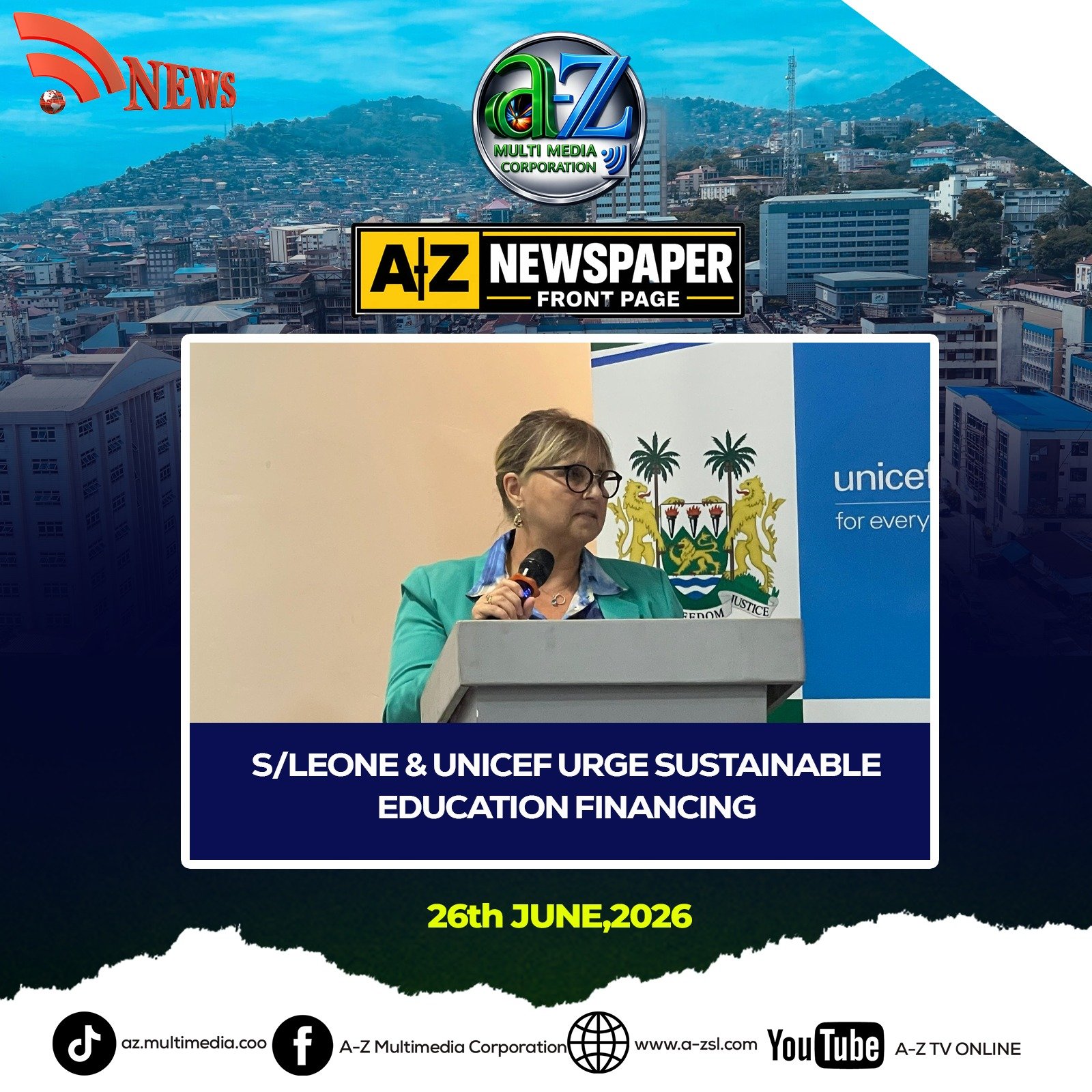
By: Precious Miracle Kargbo Snr
The Government of Sierra Leone has reaffirmed its commitment to fiscal reforms and innovative financing for education, as rising debt servicing costs and limited fiscal space continue to constrain budget allocations to the sector.
This commitment was highlighted by the Deputy Minister of Finance II, Madam Jenneh Jabati, during the opening of a two-day Strategic Workshop on Blended and Innovative Financing for Education held at the New Brookfields Hotel.
Speaking on behalf of the Minister of Finance, Sheku Ahmed Fantamadi Bangura, Madam Jabati stated that education remains a flagship priority in the Medium-Term National Development Plan (2024–2030). She noted that successive national budgets have maintained education’s share of the discretionary domestic budget at around 20 percent or above, in line with the Uhuru Declaration.
She added that the government remains committed to increasing education spending to 4-6 percent of GDP, in line with UNESCO recommendations, although recent GDP rebasing has affected the overall ratio.
The Deputy Minister also highlighted key macro-fiscal challenges facing the country. In 2024, domestic revenue mobilisation stood at 12.1 percent of GDP, below the 15 percent benchmark for low-income countries. She further noted that debt servicing continues to absorb a significant portion of domestic revenue, thereby limiting fiscal space for critical investments such as education.
According to UNICEF’s Education Finance Analysis, public debt servicing in 2026 is projected to account for 29 percent of the national budget more than double the education allocation of SLE 4 billion.
To address these fiscal constraints, the government is implementing a comprehensive revenue mobilisation strategy. This includes reforms in customs administration, income tax, goods and services tax, property tax, and non-tax revenue systems, as well as strengthened compliance and enforcement mechanisms. Recent Finance Acts have also expanded the tax base and reduced exemptions.
The National Revenue Authority is rolling out several digital reforms, including the Integrated Tax Administration System, ASYCUDA World, Electronic Cash Registers, and a fuel marking programme. Monitoring has also shifted from quarterly to daily performance tracking. In addition, customs modernisation efforts are underway through the introduction of an Electronic Single Window system.
On public financial management reforms, the government is implementing baseline budgeting to align allocations with fiscal priorities. Gender-responsive budgeting has also been piloted in ten Ministries, Departments and Agencies (MDAs).
The Expanded Cash and Debt Management Committee has been strengthened to improve budget execution and reduce arrears, while the Electronic Government Procurement system is at an advanced stage of implementation. Internal audit functions are also being enhanced through digitisation and capacity building.
In terms of debt management, the government is pursuing strategies aimed at reducing sustainability risks through prudent borrowing, sustainable fiscal policy, and the use of longer-term domestic financing instruments. It is also prioritising concessional financing while avoiding reliance on expensive non-concessional borrowing.
UNICEF, represented by Acting Representative Liv Elin Indreiten, stated that education financing is fundamentally about children’s rights and future opportunities. She noted that Sierra Leone’s commitment is reflected in the Free Quality School Education Programme and the Education Sector Plan (2022-2026), which prioritise learning outcomes, inclusion, and system resilience.
UNICEF further emphasised that education financing must reach children facing barriers such as poverty, gender inequality, disability, geographic isolation, and emergencies. It also stressed the need to strengthen systems that can withstand climate-related shocks, including flooding.
The workshop is expected to explore practical financing options over two days, including blended finance, diaspora engagement, public-private partnerships, and innovative domestic resource mobilisation strategies. Government officials noted that these approaches must remain fiscally responsible, results-oriented, and equity-driven, complementing domestic revenue rather than replacing it.
The discussions form part of broader efforts to identify sustainable and realistic pathways for long-term investment in children and young people, with particular emphasis on foundational learning and schools serving underserved communities.