

By: Audrey Raymonda John
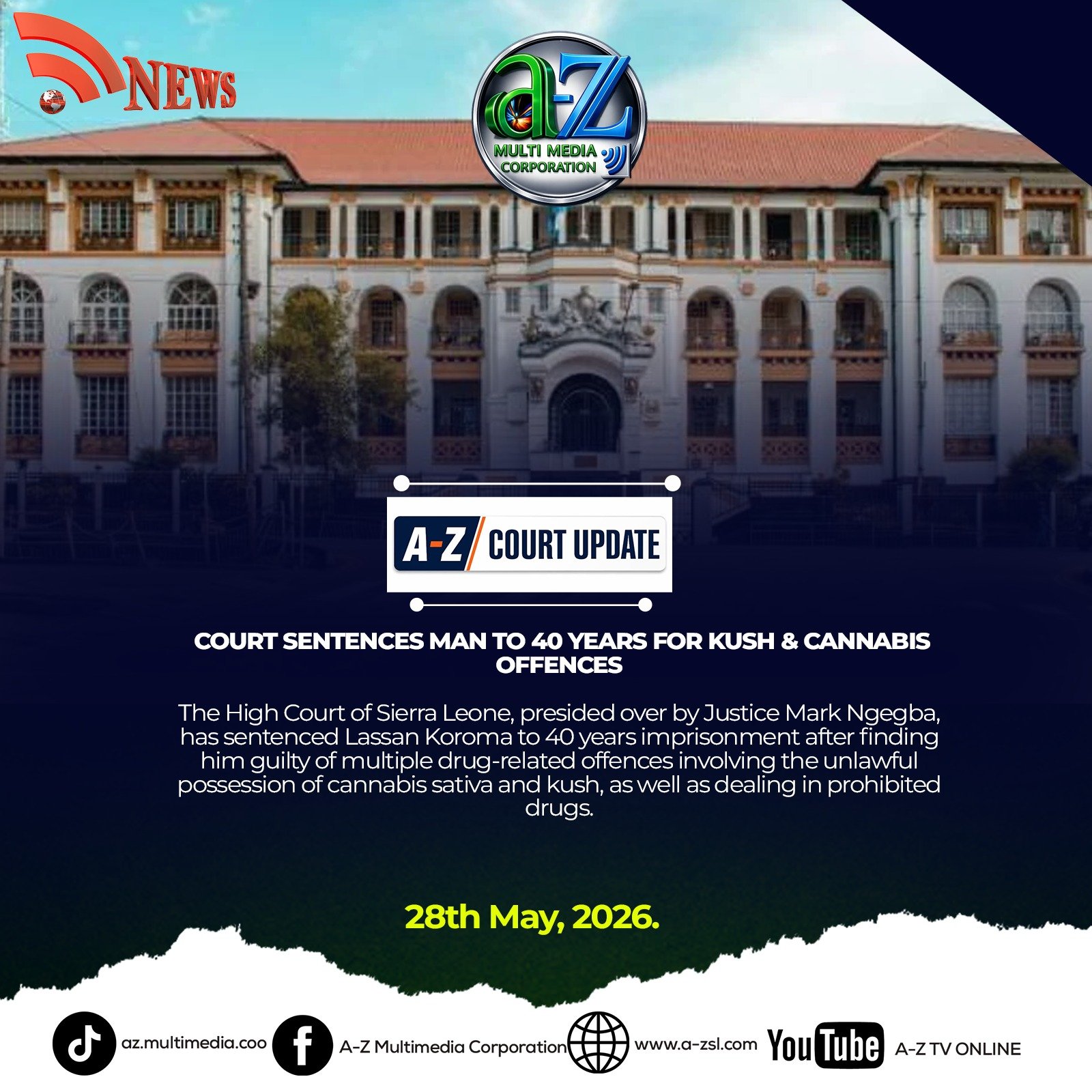
The High Court of Sierra Leone, presided over by Justice Mark Ngegba, has sentenced Lassan Koroma to 40 years imprisonment after finding him guilty of multiple drug-related offences involving the unlawful possession of cannabis sativa and kush, as well as dealing in prohibited drugs.
According to Indictment No. DDP/2025/395, the accused was arraigned before the court on four counts, including unlawful possession of prohibited drugs contrary to Section 8(a) of the National Drugs Control Act 2008, Act No. 10 of 2008, and dealing in prohibited drugs contrary to Section 7(c) of the same Act.
The prosecution alleged that on 22 October 2025, in Freetown, Western Area, the defendant was found in possession of 90.9 grams of cannabis sativa and 45 sachets of kush weighing 90 grams and was also engaged in dealing in the prohibited substances without lawful authority.
State Counsel A. Jalloh and E.A. Deen prosecuted the matter, while M.K. Dauda represented the defendant.
During the trial, the prosecution called several witnesses to establish its case against the accused.
Detective Police Sergeant Sahr Koroma Sundu, attached to the Transnational Organized Crime Unit (TOCU), testified as Prosecution Witness Two (PW2). He informed the court that on 24 October 2025, while on duty, he received a transferred case file relating to the unlawful possession of 45 sachets containing substances suspected to be cannabis sativa, together with dried leaves suspected to be cannabis seeds.
He further testified that he tendered the Arresting Officer’s Report as Exhibit “D”, the Voluntary Caution Statement of the defendant dated 22 October 2025 as Exhibit “L1-10”, the Additional Voluntary Caution Statement as Exhibit “F1-6”, and the Charge Statement as Exhibit “G1-2”.
The third prosecution witness, Detective Police Constable John Umaru, attached to the Crime Writer’s Office at TOCU, told the court that his duties include registering case files, taking exhibits into custody, and tendering them before the court when necessary.
He stated that on 23 October 2025, D/Sgt. Sundu S.K. Kargbo handed over to him 45 sachets of dried leaves suspected to be cannabis sativa and cannabis seeds. He said the items were registered in the Book of Court Exhibits as Serial No. 139/2025. According to his testimony, a forensic analyst later collected samples of the substances for laboratory examination. The cannabis seeds were tendered as Exhibit “H”, while the cannabis sativa was tendered as Exhibit “J”.
The prosecution also tendered the committal warrant from the bar, which was marked as Exhibit “K1-3”.
At the close of the prosecution’s case, the defendant elected to rely on statements previously made to the police. The statements, tendered as Exhibits “L1-10” and “F1-6”, reportedly contained admissions that cannabis sativa was found in his room during a police search.
In his judgment, Justice Ngegba explained that the term “deal” under the law should not be interpreted narrowly to apply only to commercial transactions but should instead be understood in its ordinary meaning to include any form of dealing with prohibited drugs.
The judge cited legal authorities, including R v. Maginnis (Patrick Terrance) (1987) AC 303 and R v. Delgado (1984) 1 WLR 89, emphasizing that the court must consider the entire transaction when determining whether an accused person dealt in prohibited substances.
Justice Ngegba further held that under Section 17 of the National Drugs Control Act, 2008, the burden rests on the defendant to prove lawful authority for possessing prohibited drugs.
The court also relied on the testimony of Prosecution Witness One, Joseph Stevens, a forensic analyst attached to TOCU, and his laboratory reports tendered as Exhibits “B1-2” and “C1-2”, which confirmed that the substances recovered from the accused were cannabis and kush.
The judge further noted that the defendant admitted selling cannabis sativa for three months.
After considering all the evidence presented, Justice Ngegba convicted the defendant and sentenced him to ten years imprisonment on Count One and thirty years imprisonment on Count Two, bringing the total sentence to forty years imprisonment. However, the accused was acquitted on Counts Three and Four.
The case forms part of the judiciary’s continued efforts to address the growing problem of prohibited drugs in Sierra Leone.