

By: Aminata Sesay
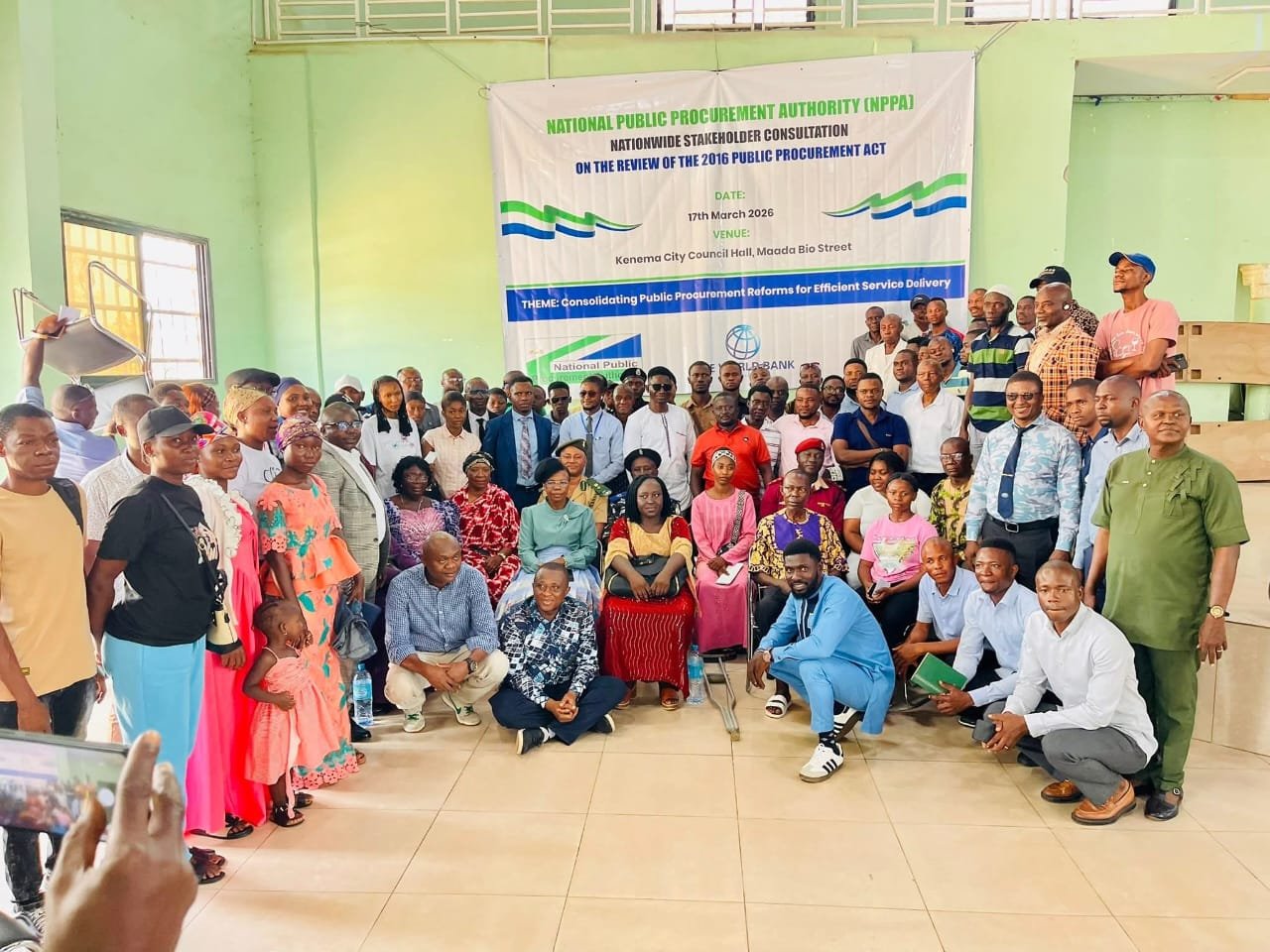
The National Public Procurement Authority (NPPA) has launched nationwide stakeholder consultations to review the Public Procurement Act, 2016, starting with simultaneous engagements in Kenema and Makeni.
The initiative aims to strengthen Sierra Leone’s public procurement system by addressing implementation gaps, enhancing transparency and accountability, and aligning the law with evolving national priorities and international best practices.
Two high-level NPPA teams led the consultations: the Chief Executive Officer (CEO) headed the Kenema session, while the Deputy CEO, Augustine J. J. Tommy, led discussions in Makeni. The engagements brought together representatives from Ministries, Departments, and Agencies (MDAs), local councils, civil society organizations, procurement professionals, private sector contractors, and development partners.
Participants in Kenema represented stakeholders from Kenema and Kailahun District, while the Makeni session included stakeholders from across the Northern Region, including Kono District, incorporated for accessibility reasons.
At Kenema, NPPA’s Head of Communications and Outreach, Sylvester B. Allieu, outlined the purpose of the consultations, emphasizing that they are designed to capture stakeholder experiences and recommendations to inform the review process. He highlighted significant developments since the last review, particularly the rollout of the Electronic Government Procurement (E-GP) system, which aims to improve efficiency, transparency, and accountability.
“All reforms must be embedded within the legal framework to ensure sustainability and effectiveness,” Mr. Allieu noted, referencing discussions from a recent NPPA Board and Management Retreat on proposed amendments.
Welcoming participants, the Chief Administrator of the Kenema City Council, Sahr Pessima, urged stakeholders to actively contribute, stressing that inclusive dialogue is essential for developing a law that reflects practical realities across institutions.
The technical presentation was delivered by the Director of Legal and Board Secretariat, Francis M. Gbaya, who outlined key areas for reform and the rationale behind the proposed changes.
In Makeni, Deputy CEO Augustine J. J. Tommy emphasized that public procurement is central to governance and sound economic management. He noted that nearly a decade after the 2016 law’s enactment, it is timely to reflect on lessons learned and introduce reforms that address emerging challenges.
The Chief Administrator of the Bombali District Council, Abdul Koroma, highlighted procurement’s role in ensuring fiscal discipline and value for money, warning that weaknesses in the system could erode public trust.
Across both locations, stakeholders raised concerns about delays in procurement approvals, limited technical capacity, and complex procedures. Many called for simplification of provisions to better reflect operational realities, particularly at the local council level.
Civil society organizations advocated for stronger transparency measures, increased public access to procurement information, and stricter enforcement mechanisms. Private sector representatives urged reforms to ensure timely payment for completed contracts and protection for contractors.
Development partners praised NPPA’s inclusive approach and reaffirmed their support for ongoing procurement reforms, stressing that a strong and transparent system is critical for effective use of public resources.
NPPA confirmed that feedback from the consultations will inform proposed amendments to the Act, aiming to strengthen governance and integrate modern reforms such as digital procurement systems and enhanced oversight mechanisms.
The nationwide consultations will continue 18 March, with sessions in Bo for the Southern Region and Port Loko for the North-West Region, as NPPA seeks broad stakeholder input to shape a more responsive and modern procurement framework.