

By: Mohamed Sahr
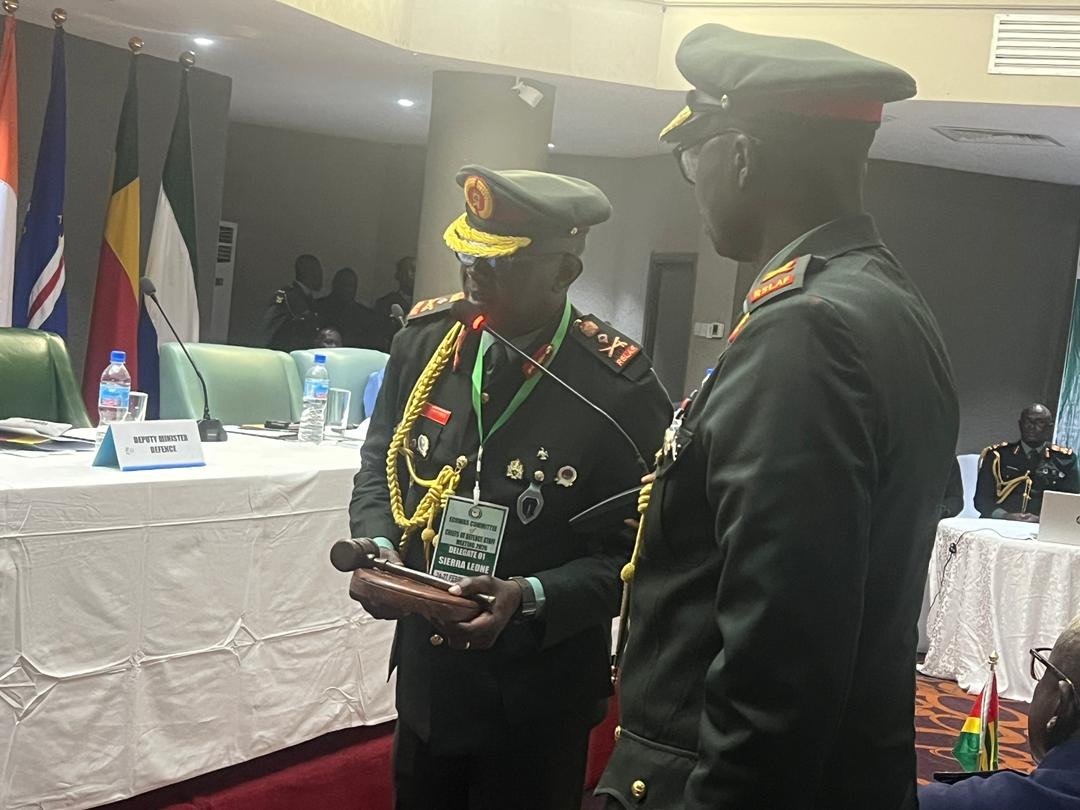
Lieutenant General Amara Idara Bangura has assumed the chairmanship of the ECOWAS Committee of Chiefs of Defence Staff (CCDS), pledging Sierra Leone’s unwavering commitment to advancing ECOWAS’ collective security vision.
“This baton of leadership is not merely ceremonial,” he said. “It represents a collective responsibility to safeguard peace, stability, and democratic governance across our region.”
The official transfer of authority from General Christopher Musa of Nigeria to Lieutenant General Bangura, Chief of Defence Staff (CDS) of the Republic of Sierra Leone Armed Forces, took place during the 44th Ordinary Meeting of the CCDS, held from 24-27 February 2026 at the Radisson Blu Hotel.
The high-level meeting brought together Chiefs of Defence Staff, senior military representatives from across West Africa, officials of the ECOWAS Commission, heads of mission, security sector leaders, and government ministers. Discussions underscored the growing importance of collective security as the region confronts increasingly complex and evolving threats.
The handover marked the end of General Musa’s tenure, which was widely praised for steering the region through significant political and security challenges while strengthening defence cooperation among member states.
The meeting prioritised the operationalisation of the ECOWAS Standby Force, logistics sustainability, and enhanced interoperability among armed forces.
Dr. Abdel-Fatau Musah, ECOWAS Commissioner for Political Affairs, Peace and Security, reaffirmed the Commission’s support for activating a 5,000-person regional counter-terrorism brigade, beginning with a 1,650-person rapid deployment force. The initiative, endorsed by Ministers of Defence and Finance, signals a decisive move toward stronger collective deterrence and rapid response capabilities.
Delegates also reviewed progress on the ECOWAS Logistics Depot in Lungi, Sierra Leone, which is expected to serve as a critical hub for the rapid deployment and sustainment of regional peace support operations.
West Africa’s security environment remains volatile. Terrorism continues to expand in scope and geographical reach, exploiting fragile border regions and socio-economic vulnerabilities. The threat is compounded by transnational organised crime, illicit arms trafficking, cyber-enabled disinformation, piracy, and illegal, unreported, and unregulated (IUU) fishing.
Speakers emphasised that terrorism anywhere in the region poses a threat everywhere, stressing that no single country can confront these challenges alone. ECOWAS’ strength, they noted, lies in unity of purpose, intelligence sharing, joint planning, and coordinated action.
Maritime security was also highlighted as a priority. With over 90 percent of regional trade transported by sea, safeguarding the Gulf of Guinea remains both a security imperative and an economic necessity. Chiefs of Naval Staff recently met in Accra, Ghana, to advance plans for a combined maritime task force and improved maritime domain awareness.
Beyond military measures, participants acknowledged that sustainable peace depends on democratic governance and socio-economic stability. Terrorist networks and unconstitutional changes of government threaten not only physical security but also democratic gains made across the region.
Delegates stressed that security responses must remain grounded in constitutional order, human rights, and the rule of law. Military action alone, they said, cannot defeat extremism; it must be supported by preventive diplomacy, early warning systems, counter-radicalisation efforts, and development programmes addressing poverty, marginalisation, and youth unemployment.
Sierra Leone’s own journey from civil conflict to stable democracy was cited as evidence that peace is achievable through institutional reform, professional security forces, and regional solidarity.
The Deputy Minister of Defence, Colonel (Rtd) Muana Brima Massaquoi, formally declared the meeting open on behalf of President Julius Maada Bio, who currently serves as Chair of the ECOWAS Authority of Heads of State and Government. He described Lieutenant General Bangura’s appointment as a defining moment for the RSLAF and a demonstration of the confidence placed in Sierra Leone by member states.
As Sierra Leone assumes leadership of the CCDS, expectations are high. The region continues to face terrorism, maritime insecurity, geopolitical shifts, and threats to constitutional governance challenges that demand unity, preparedness, and decisive collective action.