

By: Aminata Sesay
Women’s groups and governance stakeholders have called for stronger and more meaningful participation of women in Sierra Leone’s constitutional review process, stressing that increased representation must translate into real influence in decision-making.
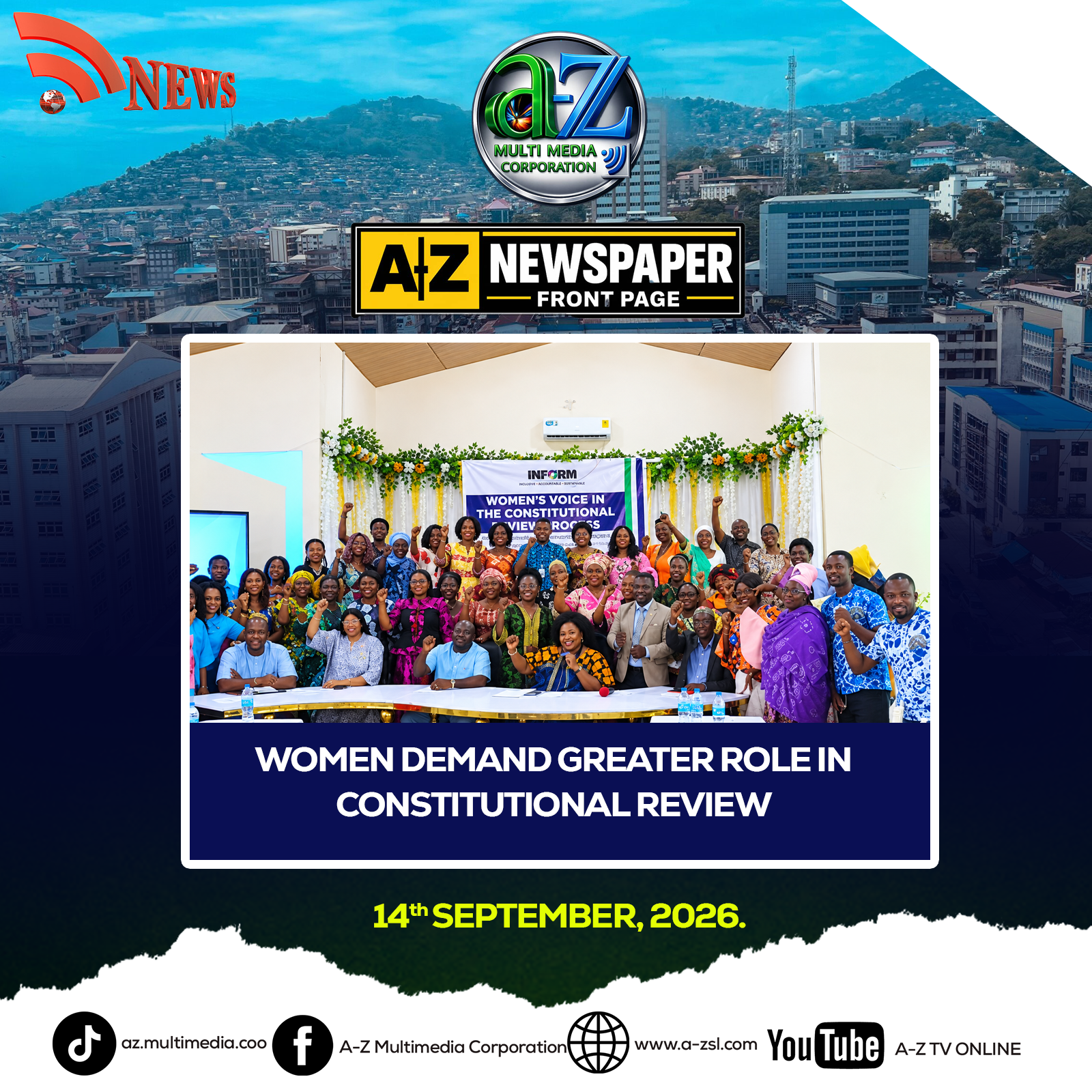
The call was made on Friday during a one-day engagement on “Women’s Voices in the Constitutional Review Process,” organised by the Campaign for Good Governance (CGG) in collaboration with Trócaire.
The engagement brought together women leaders and other stakeholders from all 16 districts to examine the Constitutional Amendment Act 2025, discuss women’s priority concerns and develop strategies for engaging Parliament and other stakeholders as the constitutional review process progresses.
Speaking at the event, CGG Executive Director Marcella Samba Sesay said women’s participation in public life had improved, but stressed that representation must go beyond occupying seats in decision-making spaces.
“We want to get voice,” she said, emphasizing the need for women to have the power and influence to shape decisions affecting the country.
Sesay urged women’s organizations to work together around common priorities and use the constitutional review process to advocate for reforms that would strengthen women’s rights and participation in governance.
Making a presentation on the proposed constitutional reforms, governance expert Ibrahim Bangura Esq. said the review process should be viewed within Sierra Leone’s broader history of constitutional and electoral reforms.
He highlighted key areas covered by the proposed Constitutional Amendment Bill 2025, including electoral institutions, proportional representation, women’s representation, presidential elections, fixed election dates, independent candidacy, executive transitions and security-sector reforms.
On women’s representation, Bangura said the proposed 30 percent requirement should be regarded as a minimum rather than a ceiling. He, however, questioned whether the provision would result in meaningful representation or simply increase the number of women nominated by political parties.
He also explained the need for greater clarity on how the Proportional Representation system would operate, particularly how votes would be translated into parliamentary seats.
Bangura noted that the proposed provision for independent candidates could provide opportunities for qualified citizens to contest elections without relying entirely on political parties.
Fatima M.D. Momodu, Public Relations Officer of the All Political Parties Women Association, also stressed the important role political parties play in determining women’s political representation.
She said that regardless of whether the country operates under the First-Past-the-Post or Proportional Representation system, political parties would remain central to candidate selection and the allocation of party symbols.
Momodu questioned whether simply increasing the number of women nominated would be sufficient, arguing that women must also receive the necessary support to win elections and occupy positions where they can influence decisions.
Speaking on behalf of the Ministry of Gender and Children’s Affairs, Charles Vandi called for greater inclusivity in the constitutional review process, particularly for women, young people and persons with disabilities.
He said the 30 percent target should not be regarded as the ultimate goal, noting that nomination alone does not guarantee election or leadership.
Vandi also called for women’s representation in parliamentary committees and other influential positions to be considered as part of broader efforts to strengthen women’s participation in governance.
Representing Trócaire, George Were said women must be active participants in shaping the laws, institutions and systems that govern their lives.
He urged stakeholders to recognize the diversity of women and ensure that the voices of young women, women with disabilities, women in informal settlements, displaced women, women in faith communities and women-led organizations are included in the process.
Providing background to the engagement, Sahr Kendema, Senior Project Manager at CGG, said the meeting was organised as a follow-up to the parliamentary debate on the Constitutional Amendment Act on August 10.
He said women had not been given sufficient opportunity to collectively assess what had worked, what had not worked and what should be done next.
Kendema said the engagement was also designed to help participants better understand the amendment, the women’s communiqué developed through previous consultations and the implications of the Proportional Representation system.
He stressed that women’s advocacy should not be limited to the 30 percent nomination requirement but should also address appointments and elected positions.
According to Kendema, recommendations and strategies emerging from the engagement will be compiled and used by CGG and its partners to guide engagements with Parliament, the Attorney General and Minister of Justice and other stakeholders.
He said participating women leaders would also take the information back to their respective districts to support wider public education ahead of the referendum.
Kendema said this was particularly important because citizens would ultimately be required to make decisions on the proposed constitutional provisions, making public understanding of the reforms essential.
Participants stressed that the constitutional review presents an opportunity to address longstanding barriers to women’s participation and ensure that women’s concerns are reflected in the country’s supreme law.
For the organizers and participants, the focus is therefore not simply on increasing the number of women in political spaces, but on ensuring that women have a meaningful voice and the influence to shape decisions affecting Sierra Leone’s governance and future.