

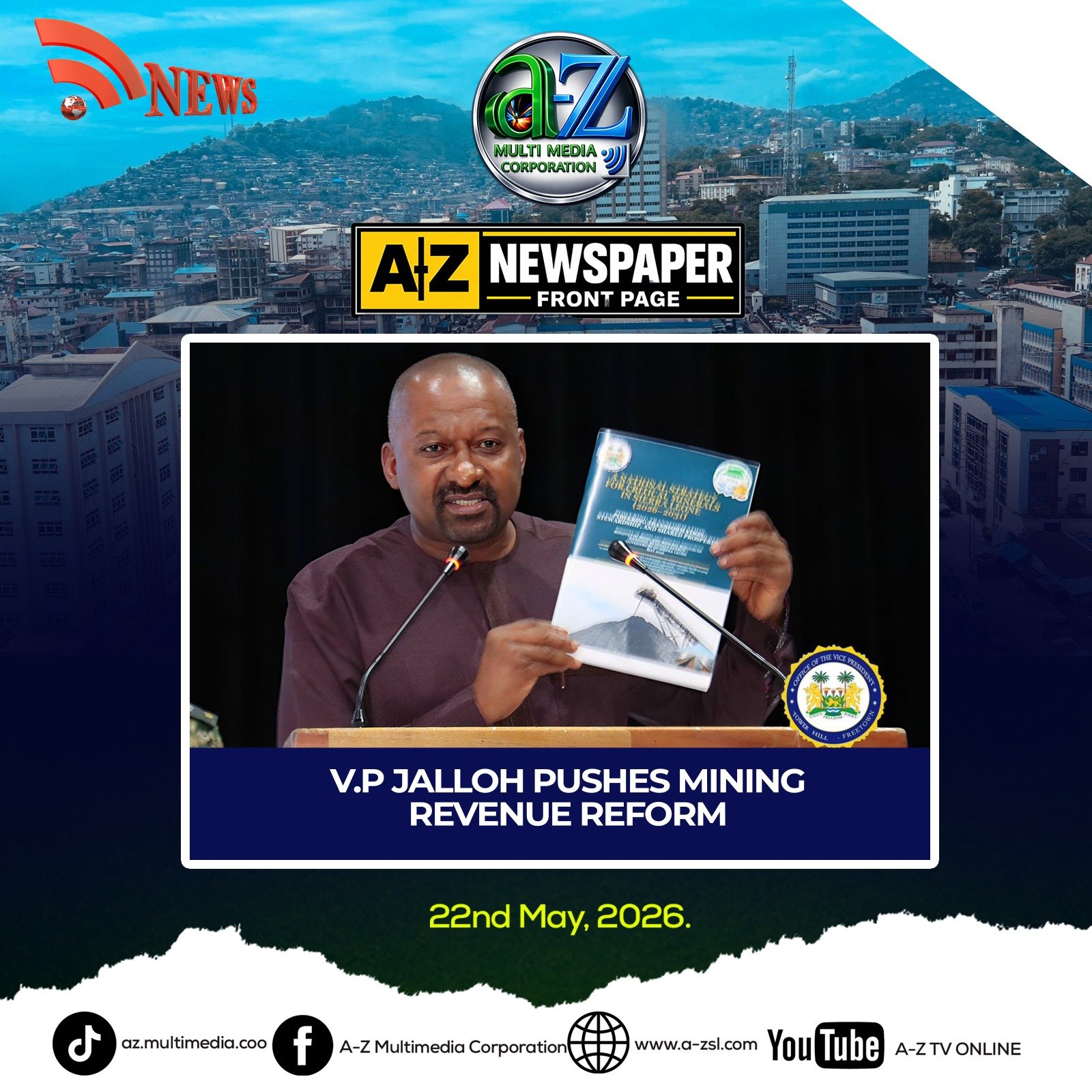
Sierra Leone’s Vice President, Dr. Mohamed Juldeh Jalloh, has delivered one of the clearest signals yet that the country intends to rely less on foreign aid and more on domestic resource mobilization, with the mining sector placed firmly at the centre of that strategy.
Speaking at the Sierra Leone Mining Week 2026, Dr. Jalloh argued that changing global economic realities have made reform unavoidable. “Global aid flows are declining. Development financing is becoming increasingly constrained. Sierra Leone must therefore finance more of its own development,” he said.
For policymakers, economists, and development partners, the speech marked a significant shift in positioning mining not merely as a sectoral issue, but as a national fiscal priority.
The figures underscore the urgency of the reforms. Sierra Leone’s mining sector generated approximately US$1.12 billion in mineral exports in 2024, yet government revenue from the sector amounted to only US$49.9 million, despite a 34 per cent year-on-year increase. “From a billion-dollar export sector, less than five cents of every dollar reaches the national treasury,” the Vice President stated.
For a country grappling with infrastructure deficits, energy subsidies, food security pressures, and rising development demands, the disparity is both politically and economically significant.
The Government now appears determined to close this gap through stronger revenue assurance mechanisms, digital monitoring systems, improved fiscal frameworks, and more effective contractual governance.
Dr. Jalloh also placed the issue within a broader global economic context affecting smaller economies. “What this has done for smaller economies like Sierra Leone is to push us from the politics of development to the politics of redistribution,” he said, referring to the economic pressures caused by global crises such as the war in Ukraine and instability in the Middle East.
In practical terms, he explained that limited domestic revenues are increasingly being diverted toward subsidies rather than long-term capital investment. This context also explains the Government’s growing interest in innovative financing tools, including royalty-backed bonds, stronger state equity participation, and partnerships with institutions such as African Export-Import Bank and African Finance Corporation.
For international observers, Sierra Leone’s policy direction reflects a broader trend among developing economies seeking greater fiscal sovereignty and reduced dependence on foreign aid.
However, the success of these reforms will ultimately depend on governance credibility, institutional capacity, and transparent management of natural resources.
The Vice President’s assertion that “Mining revenue is no longer simply an economic issue. It is a national development and security imperative,”
suggests that the Government views mining reform not as routine administrative adjustment, but as a strategic national necessity.
If implemented effectively, Sierra Leone’s mining revenue agenda could emerge as a model for how resource-rich, aid-dependent economies reposition themselves within a changing global financial landscape.