

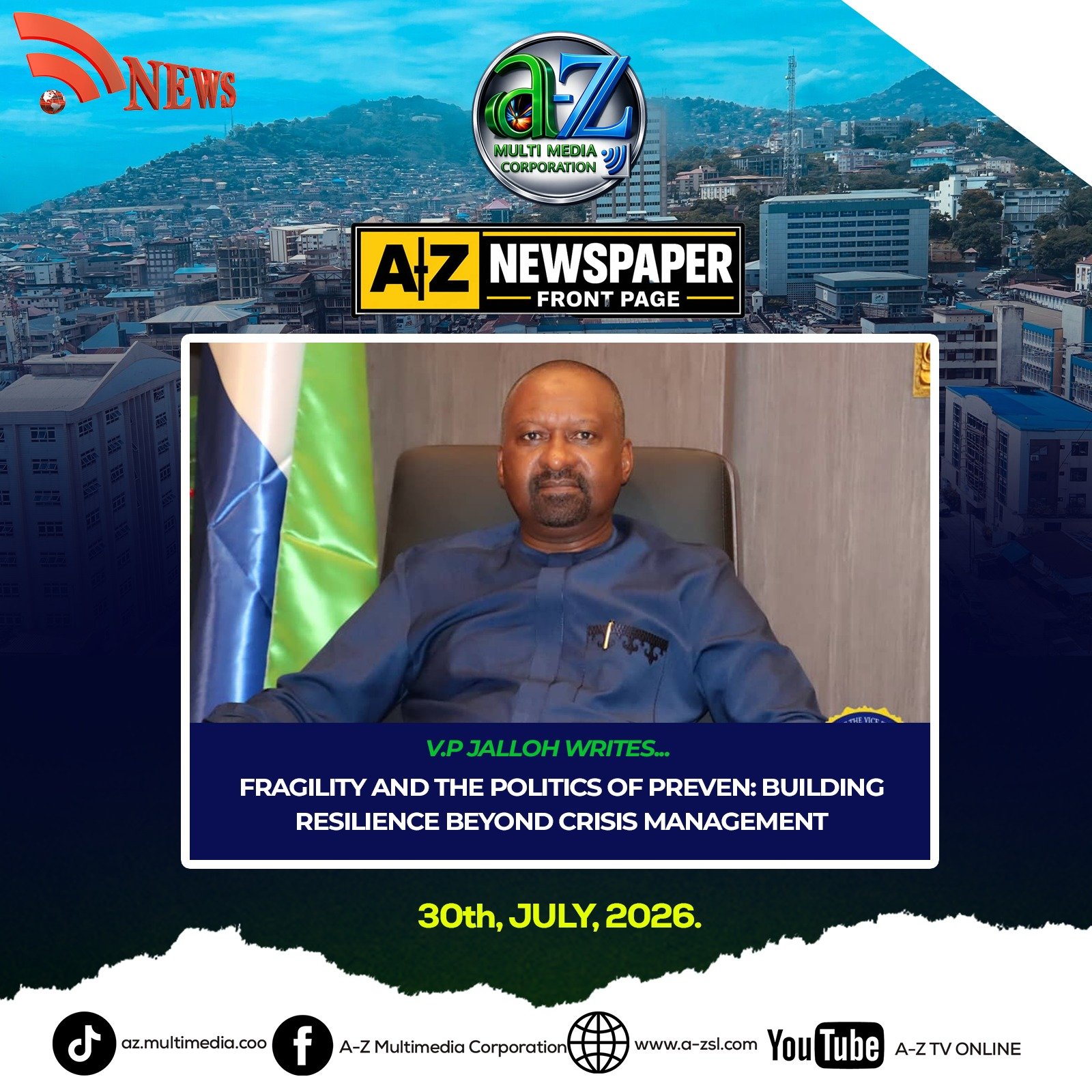
By: H.E. Dr Mohamed Juldeh Jalloh
Vice President of the Republic of Sierra Leone
A few years ago, government leaders in developing countries were primarily concerned with challenges such as debt, unemployment, and electoral pressures.
Today, these challenges have become interconnected and more complex. They are compounded by climate shocks, food and fuel crises, rising debt obligations, and declining predictability in development assistance. At the same time, citizens continue to rightly demand better public services, more employment opportunities, and improved living standards.
For countries like Sierra Leone, this reality has created what I describe as the politics of painful choices. Should governments invest more in climate resilience or expand social protection? Should they build critical infrastructure or strengthen health systems? Should they increase agricultural productivity or focus on servicing rising debt obligations? All these priorities are essential, yet fragile states often lack the fiscal space to address them simultaneously.
Too often, the response to these pressures becomes a politics of redistribution — shifting limited resources from one urgent need to another. What is required instead is a politics of prevention: an approach that expands opportunities, strengthens resilience, and increases the resources available to address future challenges.
Fragility is frequently treated as a temporary condition. However, for many countries, it is not simply a passing phase, but a long-term reality shaped by limited domestic revenue, climate vulnerability, infrastructure gaps, rapid population growth, and repeated external shocks. These factors restrict long-term investment and keep governments trapped in a cycle of crisis response.
One of the greatest paradoxes of development is that the world continues to spend far more responding to crises than preventing them. Yet prevention is almost always more cost-effective than recovery. Investments in infrastructure, climate adaptation, healthcare, education, and youth employment do more than improve living standards; they strengthen the social contract and increase public confidence in state institutions. Unfortunately, these are often the first areas affected when fiscal pressures intensify.
At its core, this is not only an environmental challenge but also a question of fiscal, social, and political sustainability.
Perhaps the clearest example of prevention is the first 1,000 days of a child’s life. The period from pregnancy to a child’s second birthday represents a critical window that shapes cognitive development, educational outcomes, future earnings, and a country’s productive capacity.
In Sierra Leone, approximately 700 children are born every day. Each represents a future worker, entrepreneur, teacher, or leader. The decisions we make during those first 1,000 days will influence our nation’s resilience and prosperity for generations. This is why nutrition must not be viewed as merely a sectoral issue but as a national development priority.
Our approach brings together initiatives such as Feed Salone, food fortification, school feeding programmes, nutrition-responsive budgeting, and the proposed Nourish Salone movement into a unified national agenda focused on human capital development.
Sierra Leone is committed to playing its part. We are investing in human capital, advancing agricultural transformation, strengthening climate resilience, and creating conditions that encourage private sector investment. However, national ambition alone cannot close the financing gap.
The future of development cannot depend on aid alone. The global conversation, including discussions at the Hamburg Sustainability Conference, must move beyond commitments and declarations. Three priorities are essential:
First, fragile states require more predictable concessional financing to support long-term development. Second, stronger risk-sharing mechanisms and guarantees are needed to encourage investment and make smaller-scale projects more viable.
Third, development finance must become more flexible and better suited to the realities of countries facing fragility, climate vulnerability, and demographic pressures.
The countries most affected by these challenges need systems designed around their circumstances, rather than models developed for stronger economies and later adapted to fragile contexts.
The true goal of development should not simply be helping countries manage crises more effectively. It should be enabling them to escape the cycle of crisis altogether moving from survival to transformation, from redistribution to productivity, from fragility to resilience, and from dependency to partnership.
The question is not whether fragile states can build a better future. They can. The question is whether the global system will evolve quickly enough to support them in making that future a reality.
The Forum “Sustainable Development 2030 and Beyond”, held in cooperation with the Hamburg Sustainability Conference, brings together leaders from government, international organizations, business, academia, and civil society to explore how sustainable development can advance in a world shaped by geopolitical tensions, economic constraints, technological disruption, and competing priorities.
The forum focuses on solutions, partnerships, and strategies for achieving sustainable development beyond 2030, with discussions centered around the key themes of the Hamburg Sustainability Conference 2026, scheduled for June 29-30.