

By: Mohamed Sahr
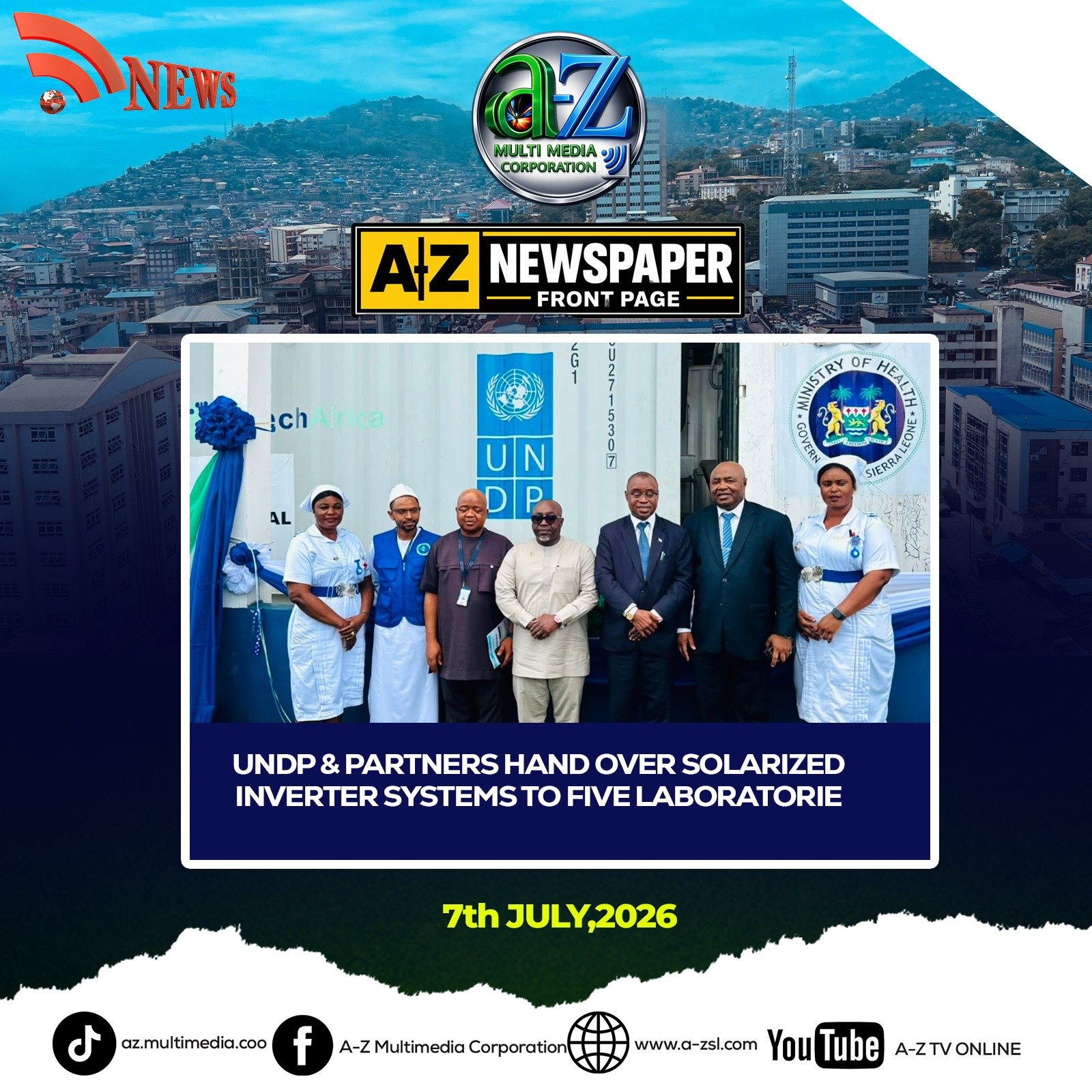
The United Nations Development Programme (UNDP), in collaboration with the Ministry of Health and the Global Fund, has officially handed over solar-powered inverter systems to five major public health laboratories as part of efforts to strengthen reliable, clean and renewable energy services for Sierra Leone’s health sector.
The symbolic handover ceremony took place on Monday, 6 July 2026, at Lakka Government Hospital, with similar systems installed at laboratories in Lakka, Kenema, Port Loko, Makeni and Bo.
Delivering the keynote address, Deputy Minister of Health, Dr. Charles Senesie, said the initiative reflects President Julius Maada Bio’s commitment to human capital development and improving healthcare delivery across the country.
He thanked UNDP, the Global Fund for their continued support to the health sector, noting that reliable electricity is critical for laboratory services, which form the backbone of disease diagnosis and surveillance. “Laboratories are essential to healthcare because they support accurate diagnosis and effective treatment,” Dr. Senesie said. “We appreciate our partners for complementing government’s efforts to improve access to quality health services.”
He disclosed that more than 50 health facilities across the country have already been fully solarized as part of the government’s broader strategy to improve healthcare infrastructure. According to him, the Ministry remains committed to expanding access to reliable energy in health facilities, particularly laboratories, while strengthening the country’s laboratory accreditation programme.
Dr. Senesie also noted that the handover coincided with the opening of the Global Fund Board Meeting in Geneva, where he serves as a member of the West and Central Africa constituency and sits on the Strategy Committee.
Speaking at the event, UNDP Resident Representative Fredrick Ampiah described the project as an investment in resilience, equity and the future of public health in Sierra Leone. He said the solarized laboratories would significantly improve healthcare delivery by ensuring uninterrupted electricity for laboratory operations.
According to Ampiah, only 36 percent of Sierra Leone’s population currently has access to electricity, while access in rural communities remains as low as 4.9 percent. He added that nearly 80 percent of the country’s energy consumption still depends on traditional biomass such as firewood and charcoal. “This highlights the urgent need to expand renewable energy, strengthen health systems, build climate resilience and improve people’s quality of life,” he said.
Ampiah emphasized that reliable electricity is indispensable for laboratory services.
“A laboratory without reliable power cannot consistently deliver timely diagnoses, preserve critical samples or respond effectively during public health emergencies,” he said.
He noted that by investing in clean and renewable energy, UNDP and its partners are strengthening Sierra Leone’s ability to detect, respond to and recover from disease outbreaks while ensuring continuity of essential health services during power outages.
He further observed that climate change is increasingly becoming a public health challenge, with rising temperatures, changing disease patterns and extreme weather placing additional pressure on health systems.
“Every unit of clean energy generated contributes not only to lower emissions but also to more reliable, affordable and sustainable healthcare for communities,” he added.
Ampiah reaffirmed UNDP’s commitment to working with the Government of Sierra Leone and development partners to expand renewable energy initiatives that improve access to clean, affordable and sustainable energy while strengthening essential public services.
Providing an overview of the project, Chief Medical Officer Dr. Sartie Kanneh said the initiative was inspired by lessons learned during the Ebola and COVID-19 outbreaks, when frequent electricity interruptions severely affected laboratory operations. “Laboratories are central to outbreak response,” he said. “They guide surveillance and provide the evidence needed for effective public health decisions.”
He recalled that power outages often interrupted laboratory testing, forcing technicians to restart procedures and discard valuable samples and reagents.
“There were days when tests requiring eight hours could not be completed because electricity failed after six hours,” he explained. “Sometimes we managed to conduct only one test instead of three in a single day because of unreliable power.”
Dr. Kanneh said Lakka had previously benefited from a World Bank-supported solar installation, but the system was insufficient to meet growing laboratory demands.
Following the COVID-19 pandemic, the Ministry successfully engaged the Global Fund to repurpose part of its COVID-19 grant to strengthen laboratory infrastructure through expanded solarization. Recognizing procurement challenges associated with international competitive bidding, the Ministry partnered with UNDP to implement the project efficiently. “We are grateful to the Global Fund for allowing us to repurpose the grant and to UNDP for helping implement the project. Without that support, we could have lost the funding,” he said.
Dr. Kanneh disclosed that the project represents an investment of more than US$2 million, implemented through collaboration between the Ministry of Health, UNDP, UNICEF, WHO, UNFPA and other development partners under the Global Fund COVID-19 grant. He praised UNDP for successfully managing procurement and implementation, noting that cost efficiencies achieved during the process enabled the project to expand beyond its original scope.
The upgraded solar capacities include Central Public Health Reference Laboratory (Lakka): 120 kVA, Lakka Tuberculosis Laboratory: 100 kVA, Kenema Regional Laboratory: 200 kVA, Makeni Regional Laboratory: 150 kVA, Port Loko Regional Laboratory: 100 kVA and Bo Regional Laboratory: An additional 20 kVA was installed to complement an existing solar system previously supported by Johns Hopkins University.
According to Dr. Kanneh, the upgraded systems will significantly improve laboratory services and strengthen Sierra Leone’s national laboratory network.
While welcoming the completion of the project, Dr. Kanneh expressed concern over repeated attempts to steal solar equipment, particularly in Kenema and Makeni, with isolated incidents also reported in Port Loko.
He called on District Medical Officers, Medical Superintendents and other health managers to take full ownership of the facilities. “Every investment made in your health facility belongs to the people you serve. It is your responsibility to protect these systems and ensure they continue delivering quality healthcare for our communities,” he urged. The solar-powered inverter systems are expected to provide uninterrupted electricity for critical laboratory services, improve disease surveillance, enhance emergency preparedness and contribute to more resilient and climate-friendly healthcare delivery across Sierra Leone.