

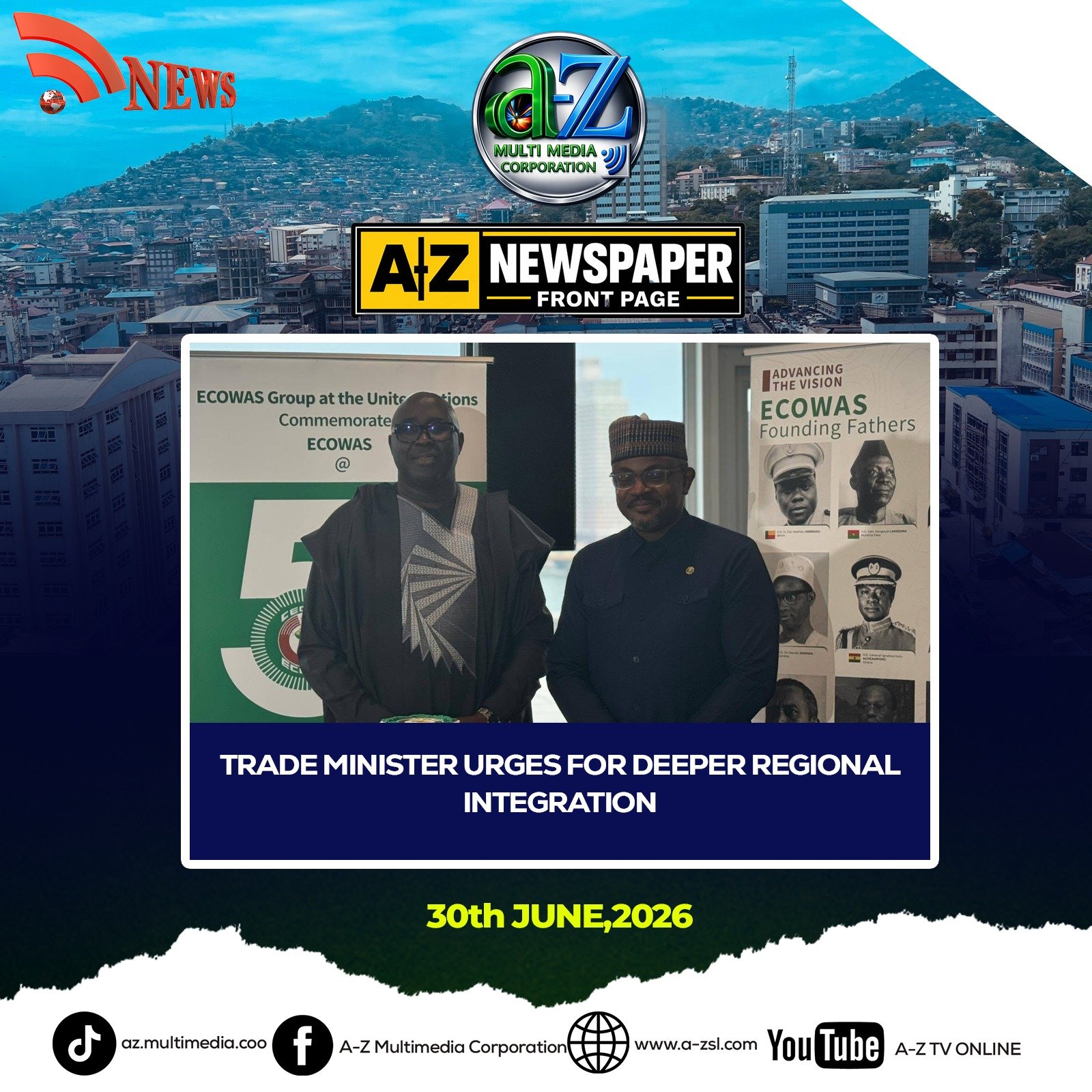
ECOWAS Council of Trade Ministers Chair urges stronger trade, investment, and regional cooperation as the foundation for lasting peace in West Africa.
The ECOWAS Group of Ambassadors in New York, in collaboration with the ECOWAS Permanent Observer Mission to the United Nations, convened the ECOWAS Day at the UN 2026 High-Level Event at the Trusteeship Council Chamber, United Nations Headquarters. The event brought together senior UN officials, ministers, regional commissioners, representatives of international financial institutions, private sector leaders, and civil society to advance trade and economic integration as pillars of lasting peace and resilience in West Africa.
Addressing intra-regional trade, Minister Sesay observed that trade among ECOWAS member states remains at approximately 12 percent of total trade, compared with 58 percent in Asia and 67 percent in Europe. He argued that the demand for a truly integrated regional market already exists through the daily movement of goods across borders, much of it occurring informally. The priority, he said, should be to formalize and support this trade rather than constrain it.
The Minister also highlighted the economic costs of climate change and regional fragility, noting that climate-related impacts cost African economies between 5 and 15 percent of GDP annually. He further observed that more than 34.7 million people across West Africa required urgent food assistance in 2025, despite an estimated US$10 billion in annual intra-regional food trade. A stronger regional market, he argued, would improve food security and strengthen resilience against instability.
A central theme of his address was the importance of empowering women and young people. Women account for approximately 74 percent of informal cross-border traders in West Africa, making simplified trade procedures, women-friendly border infrastructure, and protection from harassment essential components of economic policy rather than social welfare initiatives. He also stressed that youth employment remains West Africa’s defining development challenge, warning that regional integration cannot succeed unless it creates meaningful opportunities for young people.
Held under the theme, “Investing in Peace, Prosperity and Resilience in West Africa: Building Partnerships for Regional Economic Integration, Trade and Development,” the event commemorated the 51st anniversary of ECOWAS and the 20th anniversary of the United Nations Peacebuilding Fund. The dual celebration underscored the growing relationship between economic integration, sustainable development, and conflict prevention across the region.
The programme opened with remarks by H.E. Dr. Michael Imran Kanu, Ambassador and Permanent Representative of Sierra Leone to the United Nations and Chair of the ECOWAS Group in New York. He was followed by H.E. Ms. Kinza Jawara-Njai, ECOWAS Permanent Observer to the United Nations, while United Nations Deputy Secretary-General H.E. Ms. Amina J. Mohammed delivered the keynote statement.
The principal address was delivered by H.E. Mr. Alpha Ibrahim Sesay, Sierra Leone’s Minister of Trade and Industry and Chair of the ECOWAS Council of Trade Ministers. Conveying the greetings of H.E. Dr. Julius Maada Bio, President of the Republic of Sierra Leone and Chair of the ECOWAS Authority of Heads of State and Government, Minister Sesay presented a compelling case for deeper regional integration, arguing that economic cooperation is not only a driver of development but also one of the strongest foundations for lasting peace.
He described ECOWAS as a community of more than 450 million people with a combined purchasing-power economy valued at approximately US$3.4 trillion and projected regional economic growth of 7.1 percent by 2027. Despite this potential, he noted that the region continues to face insecurity, violent extremism, climate change, youth unemployment, and economic fragmentation. Following the withdrawal of three Sahel states in January 2025, he stressed that the solution to these challenges is greater integration not less.
Drawing on Sierra Leone’s experience, Minister Sesay acknowledged that the country’s exports remain heavily dependent on raw commodities, with iron ore accounting for approximately 55 percent of exports in 2024, while rice imports continue to dominate food consumption. He argued that regional integration offers the opportunity to transform this pattern by promoting value addition, industrialization, food security, and regional trade.
He outlined several reforms already undertaken by Sierra Leone, including the implementation of ASYCUDA World, the launch of an electronic Single Window system, adoption of the ECOWAS Common External Tariff, and the country’s commitment to implementing 82.8 percent of the WTO Trade Facilitation Agreement by 2027. He also highlighted Sierra Leone’s ratification of the African Continental Free Trade Area (AfCFTA) in 2019 and the convening of its National AfCFTA Implementation Committee in June 2025 in collaboration with the AfCFTA Secretariat and the United Nations Economic Commission for Africa.
Minister Sesay further explained that Sierra Leone’s flagship Feed Salone initiative aligns closely with regional integration by reducing food imports, increasing domestic agricultural production, creating jobs, and expanding export opportunities across West Africa.
Reflecting on Sierra Leone’s journey from post-conflict recovery to economic transformation, the Minister described the country as both a peacebuilding success story and an emerging trade and investment destination. He noted that these achievements are interconnected and demonstrate how peace and economic integration reinforce one another.
A significant portion of the discussion focused on the complementary roles of the ECOWAS Peace Fund and the United Nations Peacebuilding Fund. Minister Sesay described the two mechanisms as mutually reinforcing instruments that strengthen governance, build institutional resilience, and create the stable environment necessary for private sector investment and economic growth.
He noted that the UN Peacebuilding Fund has invested more than US$1.4 billion since its establishment, with nearly three-quarters of its current portfolio supporting African countries. However, he also highlighted a financing gap of approximately US$500 million, calling on development partners to help close the shortfall.
The Minister argued that investments in peacebuilding should be viewed as investments in trade and economic development because stronger institutions and improved governance lower investment risks and create more attractive conditions for private sector participation.
In his concluding remarks, Minister Sesay called on the United Nations system and the Peacebuilding Fund to recognize trade infrastructure and economic opportunity as long-term investments in peace. He urged the European Union, African Union, World Bank, and African Development Bank to align their financing instruments with the ECOWAS regional integration agenda while expanding climate adaptation financing for West Africa.
Addressing private sector leaders, he described West Africa as one of the world’s most promising emerging markets and reaffirmed that Sierra Leone is open for business and welcomes investment based on fair, mutually beneficial partnerships.