

By: Mohamed J. Bangura
The Sierra Leone Meteorological Agency (SLMet) is seeking increased government funding to modernize its weather observation network, strengthen its operational capacity and improve the delivery of reliable weather and climate information across the country.
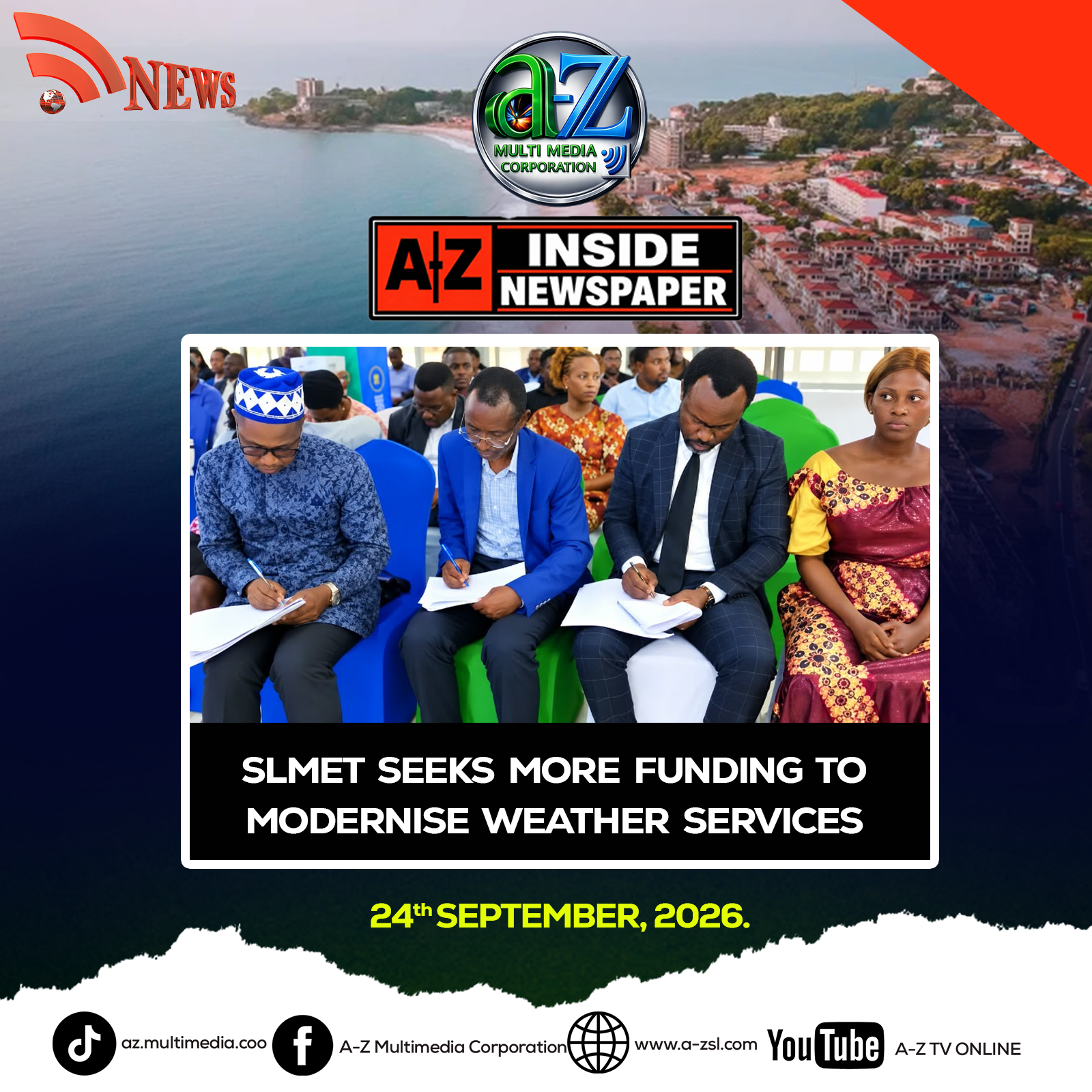
Deputy Director of Public Relations and Communications at SLMet, Ibrahim Sei Kamara, made the call on Wednesday, September 23, 2026, during the Agency’s FY2027 Budget Hearing at the Miatta Civic Centre in Freetown.
Presenting SLMet’s budget priorities, Kamara said the Agency had operated for years under significant financial and operational constraints, limiting its ability to effectively monitor weather conditions and provide timely meteorological services.
He said increased funding would enable SLMet to strengthen its workforce, maintain critical equipment, improve mobility and expand weather monitoring operations across the country.
According to Kamara, SLMet has been allocated an indicative budget ceiling of NLe18.9 million, while the Agency has submitted additional funding requirements of approximately NLe12.16 million to meet specific operational needs.
“We want to be able to leap. In leaping, we are asking for the support of the Ministry of Finance,” Kamara said.
He explained that meteorological information plays an important role in national development, particularly in agriculture, disaster preparedness, aviation, marine activities and transportation.
Kamara identified inadequate operational funding, ageing infrastructure, limited transportation and insufficient maintenance of meteorological equipment as major challenges facing the Agency.
He said the lack of vehicles was affecting SLMet’s ability to conduct monitoring and maintenance activities, particularly in remote parts of the country.
“No vehicles, no monitoring, no maintenance. Zero operational is clear,” he said.
To address these challenges, SLMet is prioritizing operational support, staff training, capacity building, improved mobility and the maintenance of meteorological stations under its FY2027 budget.
Kamara said some observation stations across the country are ageing, while others have been damaged or affected by access and security challenges.
He cited reported damage to stations in Waterloo and Kabala, while poor road conditions have also affected access to the Agency’s main station at Zaka.
He said SLMet was placing greater emphasis on community engagement when establishing or rehabilitating meteorological facilities to ensure that communities understand their importance and contribute to protecting them.
“We are saying we want to modernize our observation network and also our climate-specific facilities,” he said.
The Agency is also proposing investments in regional meteorological facilities in Bo, Kenema, Makeni, Port Loko and Kabala.
Kamara said strengthening these facilities would improve weather forecasting, data collection and the Agency’s ability to provide services around the clock.
He identified Kabala as a strategic location because of its historical importance as a meteorological observation point.
SLMet is also seeking support to establish a National Calibration Facility and Climate Data Archive to improve the accuracy of meteorological equipment and preserve important weather and climate records.
Kamara said reliable electricity, internet connectivity and secure data infrastructure would be critical to achieving these objectives.
The Agency is further seeking to improve the resilience of its infrastructure and address challenges affecting facilities located in difficult environments.
Kamara cited an agricultural meteorological station at Magburaka, which he said had become difficult to access following the development of a military barracks in the area.
He said SLMet would engage the relevant authorities on the possible relocation and improvement of the facility.
Kamara stressed that strengthening meteorological services would have direct benefits for national development, including improved agricultural planning, disaster preparedness, aviation safety, marine operations and climate resilience.
The Agency also intends to strengthen partnerships with development partners and other institutions while exploring co-financing opportunities to improve its technical capacity.
Kamara highlighted Sierra Leone’s participation in international meteorological and climate initiatives, including programmes supported by the World Meteorological Organization (WMO).
He said SLMet’s ambition was to ensure that weather and climate information generated by the Agency is accurate, timely, accessible and useful to citizens, businesses and government institutions.
He therefore called on the Ministry of Finance and other stakeholders to support SLMet’s FY2027 funding proposals, stressing that investment in meteorological services should be viewed not simply as institutional expenditure, but as an investment in public safety, food security, climate resilience and Sierra Leone’s wider development.