

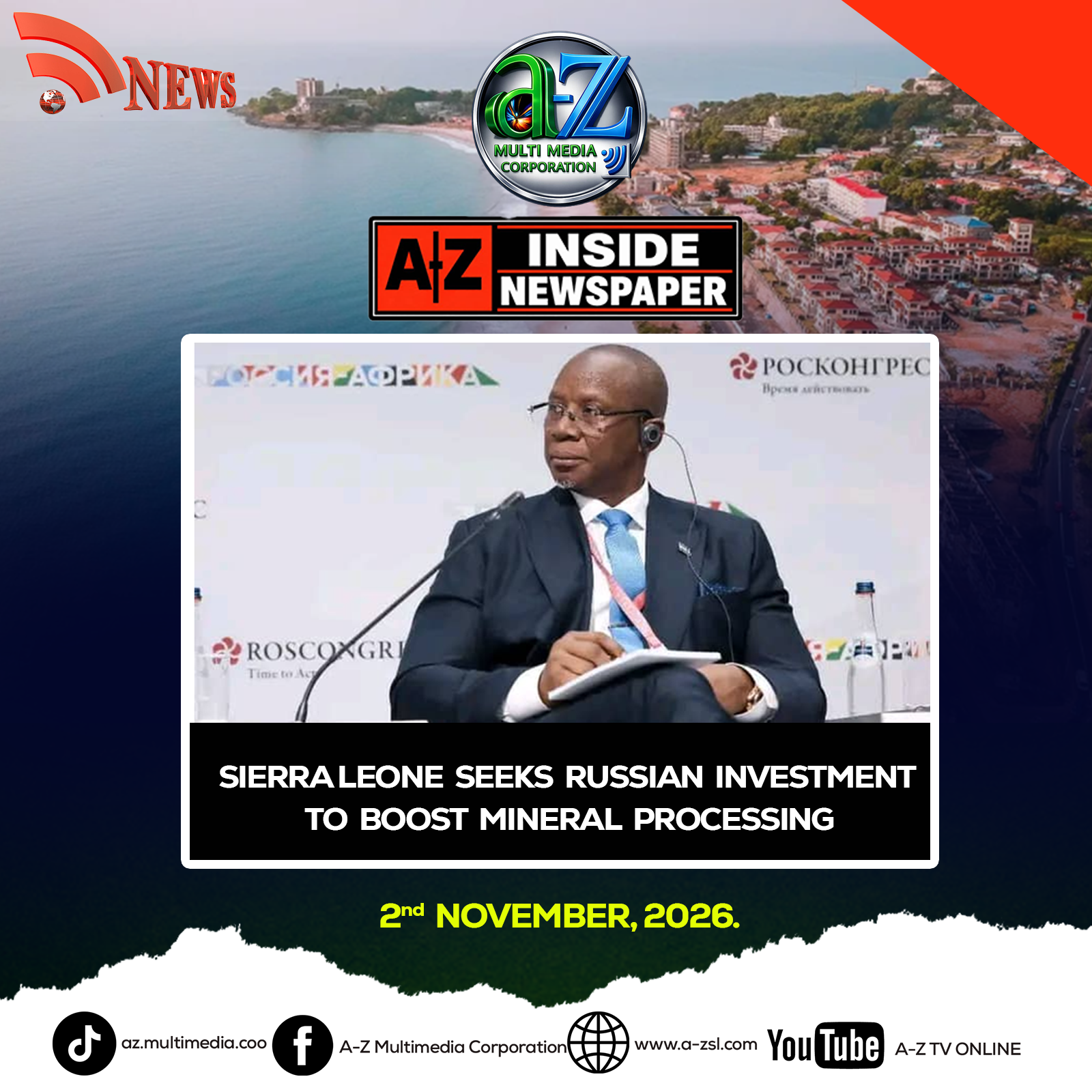
By: Mohamed J. Bangura
Sierra Leone has called for increased Russian investment and technical cooperation in geological exploration, mineral processing and skills development as part of efforts to unlock its mineral wealth, strengthen local industries and maximize the economic benefits of its natural resources.
The Minister of Mines, Julius Daniel Mattai, made the call while addressing the Russia-Africa Summit in Moscow on Wednesday, October 28, 2026, where he outlined opportunities for stronger bilateral cooperation in the mining sector.
Minister Mattai said the possession of abundant mineral resources does not automatically translate into economic prosperity, stressing that deliberate investment in geological research, modern technology, effective governance and technical expertise is essential to developing the country’s mining industry.
He noted that Sierra Leone is endowed with commercially important minerals, including iron ore and diamonds, while promising deposits of critical minerals such as lithium, cobalt, nickel and coltan present further opportunities for investment and industrial development.
According to him, strengthening geological exploration is necessary to establish the quantity, quality and commercial viability of the country’s mineral deposits before they can be developed effectively.
“We need to understand our geology better,” he emphasised, calling for systematic geological surveys and drilling to transform preliminary mineral discoveries into properly assessed mineral resources and reserves.
The Minister also referenced a Memorandum of Understanding signed in June 2024 on the inventory of Sierra Leone’s mineral resources, describing reliable geological information as fundamental to attracting investment and guiding responsible mineral development.
A major priority highlighted in his address was the need for Sierra Leone to move beyond exporting raw minerals and develop local processing and manufacturing capacity.
He stressed that increased investment in mineral beneficiation, smelting, refining and processing would create employment, strengthen local expertise and enable the country to retain greater economic value from its natural resources.
However, he acknowledged that achieving this ambition would require substantial investment in critical infrastructure, particularly reliable electricity, roads and port facilities to support industrial operations.
Mattai also underscored the importance of transparent, predictable and investor-friendly mining laws and fiscal policies that provide investment certainty while protecting Sierra Leone’s national interests.
On geological development, he identified modern geophysical technologies, including radiometric and magnetic surveys, as essential tools for identifying mineral-rich areas, improving exploration and reducing investment risks.
He further called for improved access to reliable geological, geophysical and geochemical data to support investment decisions and strengthen the government’s management of the mining sector.
The Minister maintained that transparency and accountability in the management of mining revenues must remain central to ensuring that the country’s mineral wealth translates into tangible economic and social benefits for its citizens.
On international cooperation, Mattai expressed Sierra Leone’s interest in strengthening partnerships with Russian universities and technical institutions in geology, geophysics, chemistry, mining engineering and mineral processing.
Potential areas of collaboration include scholarships for Sierra Leonean students, academic exchanges, laboratory development, technical training and the application of artificial intelligence in geological modelling and mineral exploration.
He also identified energy cooperation as another important area, particularly the development of reliable energy solutions to support industrial growth and mineral-processing activities.
Drawing on his educational experience in the former Soviet Union, the Minister highlighted the importance of academic and technical partnerships in building the skilled workforce needed to advance Sierra Leone’s mining industry.
He further noted that Africa’s population, projected to increase from approximately 1.5 billion to 2.5 billion by 2050, presents significant opportunities for industrial development, trade and investment.
Against the backdrop of growing global demand for critical minerals, Mattai urged African countries to use their natural resource potential to negotiate partnerships that promote local industrialization rather than remain suppliers of unprocessed raw materials.
He observed that the concentration of much of the world’s mineral processing and refining capacity in China presents an opportunity for African countries to benefit from the diversification of global mineral supply chains.
The Minister stressed that Sierra Leone remains open to international partnerships founded on mutual respect, national sovereignty and shared economic benefits, adding that the country is not interested in taking sides in global geopolitical competition.
“We are not looking East. We are not looking West. We are not looking North or South. We are looking downward into the ground to make more discovery and move forward to make sure we prosper,” he said.
Mattai’s presentation highlighted Sierra Leone’s ambition to attract responsible international investment, strengthen local technical capacity and develop a mining industry capable of creating employment, promoting industrialization and contributing to sustainable economic growth.
He emphasised that the ultimate measure of success should not be the volume of minerals extracted, but the extent to which the country’s mineral wealth improves the lives and livelihoods of its people.