

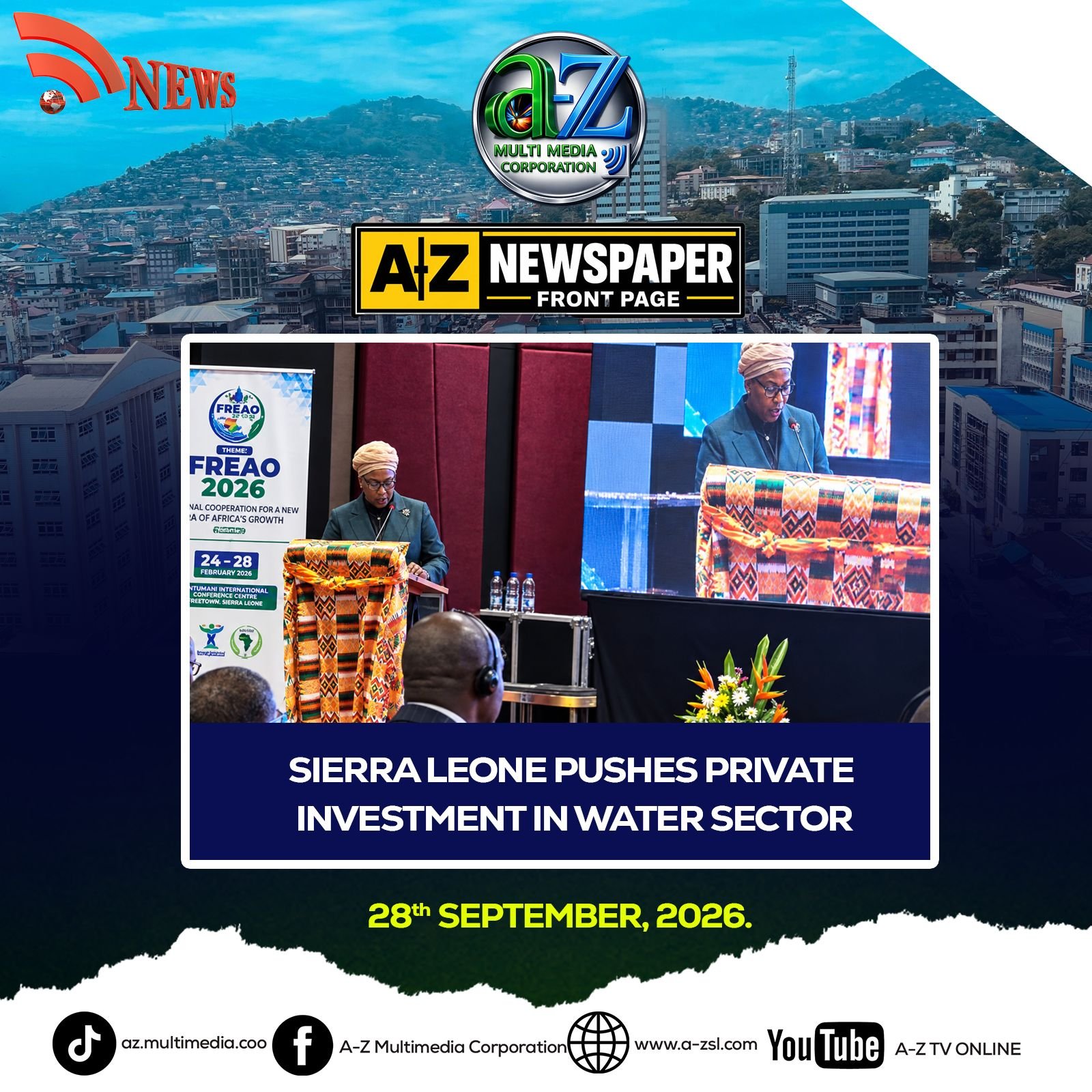
Sierra Leone has called for stronger institutional coordination, increased private-sector investment and greater regional cooperation to improve water security and WASH services across West Africa.
The call was made at the inaugural West Africa Regional Water Forum (FREAO 2026), held in Abidjan, Côte d’Ivoire, from September 24–25 under the theme, “Valuing Water to Transform West Africa.”
The forum brought together policymakers, technical experts, development partners, private-sector actors and civil society representatives to discuss integrated water resources management, water infrastructure financing, the Water-Energy-Food-Environment Nexus, social inclusion and hydro-diplomacy.
Speaking during one of the sessions, Sierra Leone’s Minister of Water Resources and Sanitation, Dr. Sao-Kpato Hannah Isatta Max-Kyne, said the Government was working to create an enabling environment for private-sector participation in the water and sanitation sector while strengthening institutional coordination.
“Basically, our programmes are designed to protect and improve access to water and sanitation services, while also encouraging greater participation from the private sector,” she said.
The Minister said the Government had been working with local and international partners to establish mechanisms that would support private investment and improve the sustainability of water and sanitation services.
“Beyond private-sector participation, we are also looking at strengthening our systems and creating an enabling environment for investment in the water and sanitation sector,” she said.
She explained that the objective was to develop a more sustainable system capable of attracting investment while improving service delivery.
Financing was identified as one of the major challenges facing the region, with participants highlighting the need for public-private partnerships, climate finance, development finance and innovative financing mechanisms to support water supply, sanitation, irrigation, wastewater management, storage, treatment and climate-resilient infrastructure.
Dr. Max-Kyne also stressed that investment in infrastructure must be matched by clear institutional responsibilities and practical results for communities.
She called for closer collaboration among water-resource management institutions, utilities, local councils and environmental authorities, noting that responsibilities for protecting water sources, regulating water resources and delivering services must be clearly defined and coordinated.
“We should measure institutional performance through practical results: reliable services, water quality, functioning infrastructure and effective protection of our water resources,” she said.
The Minister further emphasized the importance of involving communities, including women, young people and water users, in the planning, implementation and maintenance of water and sanitation services.
“For us, policies are not the problem. The real issue is how we work together as different institutions, how we work with communities, and how we work with development partners to ensure that our policies translate into practical results,” she said.
The forum also emphasized the importance of regional cooperation and hydro-diplomacy in managing shared river basins, improving data sharing, preparing for floods and droughts, and ensuring that transboundary water resources contribute to regional development.
The discussions underscored the need for West African countries to move towards more coordinated water governance systems that can attract investment, protect water resources, strengthen climate resilience and improve access to reliable water and sanitation services.