

By: Mamajah Jalloh
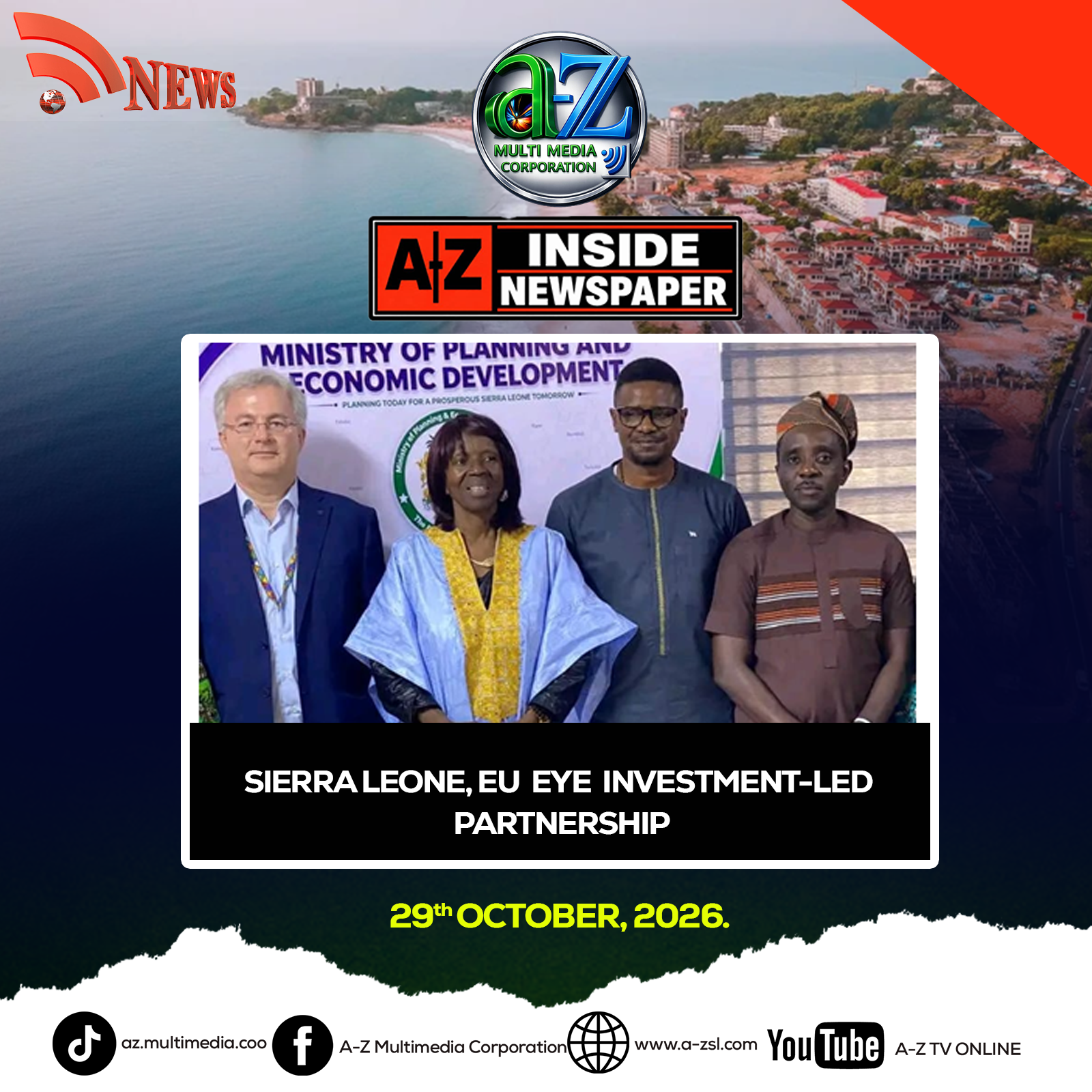
Sierra Leone and the European Union (EU) have begun consultations on a proposed 2028–2034 partnership, with the Government prioritizing private-sector investment, youth employment, skills development, climate action and regional cooperation.
The discussions took place during an EU Pre-Programming Consultation held at the Ministry of Planning and Economic Development (MoPED) Conference Room in Freetown on Tuesday, 27 October 2026. The meeting brought together ministers, representatives of Ministries, Departments and Agencies (MDAs), and officials of the EU Delegation to identify development priorities for the next programming period.
Opening the consultation, Minister of Planning and Economic Development, Hon. Kenyeh Barlay, said future cooperation must align with Sierra Leone’s Medium-Term National Development Plan (MTNDP) 2024–2030 and the Government’s Big Five Game Changers, while preparing for development priorities beyond the current plan.
She identified youth employment, food security, reliable energy, human capital development, digital transformation and climate resilience as key priorities, stressing the need for coordinated investments in skills, finance, infrastructure, transport and market access.
Minister Barlay also called for stronger national ownership of development programmes, urging relevant MDAs to take responsibility for setting priorities, implementing projects, monitoring progress and sustaining results. She said MoPED’s National Authorizing Office would continue coordinating EU development cooperation alongside its work on South-South and Triangular Cooperation.
Development Secretary Ambrose James said the EU was increasingly exploring regional and continental financing approaches rather than focusing exclusively on individual countries. He encouraged Sierra Leone to pursue opportunities through regional institutions, including the Economic Community of West African States (ECOWAS) and the Mano River Union.
James also highlighted the EU’s Global Gateway initiative, which seeks to mobilize investment in infrastructure and sustainable development. He said Sierra Leone needed to demonstrate its competitive advantages and develop projects capable of attracting European private-sector investment.
Stéphane Meert, Head of Cooperation at the EU Delegation to Sierra Leone, urged the Government to identify the major trends likely to shape the country over the next five to ten years. These include demographic changes, climate change, food security, energy, skills shortages and private-sector growth.
He said Sierra Leone should also identify areas in which the EU could provide particular value and support investments capable of delivering long-term economic benefits.
Meert cited a proposed waste-to-energy project by Infinitum as an example of how private investment could address environmental challenges while generating electricity and employment. The proposed project in Freetown is expected to process about 30 per cent of the city’s daily waste and generate approximately 30 megawatts of electricity, with an estimated investment of €200 million.
He also highlighted opportunities in plastic recycling; digital governance and technical training, stressing that private-sector partnerships could create more sustainable employment opportunities.
Meert called for closer collaboration between employers and training institutions to address skills shortages in logistics, shipping and equipment maintenance, noting that training programmes should respond directly to labour-market needs.
On agriculture, he warned that contamination associated with chemical fertilizers could threaten Sierra Leone’s organic cocoa exports. He stressed that protecting forests and maintaining organic production standards were essential to preserving the country’s competitive advantage in the international cocoa market.
Meert urged Sierra Leone to protect its niche in organic cocoa rather than compete directly with major producers of conventional cocoa.
Deputy Minister of Finance Kadiatu Alie called for a long-term development strategy based on Sierra Leone’s competitive advantages. Referring to the African Development Bank’s Country Diagnostic Report, she highlighted opportunities in rice production, solar energy, ecotourism and fisheries.
She cautioned that investments across different sectors must be properly coordinated to prevent economic activities from undermining one another. She cited destructive sand mining and fishmeal production as activities that could damage beaches, deplete fish stocks and threaten tourism.
Alie added that tourism and other major investments required supporting infrastructure, skilled workers and reliable services to achieve sustainable results.
Minister of Information and Civic Education, Hon. Chernor Bah, asked how the EU’s future cooperation would support the systems needed to create a secure and predictable environment for investment.
He identified cybersecurity, data protection, freedom of information, intellectual property rights and the digitization of public procurement as important areas for consideration in the proposed partnership.
Deputy Minister of Environment Mima Yema Sobba-Stephens raised concerns about waste management and called for greater EU support for interventions in the sector. She noted that recycling and the productive use of waste could help address environmental challenges while creating employment opportunities for young people.
A representative of the Environment Protection Agency also stressed the need to strengthen environmental protection, climate action and access to climate finance. The representative said Sierra Leone’s carbon strategy was undergoing validation and emphasised the importance of establishing clear rules to guide private companies entering the carbon market.
Meert welcomed Sierra Leone’s Climate Act, saying progress on the carbon credit strategy could create opportunities for EU support in developing the country’s carbon market.
He also highlighted sustainable forest management and ecotourism as potential areas for cooperation, while cautioning that developing a successful ecotourism sector would require sustained investment and a long-term commitment.
The Ministry of Youth Affairs representative said the Ministry was prioritizing agriculture, skills development and climate action, with innovation and entrepreneurship cutting across all three areas.
The representative cited the Masiaka Youth Farm, where a European private-sector partner had provided a 4,000-square-metre greenhouse to support increased agricultural production and potential export opportunities.
The representative also outlined efforts to broaden the National Youth Service Scheme to include young people without university degrees. Waste management, technical and vocational education and training (TVET), and private-sector participation were identified as important avenues for expanding employment opportunities and equipping young people with recognized qualifications.
Representing the Ministry of Labour, Idrissa Dumbuya called for stronger efforts to formalize the informal economy and improve the Labour Market Information System.
He said an effective system would help the Government identify the skills employers require and enable training institutions to prepare young people for available jobs.
Dumbuya also stressed the need to extend social protection to informal workers. He said approximately 89 per cent of the workforce lacked social protection or social security coverage and noted that legislation to extend coverage to the informal economy had reached an advanced stage at the Law Officers’ Department.
Emmanuel J. Momoh called for demand-driven skills development, urging the Government to work closely with industry to identify training needs in agro-processing, automotive services, marine activities, tourism and hospitality, shipping, extractive industries and renewable energy.
He emphasised the importance of strengthening technical institutes and community technical colleges to equip young people with the practical skills required for emerging employment opportunities.
In her closing remarks, Minister Barlay said youth employment had emerged as a recurring priority throughout the consultation and remained one of Sierra Leone’s key comparative advantages.
She noted that the MTNDP targets the creation of 500,000 jobs, with 350,000 expected to come from the private sector, particularly in agriculture, digitalization and manufacturing.
The Minister called for a deeper assessment of these opportunities to identify investments capable of generating the greatest economic and social benefits.
She acknowledged that projects differed in cost, implementation timelines and expected returns. Ecotourism projects in remote areas, for instance, often require substantial upfront investment and longer periods to generate returns, while other projects may produce results more quickly.
Barlay said Sierra Leone could no longer rely solely on shrinking aid flows and must increasingly mobilize investment based on its domestic economic potential.
She called for further discussions at ministerial and technical levels to establish clear investment priorities by mid-2027, ahead of the start of the proposed 2028 programming period.
The Minister added that the planned 2027 midterm evaluation of the MTNDP would provide an opportunity to reassess national priorities and strengthen the focus on investments that create jobs, support economic transformation and deliver sustainable returns for Sierra Leone.