

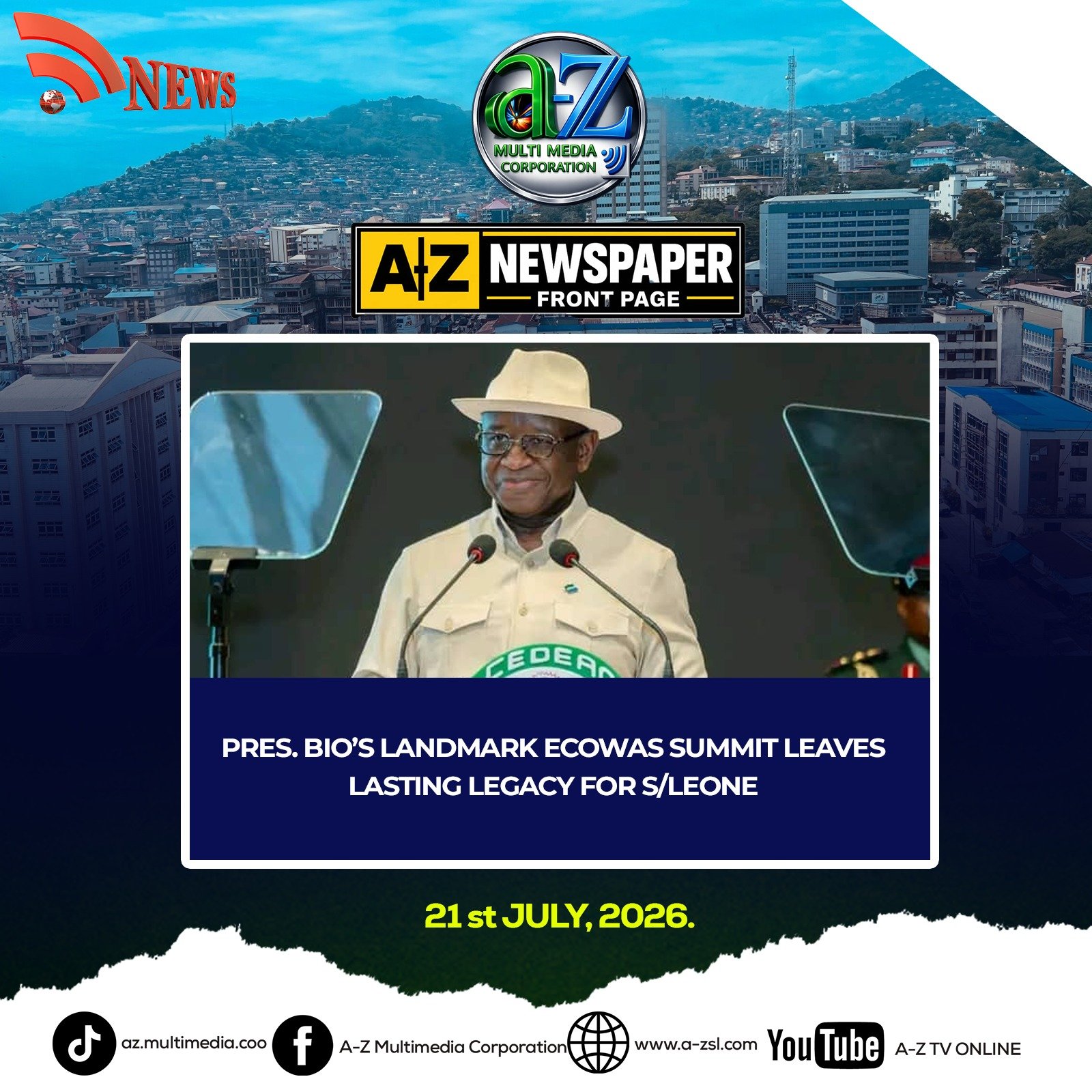
As the curtains came down on the 69th ECOWAS Summit on Sunday, July 19, at Lungi, across the Freetown estuary, President Julius Maada Bio and Sierra Leone added another defining chapter to the country’s diplomatic history.
The successful hosting of the 69th Ordinary Session of the ECOWAS Authority of Heads of State and Government was more than a routine gathering of regional leaders. It was a powerful demonstration of Sierra Leone’s growing capacity to host high-level international engagements while reinforcing its position as an influential voice in West African affairs.
For over a week, Freetown and Lungi became the diplomatic centres of West Africa as presidents, prime ministers, ministers, diplomats, development partners, private sector leaders, and hundreds of delegates converged to deliberate on the future direction of ECOWAS. The successful organization of the summit reflected careful planning, effective coordination, and significant investment in infrastructure, security, and logistics, earning commendation from participants and observers.
One of the most significant legacies of the summit is the world-class infrastructure that remains in Sierra Leone. At the centre of the event was the newly commissioned Julius Maada Bio International Conference Centre in Lungi, a modern facility built to international standards. The centre has immediately positioned itself as one of the most impressive conference venues in West Africa and demonstrates Sierra Leone’s readiness to host major continental and global meetings.
Complementing the conference centre was the construction of modern presidential villas designed to accommodate visiting Heads of State and other dignitaries. For many years, one of the challenges limiting Sierra Leone’s ability to host major international summits was the shortage of high-end accommodation for multiple visiting leaders. The new facilities have addressed this challenge while creating a lasting national asset for future diplomatic engagements, state visits, and international conferences.
The summit also benefited from enhanced logistical support, including the donation of fifteen luxury presidential vehicles by the People’s Republic of China. Beyond serving the immediate transportation needs of the summit, these vehicles have strengthened Sierra Leone’s long-term capacity to host events of similar magnitude and importance.
These developments are not temporary investments but part of a broader national vision to position Sierra Leone as a preferred destination for regional and international conferences. The infrastructure created for the ECOWAS summit provides a foundation for hosting future meetings involving the African Union, United Nations agencies, international financial institutions, and other global organizations. Such events have the potential to boost tourism, create employment opportunities, strengthen the hospitality sector, and attract new investments into the economy.
The summit itself produced several important outcomes that will influence regional cooperation in the coming years. One of the major decisions was the election of Senegal’s President, His Excellency Bassirou Diomaye Faye, as the new Chairman of the ECOWAS Authority of Heads of State and Government. He succeeds President Julius Maada Bio, whose tenure was characterized by strong advocacy for democratic governance, regional dialogue, peace, and institutional reform.
The peaceful and orderly transition of leadership highlighted ECOWAS’ commitment to democratic principles and institutional continuity. It also demonstrated the resilience and maturity of the regional bloc at a time when West Africa continued to face complex political, economic, and security challenges.
Another major achievement of the summit was the signing of strategic cooperation agreements aimed at strengthening regional integration and accelerating development. ECOWAS formalized a partnership with the Mano River Union (MRU) to deepen cooperation in peacebuilding, cross-border collaboration, and economic transformation. Given the shared history and interconnected economies of Sierra Leone, Liberia, Guinea, and Côte d’Ivoire, the partnership is expected to promote regional stability while creating new opportunities for trade and investment.
Equally important was the agreement between ECOWAS and the International Fertilizer Development Centre (IFDC). The partnership seeks to improve agricultural productivity, expand farmers’ access to improved technologies and inputs, and enhance food security across the region. At a time when climate change, global supply chain disruptions, and rising food prices continue to affect African economies, the agreement represents ECOWAS’ commitment to practical solutions that improve the livelihoods of citizens.
Security cooperation was also a key focus of the summit. President Julius Maada Bio officially commissioned the new ECOWAS Logistics Depot in Lungi, an important addition to the region’s peace and security architecture. The facility is expected to strengthen the operational readiness and rapid deployment capacity of the ECOWAS Standby Force, enabling the regional body to respond more effectively to humanitarian emergencies, conflicts, and other security threats.
The establishment of the logistics depot carries significant symbolic importance. It reflects the confidence ECOWAS member states have placed in Sierra Leone as a trusted partner in promoting regional peace and stability. Having transitioned from a devastating civil war to become an example of democratic recovery and peacebuilding, Sierra Leone’s hosting of such a strategic facility demonstrates its transformation from a peacekeeping support into a contributor to regional security.
Beyond the official resolutions and agreements, the summit delivered a broader message about Sierra Leone’s progress. The successful hosting of eleven Heads of State and Government, alongside hundreds of delegates from across West Africa and beyond, demonstrated the country’s political stability, institutional strength, and growing diplomatic credibility.
The seamless coordination among government ministries, security agencies, protocol officers, health services, aviation authorities, hospitality providers, and volunteers showcased Sierra Leone’s ability to deliver complex international events to global standards. It also highlighted the country’s progress in strengthening institutions, improving governance, and building international partnerships.
The economic benefits of hosting such a major event should not be overlooked. Hotels, restaurants, transport operators, local suppliers, and service providers benefited from increased economic activity during the summit. More importantly, the global attention generated by the event serves as an important opportunity to promote Sierra Leone as an investment destination and tourism hub.
For many international delegates visiting Sierra Leone for the first time, the summit provided an opportunity to experience a country increasingly defined not by the challenges of its past, but by the promise of its future. The professionalism and organization displayed throughout the event helped reinforce Sierra Leone’s image as a peaceful nation open to business, investment, and international cooperation.
The successful conclusion of the 69th Ordinary Session therefore represents more than a diplomatic achievement. It reflects years of investment in infrastructure, institutional development, and international engagement. It leaves behind valuable national assets, strengthens Sierra Leone’s regional influence, and creates new opportunities for economic growth and global partnerships.
As the leadership baton passes to President Bassirou Diomaye Faye, Sierra Leoneans can take pride in having hosted one of the most significant ECOWAS summits in recent years. President Bio’s role in facilitating dialogue, advancing regional cooperation, and providing a platform for critical decisions has further enhanced Sierra Leone’s standing within West Africa and beyond.
The closing of the summit on Sunday, July 19, did not simply mark the end of President Julius Maada Bio’s tenure as ECOWAS Chairman; it opened a new chapter in Sierra Leone’s diplomatic journey. The infrastructure remains, the partnerships endure, and the strategic investments are expected to continue yielding benefits.
Above all, the summit demonstrated that Sierra Leone possesses both the ambition and the capacity to serve as a leading platform for regional cooperation, peacebuilding, and sustainable development in West Africa.