

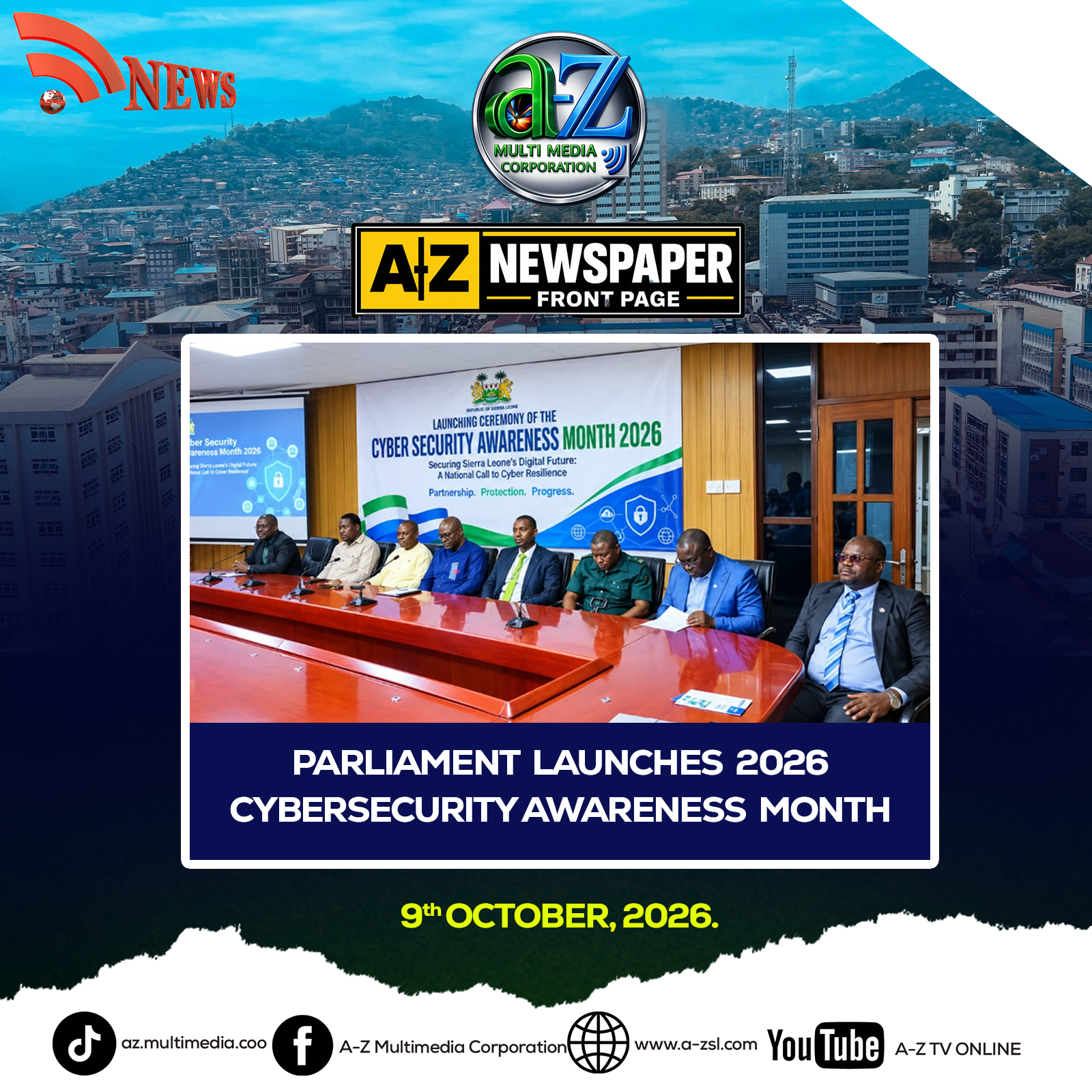
The Parliament of Sierra Leone has launched Cybersecurity Awareness Month 2026 under the theme, “Securing Sierra Leone’s Digital Future: A National Call to Cyber Resilience,” with a call for stronger collaboration among government institutions, the private sector, security agencies, technology users and other stakeholders to combat growing cyber threats.
The launch took place on Thursday, October 8, 2026, at Committee Room One, Parliament Building, Freetown.
The programme seeks to raise awareness about cybersecurity, promote responsible digital practices and strengthen the capacity of Parliament and the wider society to prevent, identify and respond to cybercrime.
In his welcome remarks, the Director of ICT, Joseph Conteh, highlighted the growing threat of online scams, particularly the takeover and misuse of WhatsApp accounts.
He explained that criminals can gain access to individuals’ accounts and contact their friends, relatives or colleagues while impersonating the account owners to fraudulently request money.
Conteh stressed that cybersecurity requires a collective approach built around partnership and protection, noting that technology users have an important role to play in safeguarding their accounts, personal information and digital resources.
He urged users never to disclose their passwords, PINs or authentication codes to suspicious individuals.
Conteh further noted that Parliament, through the enactment of the Cyber Security and Crime Act, 2021, has demonstrated its commitment to providing a legal framework for combating cybercrime and protecting Sierra Leone’s digital environment.
Giving the keynote address on behalf of the Clerk of Parliament, Deputy Clerk Gilbert Bosco Nhabay said the launch was particularly important as more aspects of everyday life move online, including banking, education, communication, commerce and government services.
He disclosed that Members of Parliament and senior officers of the Parliamentary Service had recently been targeted by WhatsApp takeover scams, in which criminals impersonated trusted individuals to solicit money and spread false information.
“If it can happen in Parliament, it can happen anywhere,” Nhabay said, stressing that cybersecurity is a shared responsibility that cannot be achieved through legislation alone.
He said Parliament’s cybersecurity efforts would be guided by three key principles: Partnership, Protection and Progress.
Nhabay called for stronger collaboration among government institutions, regulators, security agencies, financial institutions, telecommunications companies, development partners, civil society, academia and the media.
He also outlined Parliament’s 2026–2028 Cybersecurity Capacity Building Programme, which will be implemented in three phases.
The 2026 phase focuses on awareness and culture, including staff training, phishing simulations, reporting exercises and a baseline assessment of Parliament’s cyber risks.
The 2027 phase will focus on policy and governance, including the development of an institutional Cybersecurity Policy, an Incident Response Plan, role-specific training and the establishment of a Governance and Risk Committee.
By 2028, the programme will focus on technical capacity and national leadership, including advanced cybersecurity training, stronger threat detection systems, improved networks and partnerships with regional and international institutions.
The Deputy Clerk also announced the launch of “The Cyber Law, Explained for Kids,” an initiative designed to simplify the 58 sections of the Cyber Security and Crime Act, 2021, into language that children can easily understand.
He said the initiative would help young people understand their rights and responsibilities in the digital space.
The event was moderated by Parliament’s Principal Public Relations Officer, Sulaiman Bah, who underscored the importance of collective action in addressing cyber threats.
He noted that cybercrime is no longer an issue limited to the ICT sector, as individuals, institutions and businesses increasingly depend on digital platforms.
“Cybersecurity is therefore a shared responsibility,” Bah said, calling on stakeholders to use the awareness month to promote safe online practices and build a more secure and trusted digital future for Sierra Leone.
Providing an overview of Cybersecurity Awareness Month 2026 and the capacity-building programme, the Head of the Cybersecurity Unit, Mohamed Lebbie, said the national call for cyber resilience requires every institution and individual to play a role.
He explained that activities for the month include practical cybersecurity awareness training for staff and an inter-departmental cyber competition designed to improve employees’ knowledge and ability to identify and respond to cyber threats.
Lebbie emphasized that cybersecurity should not be viewed as the responsibility of the ICT Department alone, but as a daily responsibility for every Member of Parliament, manager and staff member.
A panel discussion on “Responding to Rising Cybercrime: Building a Resilient Digital Sierra Leone” brought together representatives from key institutions.
The panel comprised Mohamed Lebbie, Head of the Cybersecurity Unit; Alex David Williams, Cyber Risk Specialist at the National Cybersecurity Coordination Centre (NC3); Musa Jalloh, Deputy Director of Regulations at the National Communications Authority (NatCA); Inspector Bob Salliu of the Sierra Leone Police Cybercrime Unit; and Hon. Abdul Sulaiman Marray-Conteh, Chairman of Parliament’s Legislative Committee.
The panel highlighted the need for greater public awareness, stronger institutional cooperation, responsible use of technology and effective enforcement of cybersecurity laws.
The programme concluded with a vote of thanks delivered by Jewelyn Collingwoode Martyn of the Cybersecurity Unit, ICT Department, who expressed appreciation to the panellists, partners, colleagues and staff for their participation and contribution to the launch.
The launch marks the beginning of a month-long programme aimed at strengthening cybersecurity awareness and building a culture of digital responsibility within Parliament.