

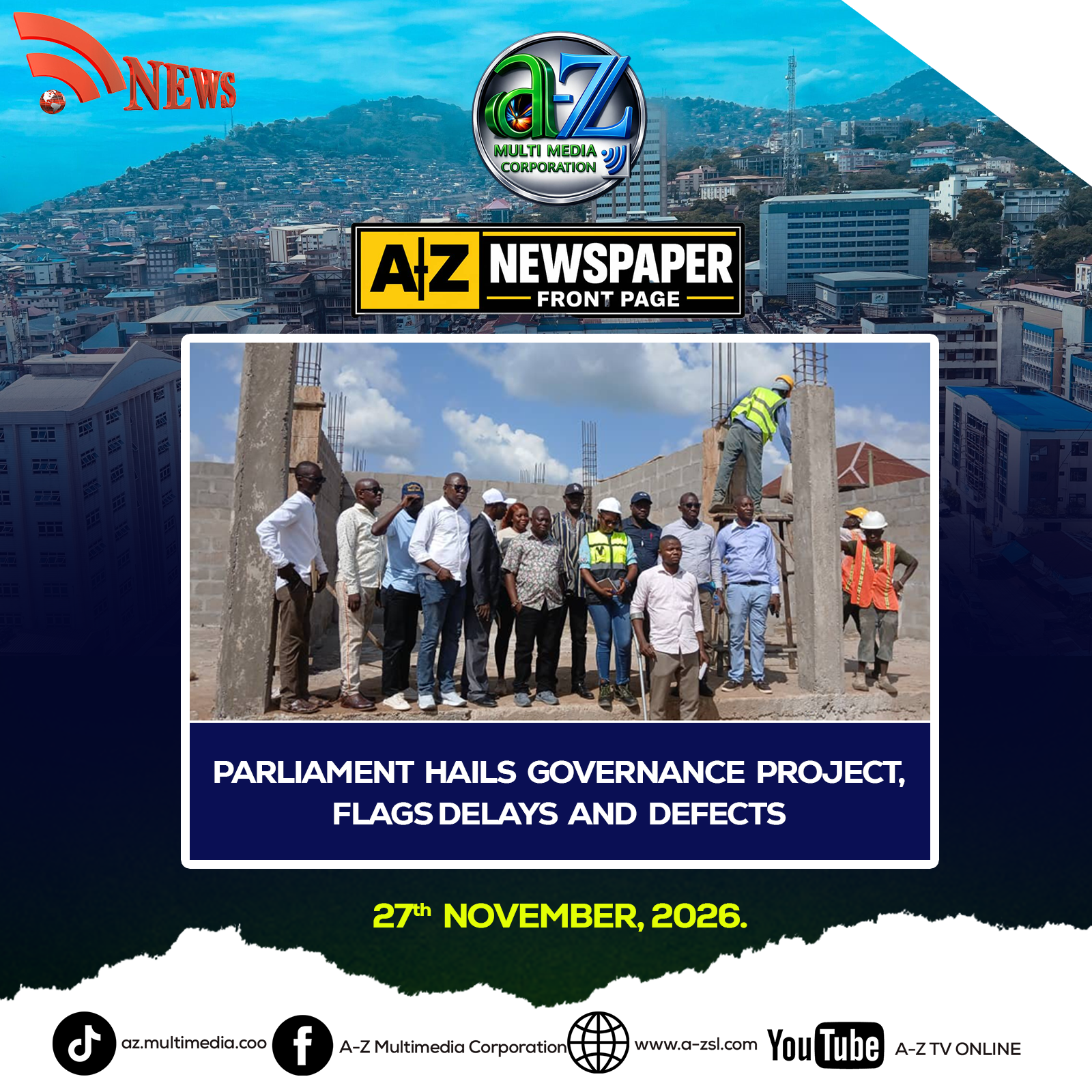
The Parliamentary Committee on Local Government and Community Affairs, chaired by Hon. Peter Yamba Koroma, has expressed satisfaction with the implementation of the World Bank-funded Accountable Governance for Basic Service Delivery Project across local councils, noting its contribution to improving healthcare, education and revenue mobilization.
However, the Committee has raised concerns over delays, construction defects and accountability gaps observed at some project sites during its nationwide oversight tour of local councils.
During the tour, Committee members inspected schools, health facilities, markets and community centres constructed or rehabilitated under the project to assess their quality, progress and impact on local communities.
At UMC Primary School in Yoyema Town, Moyamba District, the Committee encountered a deprived community where approximately 600 pupils are currently learning in a makeshift structure while construction work continues.
Residents expressed appreciation to the visiting MPs, noting that the rehabilitation and construction of the school would improve learning conditions and attract more pupils.
However, the Committee expressed serious concern over delays in the project, which were reportedly caused by the absence of an alternative signatory to facilitate payments to the contractor. Members were informed that before the appointment of a new Chief Administrator, the council had no alternative signatory to process payments, thereby affecting the pace of construction.
The Committee recommended that every local council should have alternative signatories, including Deputy Chief Administrators, to prevent similar delays whenever substantive Chief Administrators are unavailable.
At Falaba Village in Moyamba District, the Committee inspected a Maternal and Child Health Post (MCHP) constructed under the project. The facility has attracted patients from several surrounding communities, with reports indicating improved healthcare outcomes within its catchment area.
Local authorities also expressed satisfaction with the facility’s contribution to healthcare delivery.
However, the Committee discovered that the health facility’s waste management structure had not been completed and was not in use. Consequently, members moved a motion directing the council to ensure that the facility is completed within one month.
At Serabu Town, the Committee observed that the construction and rehabilitation of Al-Qudus Primary School were progressing, with two contractors undertaking the work. Residents expressed excitement over the project, while one of the contractors assured the Committee that the work would soon be completed.
The Committee noted that the improved school infrastructure had encouraged community leaders to establish a new secondary school, while the modernized facilities had contributed to increased enrolment.
Similarly, at the National Islamic Primary School in Combema, the Committee observed that the modernized school building had attracted more pupils, leading to the closure of some schools with substandard facilities.
However, members discovered that one of the classrooms allocated to Class One was being occupied by the newly established National Islamic Secondary School, thereby depriving primary school pupils of their designated learning space.
The Committee directed the Principal of the secondary school to construct a temporary structure before the commencement of the next school term to address the situation.
In Kambia Town, Kambia District, the Committee expressed frustration over the slow pace of construction of market stores under the Accountable Governance Project.
Members were reportedly informed that the contractor had a history of delaying project implementation. Consequently, Parliament has summoned both the contractor and the local council to respond to concerns and questions surrounding the project’s implementation.
At Masiaka in Port Loko District, the Committee discovered cracks in sections of the Community Centre being rehabilitated under the project. Members noted that the defects required attention to ensure the facility meets the required standards.
Meanwhile, the Chief Administrator of Bombali District Council described the Accountable Governance Project as a ‘lifeblood’ initiative that empowers communities and supports local development.
At Magbengbeh Community Health Post, located near the Guinean border, the Committee observed that the modernized facility was attracting more patients from neighboring Guinea than from Sierra Leone, owing to its improved infrastructure and service delivery.
The Committee also discovered that the facility operates a cost-recovery pharmacy from which patients from both countries obtain medication.
In response, members advised health workers to prioritize Sierra Leonean patients and consider charging patients from Guinea slightly higher fees to help subsidize medication for Sierra Leoneans who cannot afford treatment.
The Committee further observed that health facilities visited under the project had benefited from staff quarters, solar electricity, water supply and waste management facilities, among other essential improvements.
Overall, the Committee acknowledged the importance of the World Bank-funded Accountable Governance for Basic Service Delivery Project in transforming communities and improving access to essential services, particularly in healthcare, education and local councils’ own-source revenue mobilization.
However, it urged local councils and contractors to address implementation delays, construction defects and accountability shortcomings to ensure that the project achieves its objectives and delivers sustainable benefits to communities across the country.