

By: Aminata Sesay
The Public Accounts Committee (PAC) of Parliament has expressed concern over inadequate funding for the Sierra Leone Seed Certification Agency (SLSCA), warning that limited financial resources are undermining efforts to promote the use of certified seeds and improve agricultural productivity across the country.
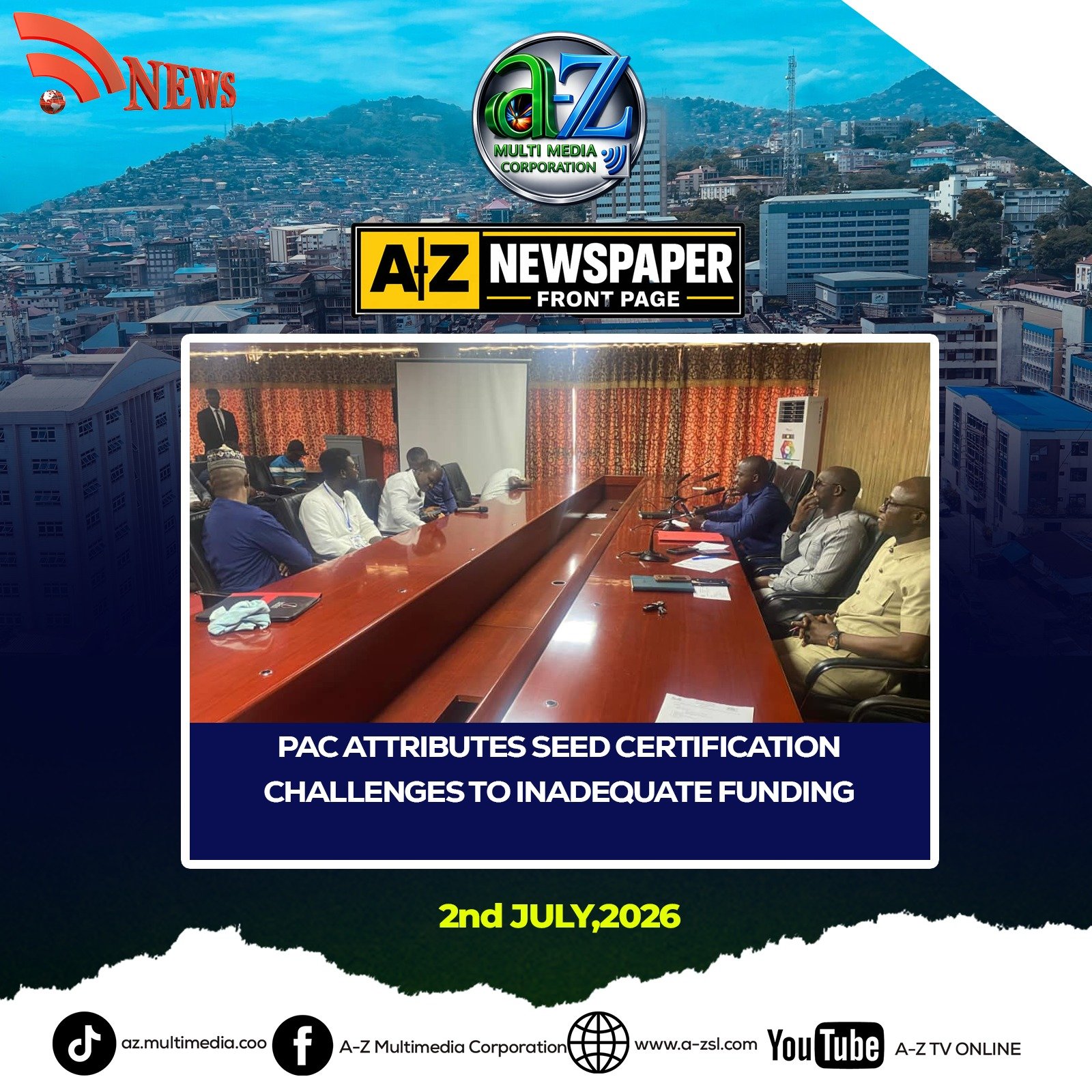
The concerns were raised during the Committee’s examination of the 2024 Auditor General’s Report, when officials of the SLSCA appeared before lawmakers on Monday, June 29, 2026, to respond to audit findings relating to the agency’s operations, compliance challenges, and financial management.
According to the Auditor General’s Report, compliance among some seed producers and vendors remains low, particularly regarding licensing, certification, and inspection requirements. The report also highlighted limited public awareness among farmers about the importance of certified seeds and the regulatory role of the SLSCA.
Responding to the Committee’s concerns, the Executive Director of the SLSCA, Dr. Robert Chakanda, acknowledged that the agency has faced significant challenges in raising public awareness since it became operational in 2021. He explained that the institution initially focused on establishing a functional seed certification system by working closely with key stakeholders, including research institutions, seed companies, and seed vendors.
Dr. Chakanda said the agency has since expanded its outreach by deploying seed technicians across all districts to educate farmers and promote the production and use of certified seeds.
He also clarified the distinct roles of the Sierra Leone Agricultural Research Institute (SLARI) and the SLSCA, explaining that while SLARI develops improved crop varieties through research and breeding, the SLSCA is responsible for ensuring that those varieties meet national certification standards before they are released to farmers.
Providing an update on certified seed development, the SLSCA’s Technical Lead, Dr. Veronica Sesay, disclosed that eight improved cassava varieties were released last year, including Baba 70, Lucas 1 and 2, Obasanjo 1 and 2, and Maada Cassava. She added that the multiplication of breeder seeds into foundation and certified seeds is ongoing in collaboration with SLARI.
She further revealed that eleven breeder rice varieties have been released, with certified rice seed production currently underway. Existing certified varieties, including ROK 34 and NERICA L19, are already being cultivated by trained farmers in different parts of the country.
Despite these achievements, Members of Parliament questioned the agency’s visibility and level of engagement with Parliament, particularly regarding the implementation of the Government’s Feed Salone agricultural initiative.
Committee member Honourable Musa Fofanah observed that Parliament often becomes aware of the operational challenges facing public institutions only during accountability hearings. He urged the SLSCA to provide regular updates to lawmakers to enable them to better support the agency’s work and educate farmers within their constituencies.
In response, Dr. Chakanda admitted that inadequate budgetary allocations have constrained the agency’s ability to fully discharge its mandate. He noted that although agriculture remains a central pillar of the Government’s Feed Salone agenda, the SLSCA continues to struggle with limited financial resources needed to implement its programmes effectively.
Another Committee member, Honourable Aaron Aruna Koroma, argued that many of the issues highlighted in the Auditor General’s Report stem from inadequate funding rather than institutional inefficiency. He maintained that expanding laboratory facilities, strengthening research, and increasing farmer awareness require sustained government investment.
He called on the Audit Service Sierra Leone to consider recommending stronger financial support for critical agricultural institutions such as the SLSCA and SLARI, stressing that improving national food production depends largely on farmers’ access to quality certified seeds.
Concluding the hearing, the Deputy Chairman of the Public Accounts Committee, Honourable Paramount Chief Desmond Mahayei Kargobai, directed the agency’s management and accounting staff to work closely with the Audit Service to submit documentary evidence demonstrating progress made in implementing the audit recommendations.
The Committee stated that its final determination on the outstanding audit issues will be based on the Audit Service’s verification of the documents submitted by the agency.