

By: Mohamed Sahr
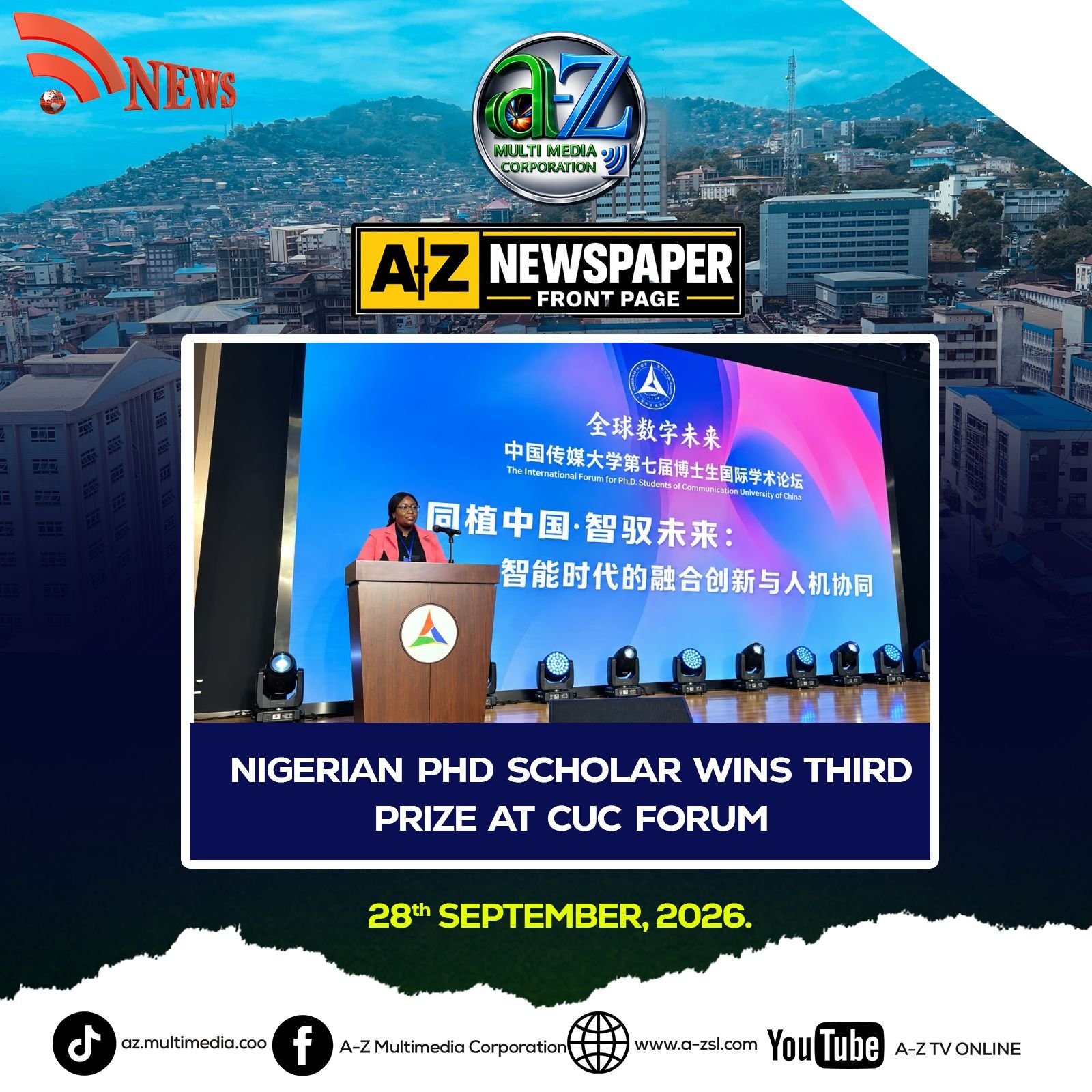
Nigerian doctoral scholar Nwekeorji Juliet Ebele has won the Third Prize at the 7th “Golden Rose” Academic Season Innovation Forum for PhD Candidates, held on September 22–23, 2026, at the Communication University of China (CUC) in Beijing.
The two-day forum, themed “Rooted in China, Steering the Future with Intelligence: Convergent Innovation and Human-AI Collaboration in the Age of Intelligence,” brought together doctoral researchers from China and other countries to present studies on information and communication, media, public opinion and artificial intelligence.
Ebele, a PhD candidate at CUC’s School of Information and Communication Studies, presented her research paper titled “AI as a Cross-Cultural Communication Medium: Adoption, Barriers, and Optimization Paths of Intelligent Chinese-Learning Tools among Nigerian Youth – Evidence from the UNIZIK Confucius Institute.”
She presented the study on the first day of the forum at the International Graduate Student Sub-Forum, where doctoral researchers from China, Russia, Tanzania, Nepal and other countries shared research on topics including AI-generated disinformation, algorithmic attitudes, media framing and communication in the Global South.
Ebele’s research examines how young Nigerians use artificial intelligence tools to learn Chinese, the challenges affecting their adoption and effectiveness, and possible ways of improving AI-assisted Chinese-language learning among African learners.
The study was conducted during a research visit to Nigeria earlier this year, when Ebele was invited to deliver a lecture at the Confucius Institute of Nnamdi Azikiwe University (UNIZIK) in Awka. During the visit, she conducted surveys and interviews with Chinese-language learners preparing for the HSK proficiency examination.
The research found that 70 percent of the learners surveyed use AI applications alongside classroom instruction rather than as a replacement for conventional teaching, while 75 percent reported positive experiences with the tools. Voice and pronunciation feedback emerged as the most valued features among the learners.
However, the study identified three major structural barriers affecting the effectiveness of AI-powered Chinese-learning tools: uneven levels of media literacy among learners, inadequate access to devices and reliable internet connectivity, and learning content designed primarily around Chinese users rather than the needs of African learners.
According to Ebele, addressing these challenges will require greater attention to the cultural and technological realities of African users as AI becomes increasingly integrated into language learning and cross-cultural communication.
Reflecting on her experience at the forum, Ebele said the opportunity to interact with scholars from different countries was as meaningful to her as receiving the award.
“Beyond the research, the true treasure of these two days was the people. We learned from each other, encouraged one another, and wrote success stories together — different countries, one table,” she said.
She also expressed appreciation to Prof. Zhang Kai, who served as the discussant at the sub-forum, for her comments and suggestions on the research, as well as to her supervisor, Prof. Qi Yue, for her continued guidance and support.
Ebele, whose Chinese name is Li Siran, said the findings of her research point to the increasingly important role of everyday digital technology in China-Africa communication.
“A student’s phone is quietly becoming one of the most important and least visible channels of China-Africa communication. It works remarkably well in places, but closing the remaining gap will require content, literacy and infrastructure moving together,” she said.
The forum was hosted by the Graduate School of the Communication University of China and the university’s Youth League Committee as part of CUC’s annual “Golden Rose” Academic Season.