

By: Mamajah Jalloh
The Ministry of Planning and Economic Development (MoPED) and the United Nations Economic Commission for Africa (ECA) have agreed to strengthen efforts to integrate health financing into Sierra Leone’s national economic planning.
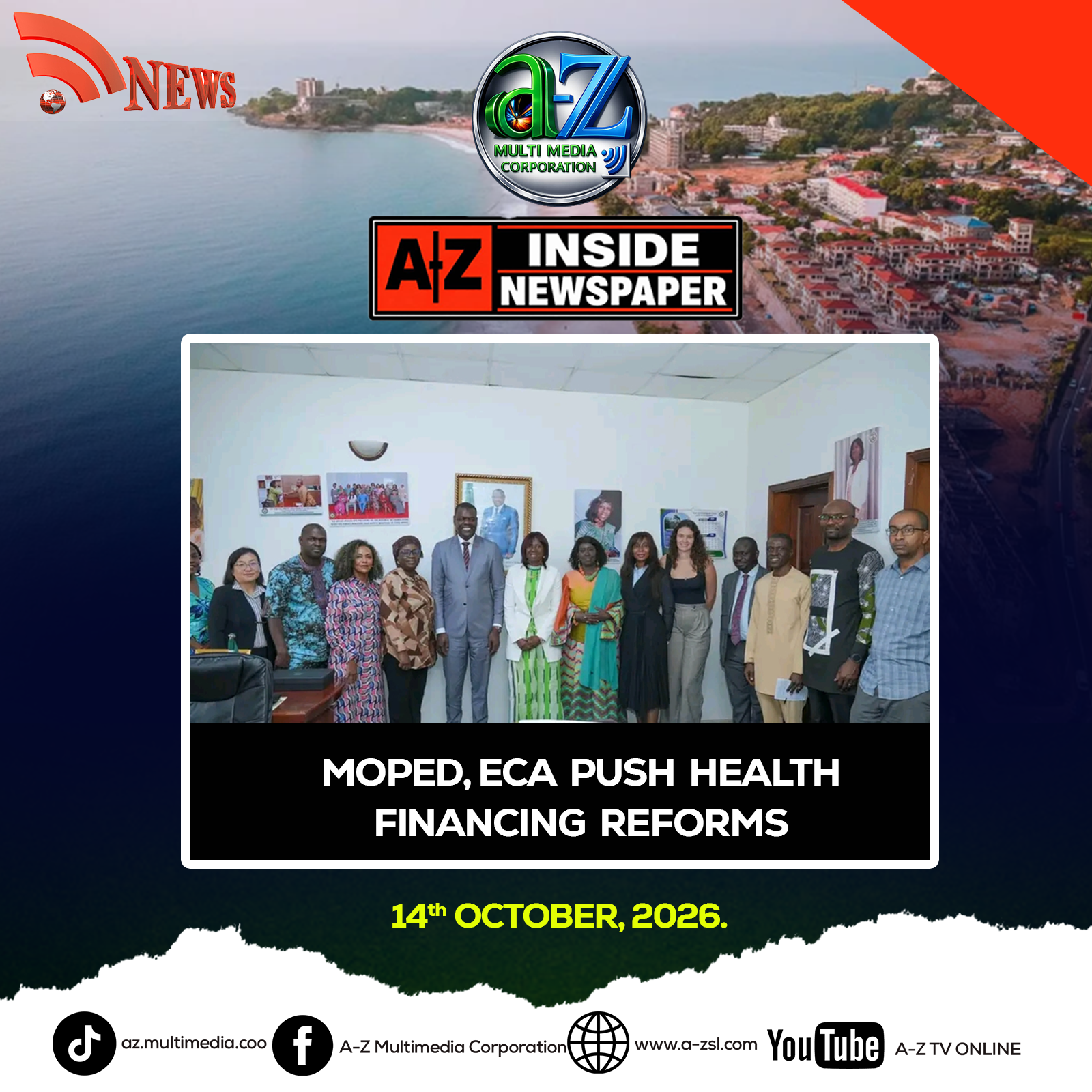
The commitment was reaffirmed during a high-level meeting held on Tuesday, October 13, 2026, at the Minister’s Office in Freetown. Discussions focused on sustainable health financing, improved data systems, resource mobilization and stronger coordination among key government institutions.
The meeting was chaired by the Minister of Planning and Economic Development, Hon. Kenyeh Barlay, and brought together an ECA delegation led by Aboubakri Diaw, Chief of Staff in the Office of the Executive Secretary of ECA.
Other members of the delegation included Mrs. Ngone Diop, Director of the ECA Subregional Office for West Africa, and Nadia Ouedraogo, Economic Affairs Officer in the Macroeconomics, Finance and Governance Division.
Representing MoPED were Haja Abie E. Kamara, Director of Development Assistance Coordination (DACO), and Joseph Samah, Deputy Director of Planning, Policy and Research (PPR).
In his opening remarks, Diaw said the engagement aimed to reposition health from being viewed primarily as a social expenditure to being recognized as a strategic economic investment that contributes to productivity, employment creation, economic growth and sustainable development.
He stressed the need for stronger collaboration among the ministries responsible for planning, finance and health to ensure that health outcomes are incorporated into national macroeconomic frameworks and public investment decisions.
Diop also underscored the importance of integrating health financing into Sierra Leone’s broader macroeconomic and development framework. She said the initiative would help identify sustainable financing options, strengthen institutional capacity and ensure that health investments contribute to inclusive economic growth and improved living conditions.
Participants explored innovative financing mechanisms, including debt swaps and targeted taxation, as potential ways to expand the fiscal space available for health amid competing public expenditure demands.
The ECA delegation further highlighted the need to strengthen data systems, improve interoperability among existing platforms and develop social accounting and economic modelling tools to demonstrate the contribution of health investments to the wider economy.
Minister Barlay welcomed the initiative, noting that health remains central to Sierra Leone’s development priorities. She explained that human capital development is one of the five game changers under the country’s current Medium-Term National Development Plan, with health and education identified as key priorities.
Although health has featured prominently in previous national development plans, the Minister stressed the need to move beyond traditional approaches to health expenditure by systematically integrating health financing into economic planning and resource allocation.
She also called for the initiative to align with existing national frameworks, including the national development plan, district development plans, chiefdom-level planning processes and the National Human Capital Development Strategy.
Barlay emphasized that the collaboration should build on existing government systems and institutional arrangements rather than create parallel structures. She identified MoPED’s development monitoring tracker, which captures progress across the five game changers, as a potential platform for strengthening health financing monitoring and reporting.
The Minister further highlighted capacity development as a priority, calling for practical training in economic modelling, data analysis and related technical fields to enable national institutions to conduct assessments independently and generate evidence to guide policy decisions.
Contributing to the discussions, Haja Abie E. Kamara stressed the importance of strengthening development assistance coordination and improving access to information on external and off-budget health financing. She said contributions from development partners must be properly documented and aligned with government priorities to support effective planning and resource allocation.
Joseph Samah also called for stronger technical capacity in economic modelling, data analysis and development planning. He supported practical training to enable government institutions to conduct more analyses independently and produce evidence to inform health financing policies.
A major issue discussed was the lack of seamless information sharing among data systems operated by MoPED, the Ministry of Finance and the Ministry of Health. Participants noted that the limited interoperability of existing platforms makes it difficult to consolidate information on health expenditure, development assistance, public investment and service delivery outcomes.
To address the challenge, the meeting explored the establishment of a health financing data exchange hub that would connect relevant information systems and link directly with MoPED’s existing development monitoring tracker.
Barlay stressed that the proposed system must respond to national needs, clearly define institutional responsibilities and facilitate information sharing among the three ministries.
Participants also highlighted the need to improve access to information on off-budget development assistance, external health financing and health-related transfers to local councils to support comprehensive planning and resource allocation.
As part of the proposed next steps, the ECA delegation outlined plans to establish a joint technical working group involving relevant government institutions and stakeholders. The group is expected to begin developing an outline for a 100-day action plan to guide the implementation of priority activities under the initiative.
The process will involve further technical consultations, reviews of existing national systems and policy frameworks, identification of feasible financing options and development of proposals that reflect Sierra Leone’s priorities and institutional capacities.
The ECA delegation reaffirmed that the initiative would support the Government in advancing existing commitments rather than creating a separate development agenda. The proposed technical assistance will also explore opportunities for in-country training and institutional capacity development.
In her closing remarks, Barlay reaffirmed MoPED’s commitment to working with ECA, the Ministry of Finance, the Ministry of Health and other relevant stakeholders to advance the initiative. She welcomed continued technical engagement and emphasized the importance of building national capacity to sustain the reforms over the long term.