

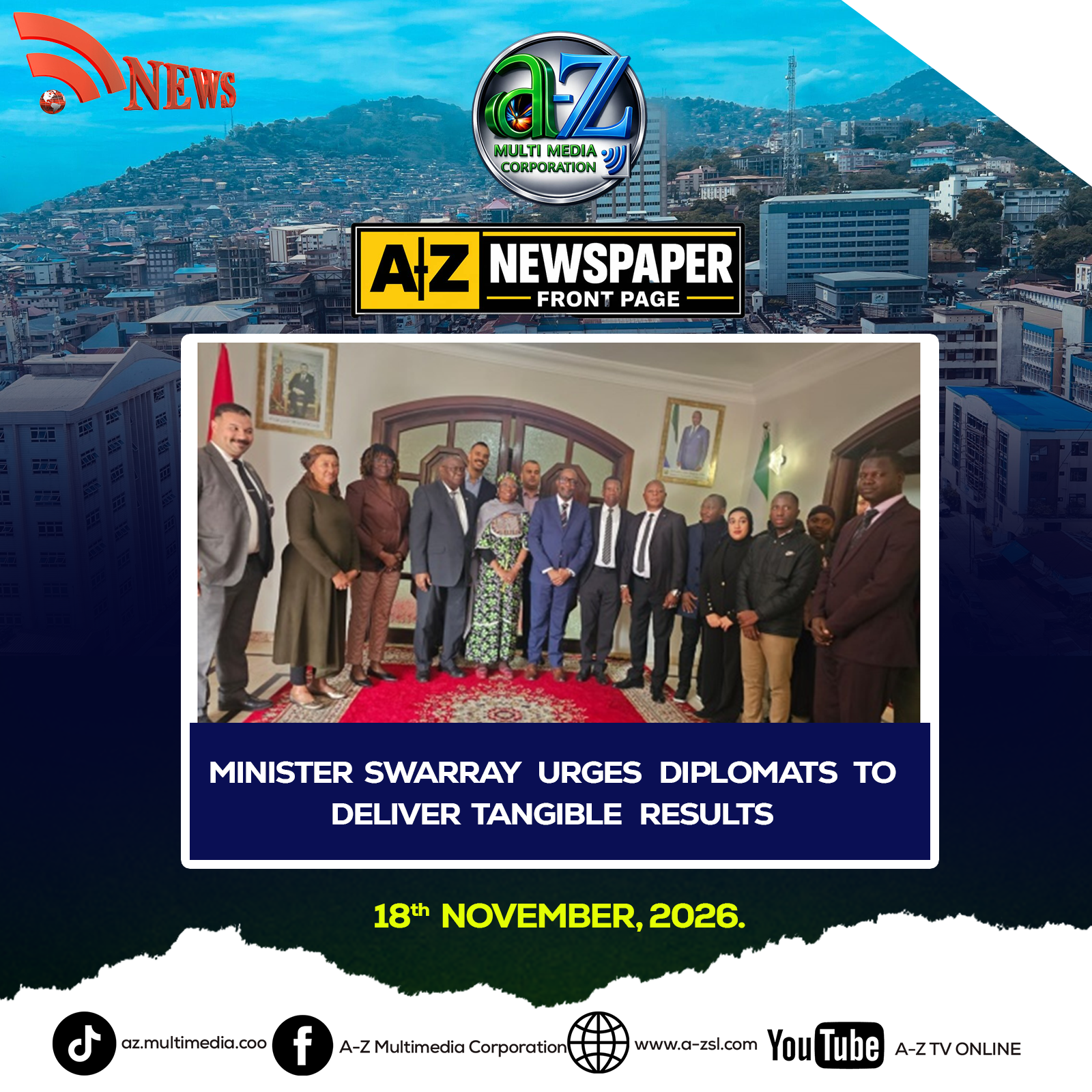
Sierra Leone’s Minister of Foreign Affairs and International Cooperation, Mohamed Rahman Swarray, has called on the country’s diplomatic missions abroad to move beyond traditional diplomatic engagements and focus on delivering tangible results that improve citizens’ living standards and contribute to national development.
Minister Swarray made the call while addressing officials at the Sierra Leone Embassy in Rabat, Morocco, during a working visit to the Kingdom. He stressed that diplomatic missions must become more proactive in attracting investment, securing development opportunities and supporting the implementation of the government’s manifesto commitments.
He said the government had clearly outlined its development priorities through its manifesto and the National Medium-Term Development Plan 2024–2030, anchored on five Big Five Game Changers. He urged diplomatic missions to align their activities with these national priorities and ensure that their engagements produce measurable outcomes.
“The manifesto is very clear about what we want to deliver while in power, and how we want to accelerate delivery. We want the missions to play their part,” he said.
The Minister cautioned that traditional diplomatic activities, including official dinners, handshakes and ceremonial photographs, were no longer sufficient measures of diplomatic performance, particularly as the international environment continues to change.
He noted that the established rules-based multilateral order was undergoing rapid changes, while international development assistance was declining and development partners were increasingly prioritizing their domestic economic challenges.
Citing the United Kingdom as an example, Minister Swarray said Sierra Leone had experienced a significant reduction in British development assistance, with funding that previously stood at approximately £70 million to £80 million declining substantially, with allocations eventually falling to about £5 million.
He said the changing funding landscape required Sierra Leone to rethink its approach to international partnerships and adopt more strategic ways of mobilizing resources for national development.
The Minister also challenged embassy officials, particularly information attachés, to prioritize reporting activities that demonstrate meaningful contributions to the country rather than focusing on ceremonial engagements.
“I even want to encourage the information attachés not to report handshakes and photographs that don’t translate into practical, on-the-ground improvements in the living standards of our people,” he emphasised.
Minister Swarray further stressed the need for diplomatic missions to demonstrate value for money, noting that the government spends approximately four per cent of the national budget on maintaining its foreign missions.
He said citizens increasingly expected to see concrete results from the resources allocated to diplomatic operations, particularly given the country’s competing development needs and limited financial resources.
Outlining his vision for the Foreign Ministry, he said forthcoming engagements would focus on improving efficiency, strengthening service delivery and introducing administrative reforms to enhance the performance of diplomatic missions.
He described the approach as achieving “small resources, big impact”, noting that improved administrative systems and the effective use of technology could reduce bureaucratic bottlenecks and increase institutional productivity.
As part of the proposed reforms, Minister Swarray announced plans to introduce a digital registration system that would allow Sierra Leoneans travelling or residing abroad to register with their respective diplomatic missions.
He explained that the initiative would enable embassies to maintain accurate records of Sierra Leonean citizens within their jurisdictions, including those travelling for business, education and other purposes.
“We want every Sierra Leonean who comes here, whether it is for business or for schooling, to be able to register with you so you know they are here. So we are digitalizing,” he said.
The proposed system is expected to strengthen consular services, improve communication with citizens overseas and enable diplomatic missions to better understand and respond to the needs of Sierra Leoneans living or travelling abroad.
Sierra Leone’s National Medium-Term Development Plan 2024–2030 is anchored on five Big Five Game Changers: Feed Salone, Human Capital Development, the Youth Employment Scheme, Technology and Infrastructure, and Transforming the Public Service Architecture.
Minister Swarray’s remarks underscore the government’s expectation that diplomatic missions should serve as strategic instruments for national development by attracting investment, expanding economic partnerships, facilitating opportunities and strengthening Sierra Leone’s international relations.
As the country navigates declining development assistance and increasing pressure on public resources, the effectiveness of its diplomatic service will increasingly be measured by its ability to translate international engagements into practical benefits for citizens at home.
Extreme poverty was estimated at approximately 46 per cent of the population in 2025, highlighting the need to ensure that economic growth translates into improved living standards, increased employment opportunities and better livelihoods for citizens.
The Bank stressed the importance of strengthening public financial management, improving governance, creating a favourable investment climate and attracting greater private-sector investment to sustain the country’s economic recovery.
Overall, the World Bank’s assessment points to meaningful progress in Sierra Leone’s economic stabilization, particularly in economic growth, inflation reduction and fiscal management. However, sustained reforms, stronger investment and effective economic policies will be essential to consolidate these gains and ensure that the benefits of economic recovery reach ordinary citizens.