

By: Saidu Jalloh
President of Sierra Leone Julius Maada Bio has urged world leaders to rethink global spending priorities, arguing that the vast resources devoted to military expenditure should be matched by greater investment in peace, development and human security.
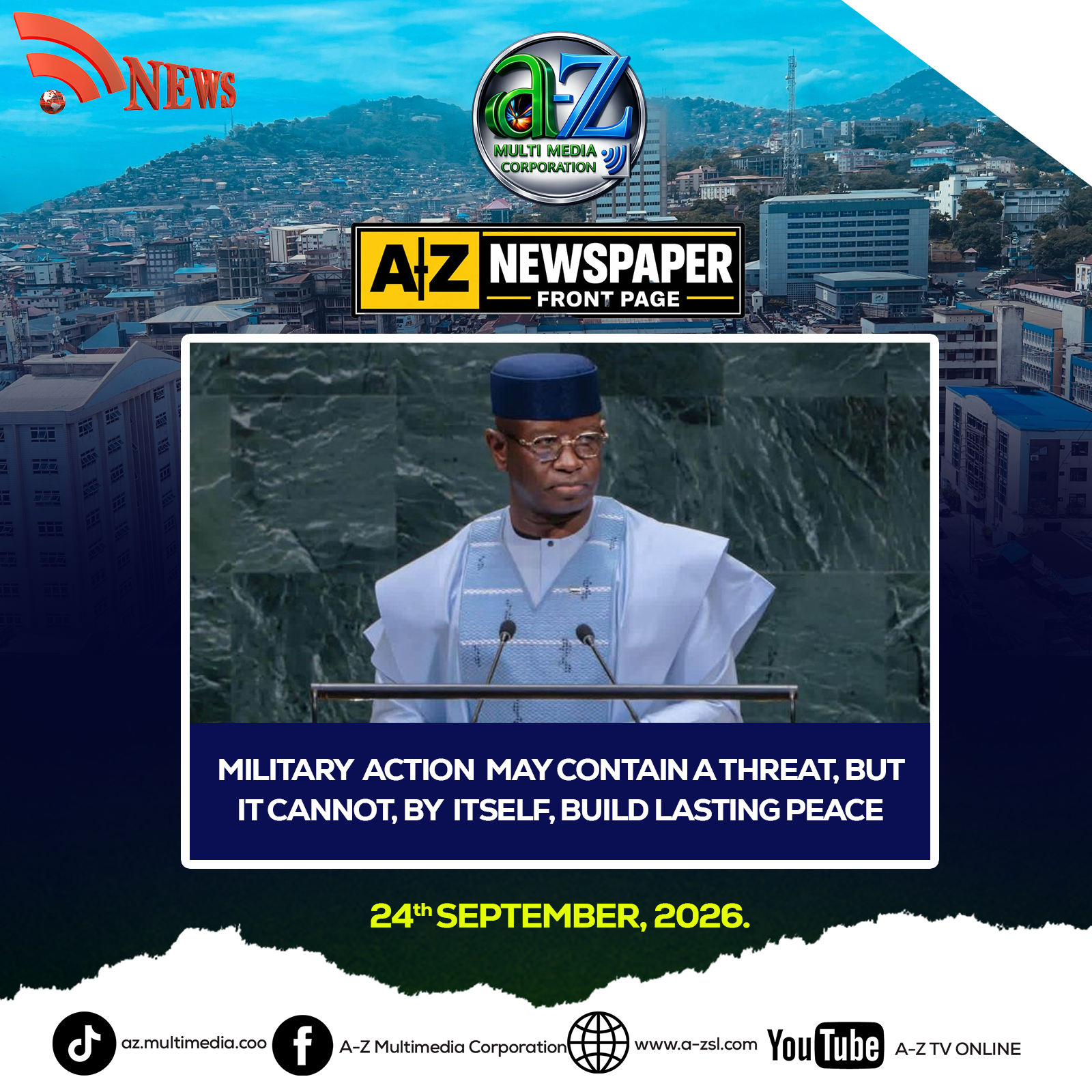
President Bio made the call while addressing the General Debate of the 81st Session of the United Nations General Assembly in New York, where he stressed that military action alone cannot deliver lasting peace.
“Military action may contain a threat, but it cannot, by itself, build lasting peace,” President Bio said, noting that insecurity often takes root where hunger, exclusion and despair persist.
He pointed to the scale of global military expenditure, which he said reached almost US$2.9 trillion in 2025, marking the 11th consecutive year of increase.
While acknowledging that countries have legitimate security needs, President Bio questioned the imbalance between resources committed to warfare and those available for preventing conflict and advancing development.
“The connection between peace and development must therefore move from our resolutions into our budgets,” he said.
President Bio said lasting global stability requires addressing conditions that contribute to conflict, including poverty, exclusion, unemployment and weak institutions.
He cited conflicts in Sudan and the eastern Democratic Republic of Congo, as well as terrorism across West Africa and the Sahel, as examples of the human cost of delayed action.
The President also called for greater fairness in the global economic system, arguing that developing countries need stronger representation, fairer voting power, affordable financing and improved debt treatment within international financial institutions.
On Africa’s natural resources, President Bio said the continent’s critical minerals, which are important to the global energy transition, should generate greater value for African economies.
He called for mineral processing at source, fairer value chains, technology transfer and the development of local industries, saying these measures could create skilled employment, strengthen economies and expand opportunities for young people.
“The green transition must not reproduce the extractive terms of the past,” he warned.
President Bio further linked economic opportunities to peace and security, particularly for Africa’s youth. He warned that young people without jobs, skills or a stake in the future could become vulnerable to exploitation, smuggling and dangerous migration.
He therefore said jobs, skills and dignity should be treated as essential components of peacebuilding and development policies.
Drawing on Sierra Leone’s experience of conflict and recovery, President Bio said the country’s peace became meaningful not only through the formal end of the civil war, but also through the rebuilding of communities, institutions and public confidence.
He urged the international community to restore confidence in multilateral cooperation and ensure that the United Nations’ theme, “For All,” is reflected in decisions that improve people’s lives.
“Let this session give them that reason,” President Bio said. “The words ‘FOR ALL’ should not remain at the end of this year’s theme. They must become the measure of our work.”