

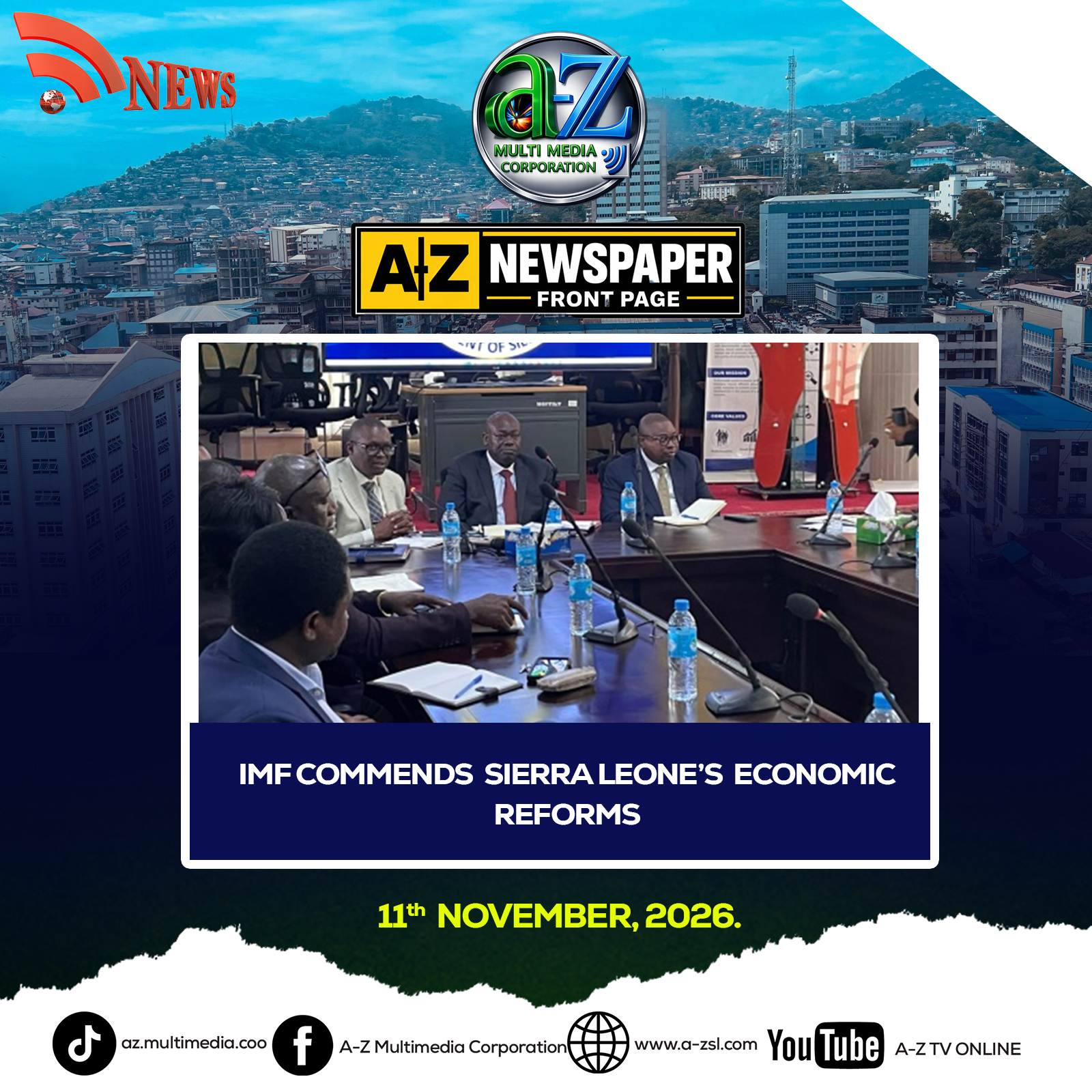
The International Monetary Fund (IMF) has completed the fourth review of Sierra Leone’s Extended Credit Facility (ECF) Programme and the first review of the Resilience and Sustainability Facility (RSF), commending the Government’s progress in restoring macroeconomic stability while warning of emerging global economic risks.
The IMF mission concluded discussions with senior officials from the Ministry of Finance, the Bank of Sierra Leone and the National Revenue Authority at the Ministry of Finance in Freetown on Tuesday, 10 November 2026.
Addressing the meeting, IMF Mission Chief Jeta Menkulasi said the team had engaged with several economic and governance institutions and observed significant progress in Sierra Leone’s economic reform agenda over the past three years. She highlighted improvements in inflation management, fiscal consolidation and the stabilization of key macroeconomic indicators as evidence of the Government’s commitment to economic recovery.
However, she cautioned that external shocks, particularly ongoing tensions in the Middle East, rising global energy and fuel prices, and renewed inflationary pressures, could undermine the progress achieved. She therefore urged the Government to sustain its reform efforts and introduce stronger policy measures to address emerging economic challenges in 2027.
Key areas discussed during the review included public debt management, domestic arrears, foreign exchange reserves, domestic revenue mobilization and governance reforms aimed at strengthening the country’s economic resilience.
The IMF Mission Chief thanked the Government for its cooperation throughout the review process and expressed optimism that, subject to the fulfilment of agreed policy commitments, the IMF Executive Board would consider and approve the reviews and associated disbursement at its December meeting.
Welcoming the mission’s findings, Minister of Finance Kerefa A.F. Kargbo reaffirmed the Government’s commitment to implementing reforms that promote sustainable economic growth and macroeconomic stability.
He acknowledged that external shocks continue to pose significant challenges to small and vulnerable economies such as Sierra Leone but stressed that the Government remains focused on strengthening public financial management and building economic resilience.
The Minister highlighted ongoing efforts to improve arrears and contract management, strengthen cash management systems, regulate foreign exchange expenditure and increase foreign exchange repatriation by major companies operating in the trade, agriculture and mining sectors.
Governor of the Bank of Sierra Leone, Dr. Brima Stevens, provided updates on monetary policy implementation, developments in the foreign exchange market and the country’s foreign reserve position, which currently provides approximately 1.8 months of import cover.
Financial Secretary Matthew Dingie described the discussions between the Government and the IMF as constructive, expressing confidence that Sierra Leone’s performance under the programme would receive favourable consideration from the IMF Executive Board, paving the way for the anticipated disbursement.
The Extended Credit Facility, approved on 31 October 2024, supports Sierra Leone’s efforts to achieve fiscal consolidation, macroeconomic stability, debt sustainability, monetary policy reforms and structural transformation.
Meanwhile, the Resilience and Sustainability Facility, approved on 18 June 2026, provides financing of SDR 155.55 million, equivalent to approximately US$211.5 million, to help the country strengthen climate resilience and implement reforms that support long-term economic stability.
The fourth ECF review assessed programme performance as of 30 June 2026, providing an opportunity for the Government and the IMF to evaluate progress, address outstanding policy commitments and agree on priorities for the remainder of the programme period.