

By: Mohamed J. Bangura
President Julius Maada Bio has reaffirmed his commitment to Sierra Leone’s constitutional term limits and a peaceful transfer of political power, saying he intends to leave office in 2028 and hand over power through a democratic process.
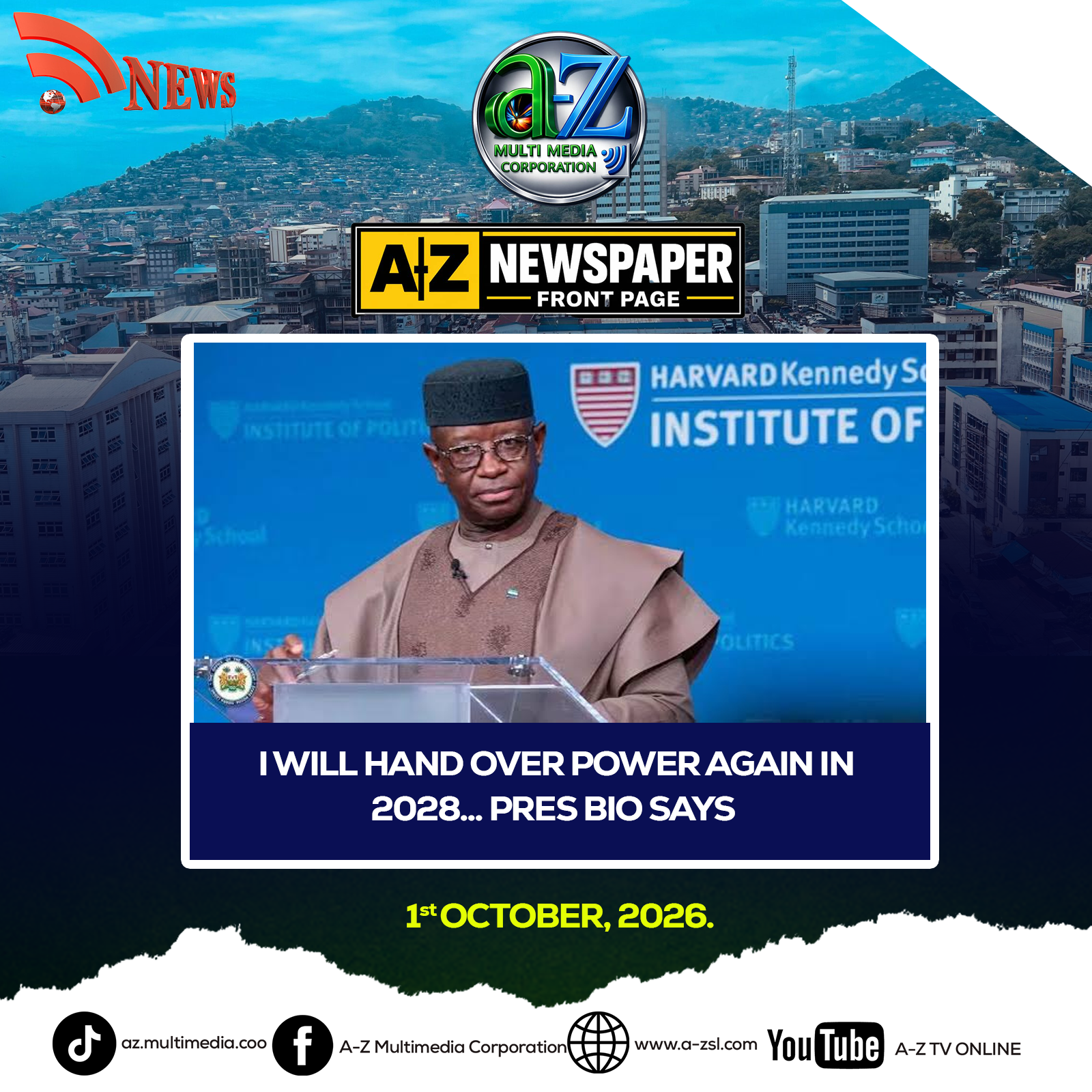
President Bio made the statement on Tuesday, September 29, 2026, during a high-level discussion on “Africa and the Shifting Geopolitical Landscape” at the John F. Kennedy Jr. Forum at Harvard Kennedy School.
The discussion focused on leadership, democratic resilience and the strategic choices facing Sierra Leone and Africa amid changing global dynamics.
“In 2028, God-willing, I will hand over power again as a democrat,” President Bio said, reflecting on his political journey and the importance of democratic leadership and institutions that outlast individual leaders.
He recalled his experience in 1996, when he served as Sierra Leone’s military Head of State during the country’s civil war. According to President Bio, some of his colleagues and people he respected at the time believed the country was not ready for elections because of the ongoing conflict.
“They urged me to wait until the war was over,” he recalled, adding that he understood their concerns because they were his colleagues.
However, he said he took a different position because he believed that indefinitely postponing political processes could undermine democratic development.
“I also knew that in politics, waiting can become never,” President Bio said.
He explained that Sierra Leoneans were eventually given the opportunity to vote and that he handed over power to an elected civilian government before leaving political office.
President Bio said that experience shaped his understanding of democratic leadership and the importance of allowing citizens to determine who governs them, even during periods of uncertainty.
He later returned to Sierra Leone and sought political office through the ballot box. In 2018, he was elected President of Sierra Leone and was re-elected in 2023 for a second term. The State House identifies him as Sierra Leone’s fifth President and states that his current second term is his final constitutional term.
Reflecting on the 1996 elections, President Bio said the decision to hold elections did not immediately end the civil war. However, he argued that the electoral process reinforced the principle that citizens should have a voice in deciding who governs them, including during difficult periods.
“The decision to hold election did not end the war, of course, but it reaffirmed a principle that we could build and uphold: even in difficult times, in times of fear, the people must have a voice in who governs them,” he said.
President Bio further linked his personal political history to his broader message about leadership in Africa, arguing that the continent needs leadership and institutions capable of lasting beyond individual office holders.
He said the priority in Africa’s changing geopolitical environment should be to build “leadership that lasts and outlasts the leader.”
“That commitment is personal, but the principle is larger than any one person,” he said, stressing that political power should ultimately serve the country and be transferred in a manner that leaves the nation in a better condition.
The President’s remarks at Harvard come as Sierra Leone prepares for its next general elections in 2028. He has previously stated that he will not seek a third term and that constitutional term limits will guide the transition.
The Harvard Kennedy School event was hosted by the Institute of Politics at the John F. Kennedy Jr. Forum and moderated by Dr. Zoe Marks, Oppenheimer Faculty Director of Harvard’s Center for African Studies.
Harvard described the discussion as an opportunity to examine leadership, democratic resilience and strategic choices for Sierra Leone and the wider African continent.
For President Bio, his account of 1996 and his pledge for 2028 presented a common thread in his political journey: that leadership should ultimately be subject to democratic institutions, electoral choice and the peaceful transfer of authority.
“In 1996, I handed over power as a soldier. In 2028, I will hand over power again in a democracy,” he declared.