

By: Mamajah Jalloh
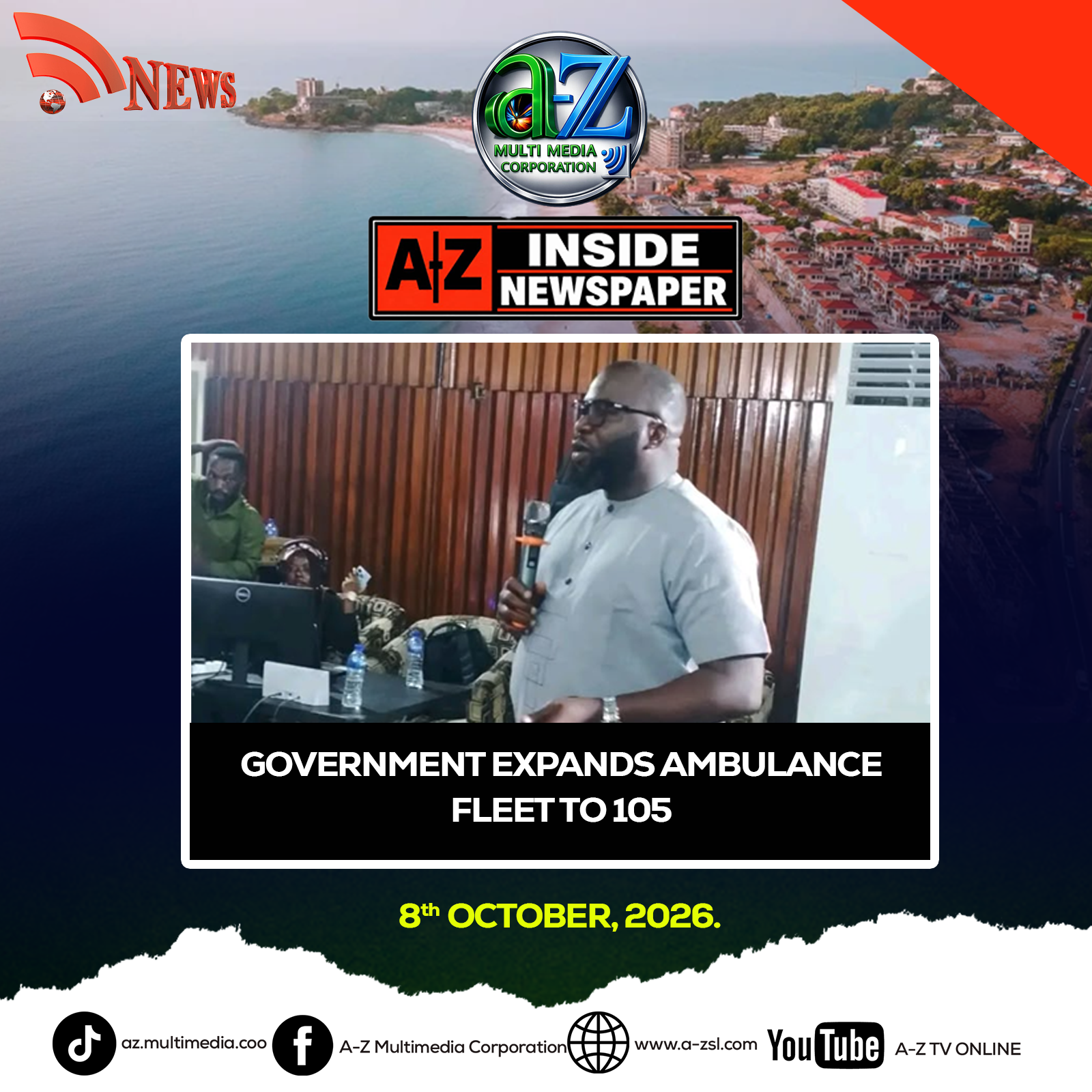
The Government of Sierra Leone, through the National Emergency Medical Service (NEMS), has expanded its ambulance fleet to 105 nationwide as it strengthens efforts to provide emergency medical response 24 hours a day, seven days a week.
The Chief Executive Officer of NEMS, Dr. Songor Kodoyoema, said the expansion was part of efforts to ensure that people across the country can access emergency medical transportation whenever the need arises.
He stressed that ambulance deployment must continually reflect population growth, geographical accessibility and changing community needs.
Dr. Kodoyoema explained that NEMS was not only focused on increasing the number of ambulances but also on ensuring that the vehicles are strategically positioned and effectively managed to provide timely emergency services.
He said the service continuously monitors its operations to identify challenges, address weaknesses and improve the quality and reliability of emergency response.
According to the NEMS chief, monitoring ambulance operations is essential to ensuring that vehicles are available and properly deployed when communities require them.
He said the monitoring process was not intended to apportion blame to ambulance drivers or health workers when operational challenges occur, but rather to identify problems, address them and improve the overall service.
“We want to watch the ambulance service. If we see that they mislead the ambulance, we address it and improve the service,” he said, emphasizing the importance of accountability and continuous improvement within the emergency response system.
Dr. Kodoyoema clarified that ambulances stationed at particular locations are strategically positioned to provide emergency services to surrounding communities and should not necessarily be regarded as serving only the specific community or health facility where they are based.
He said ambulance deployment must take into consideration population distribution, geographical accessibility and changing demand for emergency medical services.
Using Waterloo as an example, he noted that the community had grown substantially over the years, adding that such demographic changes should influence decisions on the number and location of ambulances required.
He said demographic information, including data from the Demographic and Health Survey (DHS), could assist health authorities in understanding population dynamics and determining where additional emergency medical resources are needed.
Dr. Kodoyoema explained that a rapidly growing population could create increased demand for emergency services, making it necessary for ambulance deployment to evolve alongside population growth.
He said the strategic positioning of ambulances was intended to bring emergency services closer to communities, particularly those located far from hospitals and other health facilities, where distance could delay access to urgent medical attention.
The NEMS chief disclosed that the service was preparing to increase its ambulance capacity, with additional ambulances expected to be deployed to communities where the need for emergency response is greatest.
He said the expansion would support the broader objective of building an emergency medical system capable of responding effectively to patients regardless of their location.
Dr. Kodoyoema maintained that the effectiveness of an ambulance service should not be measured solely by the number of vehicles available, but also by how strategically those vehicles are deployed and how quickly they can reach people in need.
He reaffirmed NEMS’s commitment to strengthening the reliability, accessibility and responsiveness of emergency ambulance services across Sierra Leone, particularly as population growth and changing settlement patterns continue to create new demands on the country’s healthcare system.